Microsoft CEO Satya Nadella’s AI warning: own your learning loop or get hollowed out
His “token capital” warning sounds like CEO thought leadership. Read closely, it’s a survival memo for anyone building on rented AI.
On June 14, Satya Nadella posted a long thread on X and titled it “A frontier without an ecosystem is not stable.” It crossed 28 million views inside a day. Most of the coverage filed it under CEO thought leadership and moved on.
Read it slowly and it turns into something sharper. It is a warning aimed at anyone who thinks renting an AI model counts as a strategy.
I want to walk through what he said, then the part the news writeups skipped: what you do about it if you are not running Microsoft.
What Nadella actually argued
His core claim is almost rude in how direct it is. Picking the best model is the wrong game.
The advantage, he wrote, comes from “building a learning loop on top of models where human capital and token capital compound.” Two assets. Human capital is the knowledge, judgment, relationships, ingenuity, and pattern recognition your people carry. Token capital is the AI capability a company builds and owns, not the kind it rents from an API.
Here is the line worth taping to a wall. “You can offload a task, or even a job, but you can never offload your learning.”
He kept going. Human capital does not shrink as AI grows. He said it gets more valuable, and then added a sentence that lands harder than its length suggests: “Without human direction, you have compute running in circles.”
The two-capital idea in plain terms
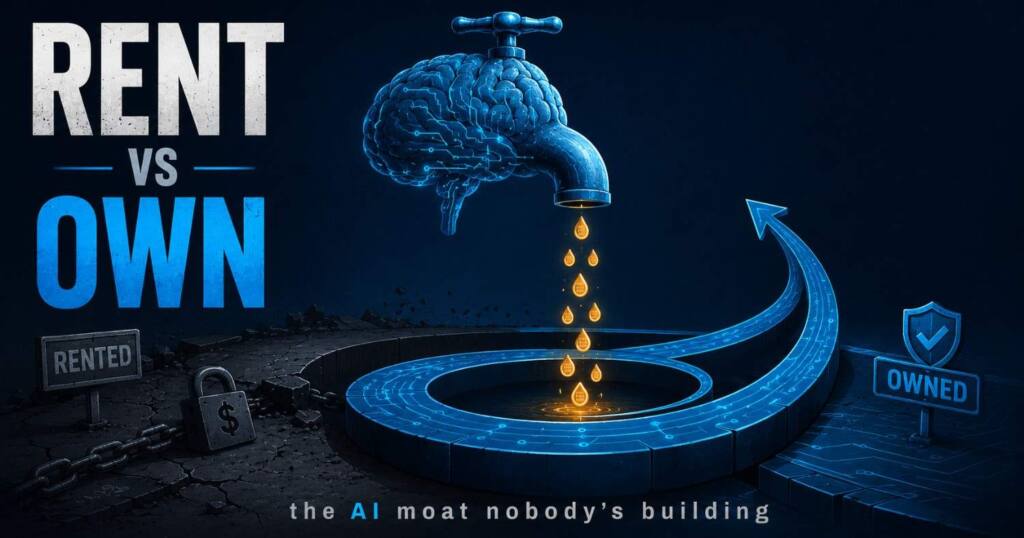
Strip away the framing and the structure is simple. Most companies treat AI as a faucet. You turn it on, tokens come out, you pay per use, and when a better faucet ships you switch.
Nadella’s point is that the faucet was never the asset. The asset is everything you teach the system while you use it: your workflows, your edge cases, the weird judgment calls only your veterans know how to make. Encode that into systems you control and it compounds.
He called the result a “hill climbing machine,” and said it carries a compound interest effect, where every improved workflow generates better training signals that sharpen the next one.
A faucet does not compound. That is the whole argument in one image.
Why this reads as a warning, not a pep talk
The warning sits underneath the optimism. If every company in every industry quietly hands its knowledge to a few general models, those models capture the value and the companies are left hollow.
Nadella said the quiet part: “The last thing any of us want is a world where every company across every sector is ceding value to a few models that eat everything they see.” And he reached for history to make it stick, drawing a line to the first wave of globalization, where outsourcing produced fine GDP charts while whole regions got hollowed out.
His blunt version: “There is no societal permission for an AI future that hollows out entire industries.” Read that as a man who has watched a political backlash form before and would rather not host the sequel.
The part the news writeups skipped
Every article I read summarized the thread. Benzinga, News9, India Today, Business Insider, all of them ran the quotes and the globalization parallel. None of them answered the only question an operator actually has.
What do I build on Monday?
So here is the translation. A “learning loop” is not a vibe. It is three concrete things stacked together.
First, a place where your AI interactions get captured instead of evaporating. Every prompt, correction, and approval is a training signal, and right now most teams throw all of it away the second the chat window closes.
Second, a private evaluation set that measures whether a model is getting better at your work, not better at a public benchmark. Nadella was specific about this, calling for private evals tied to “outcomes that matter to the business, not just external benchmarks.”
Third, an architecture where you can swap the underlying model without losing the accumulated expertise sitting on top of it.
That third one is the moat, and it is the easiest to get wrong. He framed the goal as being able to “switch out a generalist model without losing the company veteran expertise built into their learning system.” If switching from one model to another wipes your institutional memory, you never owned anything. You were renting the whole time and calling it a strategy.
Now the part nobody at Microsoft will say out loud
Let me be honest about the obvious thing. This is also a sales pitch.
Microsoft sells the picks and shovels for exactly the kind of owned AI capability Nadella is describing. Azure, Foundry, the private evaluation tooling, the infrastructure to run your own learning loop.
A CEO telling you to build token capital is a CEO whose company would very much like to host it. That does not make him wrong. It makes the advice load-bearing in two directions at once, and you should hold both in your head.
I will also say where I am reserving judgment. The learning loop sounds clean on a slide and turns ugly the moment real data, messy permissions, and a model that changes under you enter the room.
Compounding advantage assumes you set the loop up correctly and feed it for a year. Most companies will not. They will buy a tool, call it token capital, and wonder why nothing compounded.
What this means if you are not Microsoft
You do not need a research lab to start. The smallest version of token capital is almost embarrassingly low tech.
Keep a structured record of how your best people make decisions, and feed that record into whatever model you use. A solo creator with a tight prompt library, a documented voice, and a folder of corrections that actually get reused already owns more learning loop than a Fortune 500 team that lets every chat session die on close. Scale changes the budget, not the principle.
Replit’s Amjad Masad backed the framing publicly, calling it one of the more useful ways to think about scaling AI inside a company without turning it into humans versus machines. Plenty of replies were less kind, and some called the whole thing self serving. Both reactions can be correct, which is usually the sign that something landed.
Frequently asked questions
What did Satya Nadella actually warn about? He warned against an AI economy where a few general models capture most of the value, leaving companies and entire industries hollowed out. His fix is for organizations to build owned AI capability, what he calls token capital, rather than depending only on rented frontier models.
What is the difference between human capital and token capital? Human capital is your people: their knowledge, judgment, relationships, and pattern recognition. Token capital is the AI capability a company builds and owns, including its private models, context, and the learning systems wrapped around them. Nadella’s claim is that the two compound together, and that human capital gets more valuable as token capital grows.
What is a learning loop? A feedback cycle where human input and AI output keep improving each other inside a company. You capture interactions, evaluate the model against your own outcomes, and feed the results back in, so institutional knowledge accumulates instead of leaking to whatever model you happen to rent.
Is Nadella saying frontier models do not matter? No. He is saying picking the single best model is the wrong place to compete, because models get swapped and commoditized. The durable advantage is the loop you build on top of them, which is why he wants companies able to switch models without losing what they have taught their systems.
Why did he bring up globalization? As a cautionary parallel. The first wave of outsourcing produced healthy GDP numbers while hollowing out specific industries and regions, and Nadella argued the political economy will not tolerate a repeat where AI value pools inside a handful of companies.

Ved Vyas
Writer at Fable Knows, covering AI and the technology shaping everyday life.