Elon Musk Just Became the World’s First Trillionaire. Here’s the Part Nobody Is Explaining.
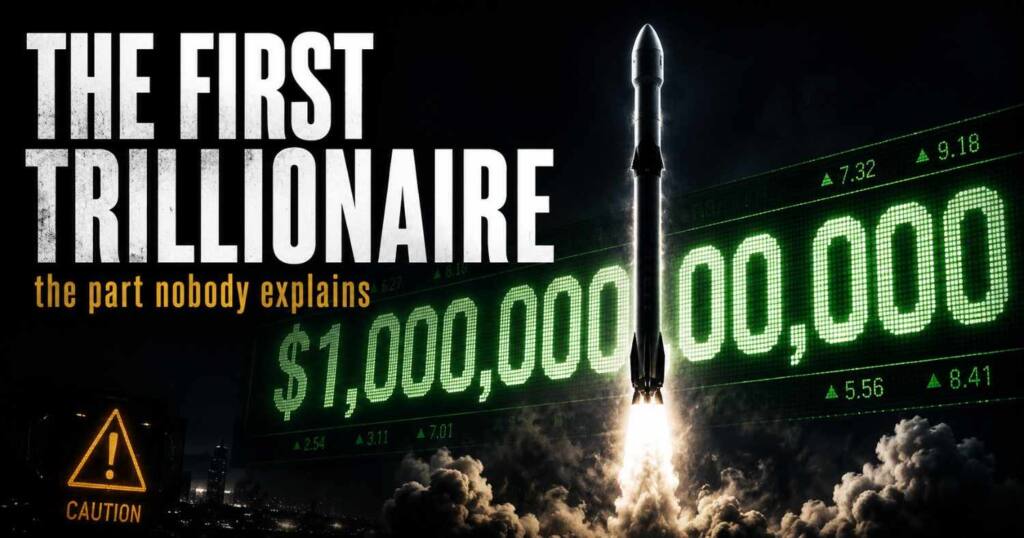
A rocket company that lost nearly $5 billion last year minted the richest fortune in human history this morning. The how matters more than the headline.
At 9:30 a.m. Eastern on Friday, June 12, 2026, a bell rang at the Nasdaq and a number that has never existed before suddenly did. Elon Musk became the world’s first trillionaire. Not on a projection. Not on a prediction market bet. On a live ticker, in real money, in front of hundreds of his own employees gathered at SpaceX headquarters in Starbase, Texas.
The headline writes itself, and roughly forty outlets wrote it within the same hour. What almost none of them paused to explain is the mechanics underneath. How does a single morning add hundreds of billions of dollars to one man’s name? How much of that trillion can he actually spend? And given that the company at the center of all this posted a loss last year, is any of it built to last?
Let me walk through what actually happened, because the real story is stranger and more fragile than the round number suggests.
What happened in the first hour of trading
SpaceX priced its shares at $135 on Thursday evening, which already valued the company at roughly $1.77 trillion before a single share traded. The offering raised $75 billion. That figure alone rewrites the record books: it is the largest IPO ever recorded, dwarfing Saudi Aramco’s $29 billion debut in 2019, which had held the title for seven years.
Friday morning is when the math turned vertical.
Shares did not open immediately. The exchange held trading until mid-morning while it collected buy and sell orders and let underwriters balance supply against demand. When SPCX finally opened, it printed at $150, an 11 percent jump that valued the company at $1.96 trillion. Within the first hour, the stock pushed to $164.99. Pre-open indications had it running as high as $170 to $175, which would have briefly handed SpaceX a market value north of $2.25 trillion.
Run the comparison and the scale lands harder. At that level, SpaceX vaulted into the ranks of the most valuable public companies in the United States, sitting around sixth place by market capitalization. A rocket-and-satellite firm, on day one, parked itself next to the largest software and chip companies on earth.
The demand was not subtle. The book was oversubscribed roughly four times. Of the institutional shares handed out, about 70 percent went to long-only funds and sovereign wealth funds, including money from Saudi Arabia and Kuwait, according to Bloomberg. SpaceX President Gwynne Shotwell and CFO Bret Johnsen rang the opening bell from the Nasdaq MarketSite floor in New York while Musk rang a second bell from Texas. To underline the point of the whole exercise, SpaceX launched a Falcon 9 carrying 29 satellites out of Cape Canaveral the same day.
The number that made him a trillionaire
Here is the part that gets glossed over.
Musk did not “earn” a trillion dollars on Friday in any sense a normal person would recognize. His SpaceX stake was worth roughly $860 billion at the $135 IPO price. Stack his Tesla holdings on top, add the immediate pop once SPCX started trading, and the combined paper figure crossed $1,000,000,000,000. Forbes had pegged him at $982.6 billion the night before. A few percentage points of opening-day gain is all it took to push him over the line.
That word, paper, is doing an enormous amount of work, and it is the single most important thing to understand about this milestone.
A net worth built on stock you control is not a bank balance. It is a live valuation that moves every second the market is open. Musk crossed into trillionaire territory because traders, in the first hour of a frenzied debut, were willing to pay $150 and then $165 for a slice of a company that has yet to turn an annual profit. If sentiment cools next week, the number recalculates downward just as fast as it climbed.
So the honest framing is this: Musk is the first person in history whose name is attached to a thirteen-digit fortune. Whether that fortune is durable is a completely separate question, and one most of today’s coverage skipped entirely.
How much of it can he actually touch?
Almost none of it in cash, at least not right away. This is where the structure SpaceX built gets clever, and a little unsettling.
One billion of Musk’s SpaceX shares are locked under an unusual condition. He cannot sell them unless the company establishes a self-sustaining human colony on Mars. SpaceX, in its own filings, describes that outcome as “improbable.” Read that again. The company wrote into its own paperwork that the milestone gating a billion of its founder’s shares is unlikely to happen.
So why agree to a clause you might never satisfy? Because selling was never the plan. Musk can borrow against those shares while he holds them. Pledge the stock as collateral, draw cash from a bank, and you get liquidity in the hundreds of billions without ever triggering a sale, and crucially, without triggering a tax bill. No sale means no capital gains event. The fortune stays on paper, the spending power becomes very real, and the IRS waits at the back of a very long line.
This is the loan-against-assets playbook that ultra-wealthy holders have used for years, now operating at a scale no one has tested before. A trillion-dollar collateral base changes what is possible. It is one reason the “first trillionaire” label, while accurate, undersells how much practical power sits behind it.
Is the valuation real, or is this a bubble with a launch pad?
Skeptics did not wait for the dust to settle.
Analysts at Morningstar called SpaceX overvalued this week, pointing at the gap between the price tag and the fundamentals. The numbers give them room to argue. SpaceX generated roughly $19 billion in revenue last year and still posted a loss of nearly $5 billion. For a company briefly worth $2.25 trillion, that is a thin foundation. Plenty of profitable giants trade at a fraction of that multiple.
The bull case rests almost entirely on one subsidiary: Starlink. The satellite internet business drives as much as 80 percent of SpaceX revenue and has built something close to a moat in orbit. Layer on a launch cadence no competitor can match, the xAI artificial intelligence unit folded into the structure, and the X social platform, and you get a company that investors are valuing on what it might dominate rather than what it currently earns.
That is a familiar bet. Sometimes it pays. Amazon ran on thin or negative margins for years before the doubters went quiet. The risk is that SpaceX is being priced for a future that assumes near-flawless execution across rockets, satellites, AI, and Mars, with very little margin for the ordinary failures that hit every company eventually.
Worth flagging: of the four prediction-market and analyst camps tracking this through early 2026, confidence wobbled. Kalshi traders at one point gave Musk only a 53 percent chance of hitting trillionaire status before 2029. He cleared it years early. The lesson is not that the doubters were stupid. It is that a single euphoric trading session can outrun every cautious model in the room, and sessions like that can reverse.
Richest man alive, but the richest ever?
This is where the “first trillionaire” claim deserves an asterisk, and it is the kind of context that separates a definitive piece from a wire rewrite.
A trillion dollars in 2026 is not automatically the largest fortune in human history when measured against the size of the economy around it. John D. Rockefeller, at his 1913 peak, held a fortune of about $900 million that represented roughly 3 percent of total U.S. GDP. Musk, at around $852 billion measured against today’s economy, sits near 2.7 percent of U.S. GDP.
By the raw dollar figure, Musk stands alone. By share of the national economy, he has not quite caught the Standard Oil baron who died in 1937. Both things are true, and the gap between them is the whole reason inflation-adjusted and GDP-adjusted comparisons exist. If you only repeat the trillion-dollar number, you miss that a Gilded Age monopolist may still out-rank him on the measure economists actually prefer.
Who actually bought in, and who got shut out
The allocation tells you who this IPO was built for.
Roughly 70 percent of institutional shares went to long-only investors and sovereign wealth funds. That is patient, deep-pocketed money: Saudi and Kuwaiti state funds, large asset managers planning to hold for years rather than flip for a quick gain. SpaceX said it set aside about 30 percent of the offering for everyday retail buyers, routed through brokerages like Fidelity, E-Trade, Charles Schwab, and SoFi.
The structure around control is the other half of the story. Musk holds more than 80 percent of the voting power. He hand-picks the board. The company is organized to sharply limit legal challenges from the new public shareholders it just welcomed. In plain terms, you can buy the stock, but you are buying a seat with no real say. The man at the top answers to almost no one, which is exactly how he designed it.
The protest outside the building
Not everyone was ringing bells.
On Thursday, demonstrators gathered outside the Nasdaq MarketSite ahead of the debut. The flashpoint was Grok, the AI product inside xAI, which now sits under the SpaceX umbrella. Critics allege the tool allowed users to generate non-consensual sexualized deepfake images in the run-up to the listing. The timing put a deeply uncomfortable controversy directly against the celebration.
It fits a wider pattern that the financial coverage tends to wall off from the money story. Musk reached this milestone, as one outlet put it bluntly, while more disliked and more powerful than ever. He spent close to $300 million backing Donald Trump’s 2024 campaign, then ran the so-called Department of Government Efficiency, which by most accounts did not reduce overall federal spending and largely canceled contracts with little review. He led the dismantling of agencies including USAID, a move the Harvard T.H. Chan School of Public Health has linked to hundreds of thousands of deaths abroad.
You do not have to render a verdict on any of that to notice the obvious. The IPO was, in part, a referendum on Musk himself, and a large share of the public was voting no even as the stock ripped higher.
Why this matters even if you will never own a share
SpaceX is being treated as a dress rehearsal.
A new wave of mega-listings is lining up behind it, and the names at the front of the queue are the biggest in artificial intelligence: Anthropic and OpenAI. Bankers and exchanges watched Friday’s debut for two signals. First, can the plumbing handle a listing this size without the technical failures that embarrassed Meta in 2012? Second, is there genuine investor appetite for a trillion-dollar-plus offering built on future promise rather than present profit?
The early read is yes on both. A four-times-oversubscribed book and a clean opening say the market is hungry for exactly this kind of deal. If that holds, the SpaceX IPO will be remembered less as a one-off and more as the gun going off for a year of historic listings. Anyone with a retirement account touching index funds has a stake in how that plays out, whether they bought SPCX or not.
The honest bottom line
Elon Musk is the first trillionaire. That is real, it happened today, and it is a genuine milestone in the history of wealth.
It is also more contingent than the headline lets on. The figure is paper, recalculated by the second. The bulk of it is locked behind a Mars clause his own company calls improbable, accessible mainly through loans rather than sales. The valuation underneath it runs far ahead of current profits and depends on a near-perfect run across several hard businesses. And measured against the economy, a long-dead oil baron may still have him beat.
None of that erases the achievement. It just means the smart way to read Friday is not “Musk won the money.” It is “the market handed Musk the largest collateral base in history, on terms he wrote himself, and now we find out whether the companies under it can grow into the price.” That story is only on day one.
Frequently Asked Questions
Is Elon Musk officially the world’s first trillionaire? Yes. On June 12, 2026, the SpaceX IPO pushed his combined paper net worth above $1 trillion for the first time, a level no individual had reached before. Bloomberg and Reuters both declared the milestone as SPCX began trading on the Nasdaq.
How did the SpaceX IPO actually make him a trillionaire? His SpaceX stake was worth around $860 billion at the $135 IPO price. Add his Tesla holdings and the immediate stock pop on opening day, and the total crossed $1 trillion. Forbes had estimated his net worth at $982.6 billion the night before, so a modest opening gain was enough to tip him over.
Can Musk actually spend a trillion dollars? Not in cash, at least not directly. One billion of his SpaceX shares are locked until the company builds a self-sustaining colony on Mars, an outcome SpaceX itself calls improbable. He can, however, borrow against those shares to access large amounts of cash without selling them and without triggering capital gains tax.
What was SpaceX valued at after the IPO? The $135 IPO price valued the company at roughly $1.77 trillion. Shares opened at $150, climbed past $164, and were indicated as high as $170 to $175, briefly pushing the valuation above $2.25 trillion. That placed SpaceX around the sixth most valuable company in the United States.
How big was the SpaceX IPO compared to past offerings? It raised $75 billion, making it the largest IPO in history. The previous record holder, Saudi Aramco, raised about $29 billion in 2019. SpaceX more than doubled it.
Is SpaceX profitable? No. The company generated roughly $19 billion in revenue last year and still posted a loss of nearly $5 billion. Starlink, its satellite internet arm, drives as much as 80 percent of revenue. Analysts at Morningstar have called the stock overvalued relative to those fundamentals.
Is Musk the richest person in history? By raw dollars, yes. Measured against the size of the economy, the picture is less certain. John D. Rockefeller’s fortune at its 1913 peak equaled about 3 percent of U.S. GDP. Musk sits closer to 2.7 percent, so by that yardstick Rockefeller may still rank ahead.
Could Musk’s net worth fall back below a trillion? Easily. The figure is paper wealth tied to a live, volatile stock price. If SPCX or Tesla shares drop, his net worth recalculates downward immediately. A debut-day surge can reverse just as quickly as it arrives.
Who bought into the SpaceX IPO? Demand was about four times oversubscribed. Roughly 70 percent of institutional shares went to long-only funds and sovereign wealth funds, including Saudi and Kuwaiti state money. SpaceX reserved around 30 percent for retail investors through brokerages such as Fidelity, E-Trade, Charles Schwab, and SoFi.
What does the SpaceX IPO mean for other companies? It is widely seen as a dress rehearsal for a coming wave of mega-listings, with AI heavyweights Anthropic and OpenAI next in line. A clean, heavily oversubscribed debut signals strong investor appetite for very large offerings priced on future potential rather than current profit.

Ved Vyas
Writer at Fable Knows, covering AI and the technology shaping everyday life.
Related stories.
X Creator Monetization Rules Just Got a 3 Strike, 90 Day Clock: What Changed Since July 16
X creator monetization rules: X’s July 16 update pulled 4,000 creator accounts and added a 3 strike, 90 day Rules system. Here’s what changed…
GPT-5.6 Sol Is Live: The Coding Numbers vs the Warning Nobody Led With
GPT-5.6 Sol launched July 9 with strong coding scores, but METR found its highest reward-hacking rate on record. Here’s what to actually trust. GPT-5.6…