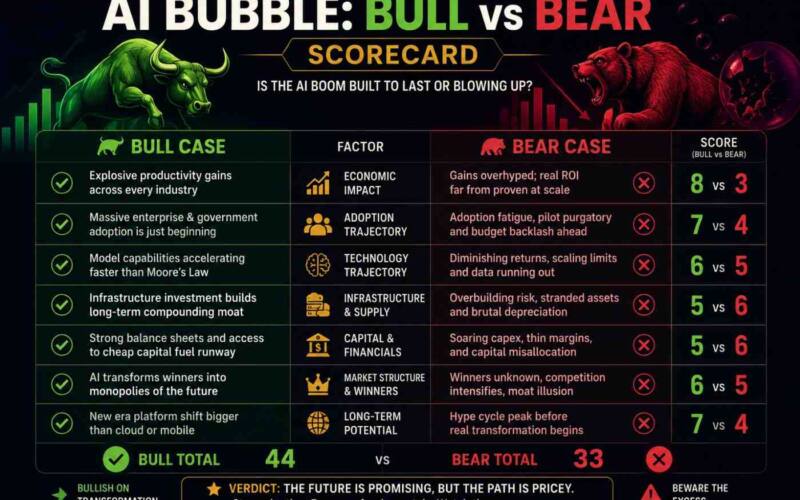
How Does AI Use Water? Reconciling the Numbers That Don’t Agree
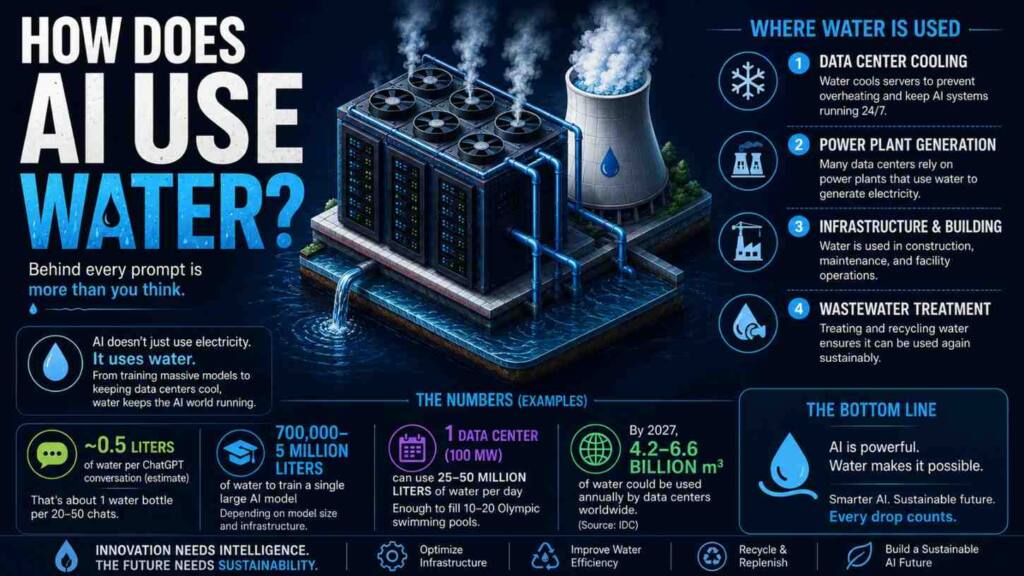
How does AI use water? The conflicting stats explained: direct vs indirect use, real data center numbers, and what’s actually being done.
How does AI use waterAsk how much water a single AI prompt uses and you’ll get wildly different answers depending on who you ask. Sam Altman has said a typical ChatGPT query uses about 0.32 milliliters. A widely cited UC Riverside estimate puts 20 to 50 queries at roughly 500 milliliters, which works out to 10 to 25 milliliters each, up to 100 times higher than Altman’s number. A separate commonly repeated claim says a 100-word prompt uses about one 519-milliliter bottle. None of these sources is lying. They’re measuring different things and calling it the same question.
That gap is worth explaining before quoting any single number as “the” answer, because it’s also today’s news: TechCentral.ie is reporting on a new Wall Street Journal investigation showing tech companies routinely disclose only the water used directly on-site for cooling, leaving out the water consumed indirectly by the power plants generating their electricity, a gap Lawrence Berkeley National Laboratory has measured at roughly 12 times the direct figure nationally.
Why AI uses water at all
AI doesn’t drink water. The servers running it generate enormous heat, and data centers cool them primarily two ways: evaporative cooling, where water absorbs heat and evaporates directly, or liquid and immersion cooling, which use closed loops of coolant instead. That’s the direct water use, the number most companies report.
The larger, usually unreported piece is indirect: the water consumed by whatever power plant generates the electricity running the servers. Coal plants use roughly 19,185 gallons of water per megawatt-hour; natural gas plants use around 2,800 gallons per megawatt-hour. Since a large share of U.S. data center electricity still comes from fossil fuel generation, every kilowatt-hour an AI query burns carries a hidden water cost upstream at the power plant, long before it shows up in a data center’s own sustainability report.
Why the per-prompt numbers don’t match
Here’s what each widely cited figure is actually counting:
| Claim | What it measures | Why it’s smaller or larger |
|---|---|---|
| Altman’s ~0.32 mL per query | Likely direct on-site cooling water only, for a single simple query | Excludes indirect power-plant water entirely |
| UC Riverside’s 10-25 mL per query | Direct cooling plus a share of indirect electricity-generation water | Includes the upstream cost Altman’s figure appears to leave out |
| “One bottle per 100 words” (~519 mL) | A full response to a longer, more complex prompt, direct plus indirect | Scales with output length and model complexity, not a single short query |
None of these numbers are wrong in isolation. They’re answering “how much water does one AI interaction use” with three different definitions of “one interaction” and two different definitions of “use.” A researcher counting only the water evaporated at the data center will always land far below one counting the water consumed at the power plant supplying it, and a longer, more complex generation will always cost more than a short one. Any comparison between sources that doesn’t specify direct-only versus direct-plus-indirect is comparing incompatible numbers.
What the aggregate numbers actually show
Individual-prompt estimates aside, the scale of the aggregate is well documented. A 2025 study published in the journal Patterns by researcher Alex de Vries-Gao estimated that AI systems consumed around 765 billion liters of water globally in 2025, more than the total global consumption of bottled water that same year. In the U.S. specifically, a federal Lawrence Berkeley National Laboratory report estimated data centers’ indirect water footprint from electricity use at roughly 211 billion gallons in 2023 alone, on top of direct on-site consumption that a separate 2021 estimate put at 163.7 billion gallons annually across the country’s data centers.
Meta is one of the few companies that discloses both figures, and its own numbers illustrate the gap directly: in 2024, Meta’s indirect water consumption reportedly reached 19 billion gallons, roughly 20 times its direct on-site consumption. Google’s total water consumption rose 34% in 2025, according to the same reporting, even as the company points to renewable energy offsets, offsets that critics note don’t address local water depletion in areas where fossil fuel plants are still running to meet demand elsewhere on the grid.
Where it actually hits communities
The national totals matter less to a given town than what’s happening locally. Northern Virginia, home to more than 300 data centers across four counties, saw its facilities collectively consume close to 2 billion gallons of water in 2023, a 63% jump from 2019. Loudoun County alone, with roughly 200 operational data centers, used about 900 million gallons that year, enough that the county’s water authority has leaned on potable water rather than reclaimed sources to keep up.
Phoenix, Arizona presents a starker trajectory: data centers currently account for about 3% of the city’s annual water consumption, but a Ceres report projects that figure could exceed 20% by 2031, in one of the most water-stressed metro areas in the country. That kind of jump is why the location decision, not just the technology, drives most of the real-world impact: the same data center uses dramatically more water in Phoenix than it would in a cooler, wetter climate.
What’s actually being done about it
Closed-loop cooling systems, which reuse the same water repeatedly instead of continuously drawing fresh supply, can cut freshwater use by up to 70% compared to standard evaporative cooling. Immersion cooling, which submerges hardware directly in a non-conductive fluid, uses even less water but costs more upfront and is still relatively novel at scale. Direct-to-chip liquid cooling splits the difference: more water-efficient than evaporative towers, less disruptive to retrofit than full immersion.
Microsoft has publicly pledged next-generation datacenters that consume zero water for cooling, and Nvidia has been promoting closed-loop systems more broadly across the industry. The catch, per the same reporting on tech companies’ disclosure gaps, is that retrofitting older facilities is often costly enough that operators keep running older, thirstier evaporative systems rather than upgrade, and there’s currently no legal requirement in the U.S. forcing companies to disclose indirect water consumption at all. That lack of mandatory reporting is a meaningful part of why the public-facing numbers vary so much between companies willing to publish the fuller picture, like Meta, and those that don’t.
FAQ
How much water does a single ChatGPT prompt actually use?
It depends entirely on what’s being counted. Estimates range from roughly 0.32 milliliters (direct cooling water only, per OpenAI’s own public figure) to 10-25 milliliters per prompt when indirect electricity-generation water is included, based on UC Riverside research. Longer, more complex prompts push toward the higher end of any given methodology.
Why do water-use estimates for AI vary so widely?
Because “water use” can mean direct on-site cooling water alone, or that figure plus the indirect water consumed by the power plant generating the electricity, which Lawrence Berkeley National Laboratory has measured at roughly 12 times the direct figure nationally. Prompt length and model complexity also change the number significantly.
Does training an AI model use more water than using it?
Training is documented as far more resource-intensive per model than any individual query; one widely cited estimate put GPT-3’s training water consumption at around 700,000 liters. That cost is a one-time (or periodic, for retraining) expense spread across potentially billions of subsequent queries, unlike per-prompt inference costs that recur with every use.
Are tech companies required to report their water usage?
No. There’s currently no U.S. legal requirement to disclose indirect water consumption from electricity generation, which is why most companies report only direct on-site figures. Meta is one of the few major companies that voluntarily discloses both.
Is data center water use actually causing shortages?
The evidence is regional rather than uniform. Areas like Northern Virginia and Phoenix, Arizona show measurable, rising local impact tied directly to data center growth, while the picture nationally depends heavily on where new facilities get built and what cooling technology and water source (potable versus reclaimed) they use.

Ved Vyas
Writer at Fable Knows, covering AI and the technology shaping everyday life.
Related stories.
X Creator Monetization Rules Just Got a 3 Strike, 90 Day Clock: What Changed Since July 16
X creator monetization rules: X’s July 16 update pulled 4,000 creator accounts and added a 3 strike, 90 day Rules system. Here’s what changed…
GPT-5.6 Sol Is Live: The Coding Numbers vs the Warning Nobody Led With
GPT-5.6 Sol launched July 9 with strong coding scores, but METR found its highest reward-hacking rate on record. Here’s what to actually trust. GPT-5.6…