Is There an AI Bubble? What the Bulls, the Bears, and Today’s Treasury Leak Actually Show
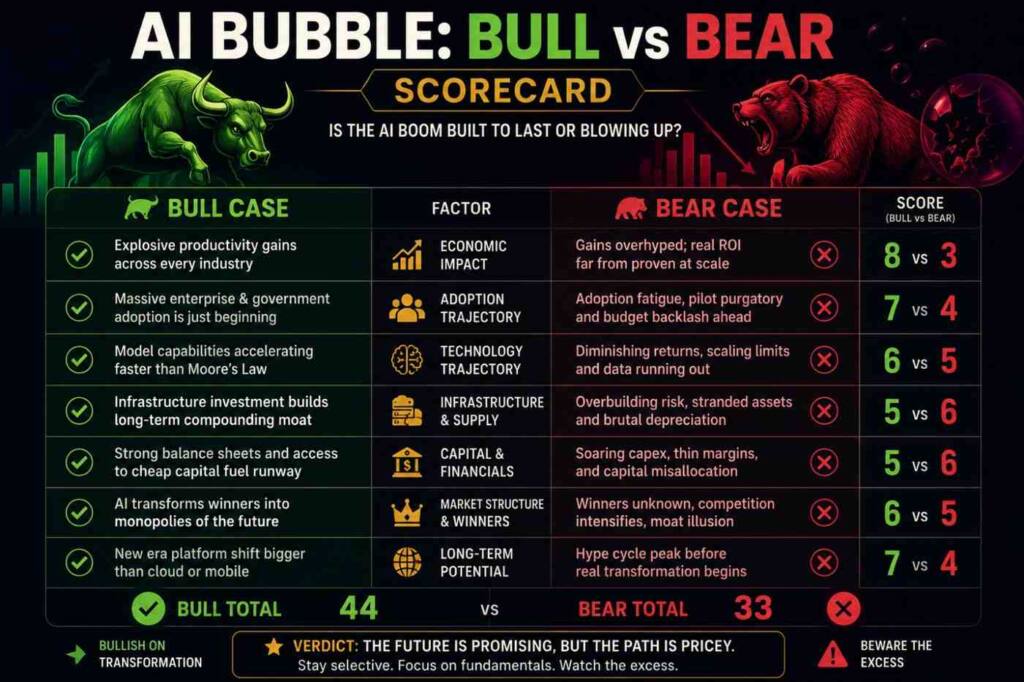
Is there an AI bubble? The bull case, the bear case, and today’s leaked Treasury report, cross-referenced in one scorecard. Not financial advice.
A draft report inside the U.S. Treasury Department is warning that an AI-driven downturn could ripple through banks, private credit markets, data center financiers, and utilities, comparing key aspects of the current buildout to the dot-com crash. The document, reported today, was prepared for Treasury Secretary Scott Bessent and Fed Chair Kevin Warsh and has been sitting finished for weeks, awaiting approval before it’s expected to reach the public. Publicly, the administration has stayed bullish; privately, its own analysts are running the dot-com comparison.
That gap between public confidence and private hedging is the real story here, and it’s a useful lens for the whole debate. Below is where the evidence actually stands, on both sides, cross-referenced against a specific five-factor framework used by Wall Street analysts to judge past bubbles, not just asserted as a hunch.
This is not investment advice. It’s a synthesis of what’s publicly documented, for readers trying to understand the debate rather than trying to time a trade.
How the argument escalated through 2025 and 2026
The bubble talk didn’t start today. In late January 2025, DeepSeek’s surprise launch knocked Nvidia’s shares down 17% in a single day before they recovered 8.8% the next day. Through the rest of 2025, Nvidia became the first company to reach a $4 trillion valuation in July, then crossed $5 trillion by October, at one point exceeding the GDP of every country except the US and China. AI-related companies accounted for roughly 80% of American stock market gains over the year, and by late 2025, the five largest companies alone held up 30% of the S&P 500 and 20% of the MSCI World index, the tightest concentration in half a century. Wikipedia + 3
Sam Altman said in 2025 he believes a bubble is underway. Ray Dalio called current AI valuations “very similar” to dot-com era excess. Jamie Dimon said he thinks AI itself is real, but that some invested money will be wasted, and that the odds of a meaningful stock drop over the next two years are higher than markets reflect. The Bank of England and the IMF both flagged overvaluation risk through late 2025.
Against that, Federal Reserve Chair Jerome Powell has explicitly distinguished the current cycle from dot-com, arguing AI capex is functioning as a genuine growth engine rather than speculative excess, and Goldman Sachs, Morgan Stanley, and JPMorgan have each published research concluding the “bubble” label doesn’t fit the current numbers.
The bear case, in specifics
Circular financing. Nvidia made a $100 billion investment into OpenAI in September, expanding an existing stake, on the expectation that OpenAI would use that money to buy Nvidia GPUs for its own data centers, a loop where the chip supplier funds its own customer’s purchases.
Nvidia separately entered a $6.3 billion deal with CoreWeave to buy unsold data center capacity through 2032, while holding a 7% stake in CoreWeave, and OpenAI, Microsoft, and Oracle are all cross-invested in each other through a $300 billion Oracle deal alone. These structures make it hard to tell how much of the reported demand is organic. WikipediaWikipedia
The unprofitability gap. OpenAI has committed to $1.4 trillion in datacenter spending over 8 years against just $13 billion in current revenue, funded substantially by debt. The company told investors it expects annual losses through 2028, including $74 billion in operating losses in 2028 alone, while a Wall Street Journal review of internal documents found OpenAI projecting a swing to significant profit by 2030. Deutsche Bank’s Jim Reid separately estimated OpenAI’s cumulative losses at $140 billion between 2024 and 2029. WikipediaWikipedia
Debt exposure. Morgan Stanley estimated global datacenter spending between 2025 and 2028 at roughly $3 trillion, with private credit covering about half. That’s a meaningfully different funding structure than equity-financed capex, and it’s the detail Treasury’s internal analysts are reportedly the most focused on: unlike consumer-facing dot-com speculation, this cycle is underwritten by institutional debt markets that touch banks and private credit funds directly. Wikipedia
Productivity hasn’t caught up yet. A February 2026 National Bureau of Economic Research study found that despite 90% of firms reporting no measurable AI impact on productivity, executives still projected AI would raise productivity 1.4% and output 0.8%, a gap that economists have compared to the historical productivity paradox. Wikipedia
The bull case, in specifics
Fidelity’s research team runs the current market against five indicators it argues predicted past bubble bursts: earnings growth, earnings quality, valuation multiples, capex-to-cash-flow, and the rate cycle. On the last of those, Fidelity notes that AI capex today is funded almost entirely from corporate earnings rather than debt at the aggregate market level, unlike the dot-com era when technology companies spent more than they generated in cash flow for nearly a decade.
On valuations, Fidelity found the “Magnificent 7” traded at roughly 28 times forward earnings as of December 2025, less than half the average 65.6 times forward earnings the seven largest 1999 stocks carried at their peak. fidelityfidelity
That capex-funding distinction matters because it’s the same data point the bear case leans on from a different angle: Treasury’s analysts and Morgan Stanley are looking at data center debt specifically, a category that has grown fast even if it isn’t yet dominating the aggregate corporate balance sheet the way 1999-2000 tech debt did. Both claims can be true at once: today’s biggest AI companies are largely self-funding, while a meaningful and growing slice of the infrastructure buildout underneath them runs on private credit.
JPMorgan’s December 2025 analysis applied a five-factor diagnostic to the AI rally and concluded the sector shows genuine structural utility rather than pure speculation, tying capital inflows to measurable revenue growth rather than hype alone. Powell has made a similar point publicly, arguing realized AI revenue distinguishes this cycle from dot-com-era companies that had none.
A side-by-side that neither side alone gives you
Cross-referencing Fidelity’s own five-factor bull framework against the specific bear-case data points documented above produces a scorecard no single source lays out this way. This isn’t a prediction; it’s a status check on the exact metrics both sides say matter.
| Fidelity’s indicator | Bull-case reading | Bear-case complication |
|---|---|---|
| Earnings growth | S&P 500 on track for 10th straight quarter of growth | Growth concentrated in a handful of AI-linked names |
| Earnings quality | GAAP earnings trend healthy, restatements declining | Doesn’t capture unprofitable AI-native firms like OpenAI, which isn’t public |
| Valuations vs. history | Top 7 at ~28x forward earnings, well below 1999’s ~66x | S&P 500 Case-Shiller P/E topped 40 in late 2025, the highest since dot-com |
| Capex vs. cash flow | Aggregate market capex funded from earnings, not debt | ~$1.5 trillion of the ~$3 trillion 2025-2028 datacenter buildout runs on private credit |
| Rate cycle | Fed in an easing cycle, historically the calmer phase | Treasury’s own internal analysts still flag systemic risk if conditions shift |
Read across the row for capex: this is the one place the two camps are quite literally describing different slices of the same spending pile, the market-wide aggregate versus the datacenter-specific debt buildout, and that distinction is doing most of the work in why smart people disagree.
What’s actually different from the dot-com bubble
The most substantive dot-com comparison isn’t the stock chart, it’s the underlying asset. Dot-com excess was built on fiber and networking infrastructure that, even after the crash, retained decades of reusable value; that leftover capacity arguably seeded the 2000s and 2010s internet buildout. GPUs depreciate faster and have a narrower resale market outside AI workloads specifically, which is part of why critics like Ed Zitron argue this bubble, if it pops, has less salvageable value underneath it than fiber did.
Treasury’s internal analysts reportedly reached a related but distinct conclusion: AI firms are more deeply embedded in the broader economy today than dot-com firms were, so a downturn would likely be slower and less catastrophic than 2000-2002, but would ripple further, touching banks, private credit, cloud providers, chip makers, and utilities simultaneously rather than staying contained to tech-sector stocks.
FAQ
Is there an official consensus on whether AI is a bubble?
No. Major banks (Goldman Sachs, Morgan Stanley, JPMorgan) and the Fed chair have publicly argued current valuations don’t meet historical bubble criteria, while the Bank of England, the IMF, and reportedly Treasury’s own internal analysts have warned of correction risk. Both sides cite real data; they’re weighting different metrics.
What is “circular financing” in the AI context?
It refers to structures like Nvidia investing in OpenAI on the expectation OpenAI will use that capital to buy Nvidia chips, or Nvidia holding equity in a company (CoreWeave) it also supplies and buys capacity from. Critics say this makes reported demand harder to distinguish from investment flowing in a loop between a small number of firms.
How is this different from the 2000 dot-com crash?
The most-cited differences: today’s largest AI companies generate substantial real revenue and fund most capex from earnings rather than debt, unlike many dot-com firms. The most-cited similarity: valuation concentration in a handful of stocks is now tighter than at any point since 1999-2000, and the Case-Shiller P/E ratio has again crossed 40.
Did OpenAI’s financials factor into the bubble debate?
Yes, heavily, since OpenAI isn’t public and its documented losses (projected through 2028) and debt-funded infrastructure commitments are frequently cited as the clearest example of spending running far ahead of revenue in the sector.
read more article here

Ved Vyas
Writer at Fable Knows, covering AI and the technology shaping everyday life.
Related stories.
X Creator Monetization Rules Just Got a 3 Strike, 90 Day Clock: What Changed Since July 16
X creator monetization rules: X’s July 16 update pulled 4,000 creator accounts and added a 3 strike, 90 day Rules system. Here’s what changed…
GPT-5.6 Sol Is Live: The Coding Numbers vs the Warning Nobody Led With
GPT-5.6 Sol launched July 9 with strong coding scores, but METR found its highest reward-hacking rate on record. Here’s what to actually trust. GPT-5.6…