What Is a Token? A Simple Guide to Tokens in AI for 2026
What is a token in AI? A simple 2026 guide for students and beginners: how tokens work, why AI charges per token, and why it can’t count letters.
The beginner-friendly explanation of what a token is, why AI bills you for them, and why they explain some of the strangest things chatbots do.
Type a sentence into ChatGPT, Claude, or Gemini and it never actually sees your words. It sees tokens. That one fact explains why these tools charge by the token, why they sometimes cannot count the letters in “strawberry,” and why a 500-word email and a 500-word block of code cost different amounts to process. Tokens are the hidden unit underneath everything an AI model reads and writes, and once you can picture them, a lot of confusing AI behavior suddenly makes sense.
This guide explains what is a token in plain language, with examples you can try yourself. No machine-learning background required.
What is a token, in one plain sentence
A token is a small chunk of text that an AI language model treats as a single unit. It might be a whole word, a piece of a word, a single character, or a punctuation mark. Models do not read letter by letter the way we sometimes do, and they do not read whole sentences at once either. They read and write in these in-between chunks called tokens, which is the first and most important thing to grasp about what is a token.
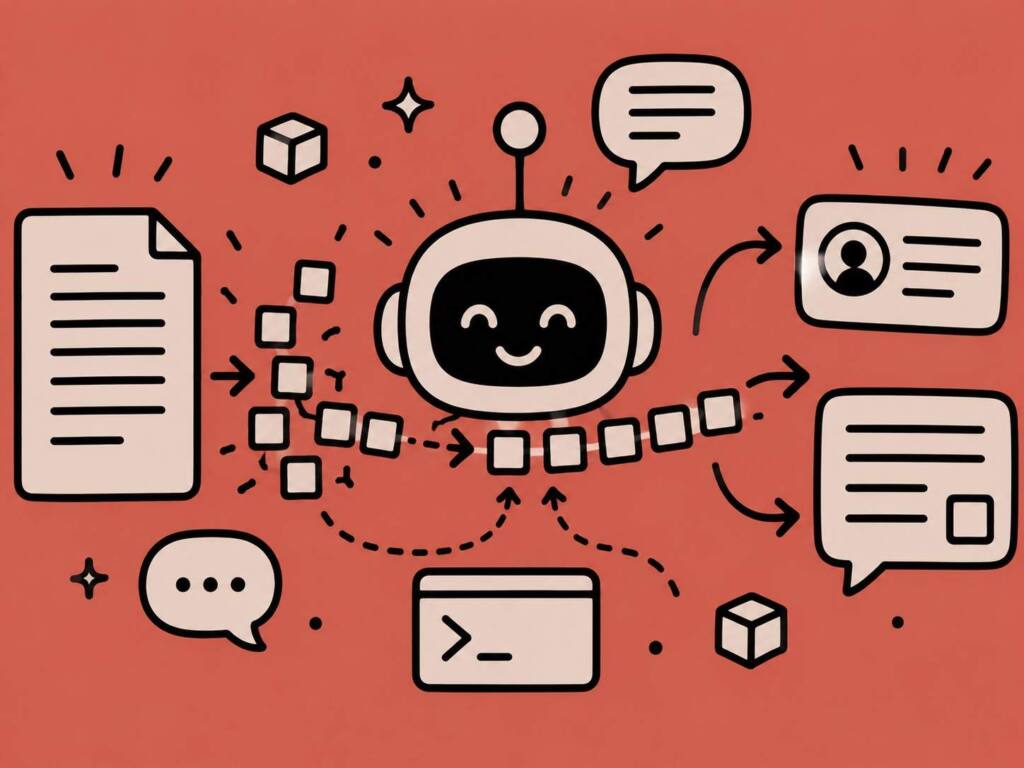
Think of it like this. When you read, your eye glides over a continuous stream of letters. An AI model instead chops that stream into Lego-like pieces first, then works only with the pieces, never with the original flow of text. Every prompt you send gets shattered into tokens before the model does anything at all, and every reply you receive gets built back up one token at a time until it decides to stop.
The collection of every unique token a model knows is called its vocabulary, and it usually runs to tens of thousands or even a hundred thousand-plus distinct pieces of text. Anything you type has to be expressed using pieces drawn from that one fixed set, so the vocabulary is effectively the alphabet the model actually thinks in.
How text becomes tokens: a worked example
The process of slicing text into tokens is called tokenization, and seeing it in action is the fastest way to understand a token.
Take the simple sentence “I heard a dog bark loudly at a cat.” A word-based approach would split it into nine tokens, one per word: I, heard, a, dog, bark, loudly, at, a, cat. Clean and intuitive. Each token then gets assigned a number, an ID, so the very same word always maps to the very same ID every time it appears anywhere in any text. The word “a” shows up twice in our sentence and gets the identical ID both times, because to the model a token really is just that ID number and nothing more.
Now take a trickier word: “unhappiness.” A modern model does not store every possible word in existence, because doing so would demand an impossibly enormous vocabulary that no system could hold or search efficiently. Instead it breaks the word into familiar sub-pieces, something like “un,” “happi,” and “ness.” Three tokens for one word. This subword approach is the clever compromise that nearly every current model relies on, because it lets the model handle words it has literally never encountered before by assembling them on the fly from smaller parts it does already know. A made-up word like “scrumptiousify” still tokenizes fine. It just turns into more pieces.
So a token is not the same thing as a word, and that mismatch is worth sitting with for a moment. Sometimes one word is exactly one token. Sometimes one word is three or four tokens. And sometimes, with very common short words, a token even swallows the leading space in front of it, so ” the” with a space and “the” without one can register as two genuinely different tokens to the model. You do not need to memorize any of these rules. You just need to drop the assumption that one word equals one token.
Why one word does not equal one token
Here is the rule of thumb worth remembering: in English, 1,000 tokens come out to roughly 750 words. Put the other way, a single word averages around 1.3 tokens.
That ratio shifts depending on what you write. Plain, common English words tend to be one token each. Rare words, technical terms, names, and anything with unusual spelling get split into more pieces, sometimes several pieces for a single word, which quietly inflates your count. Numbers, emojis, code, and other languages can be far less efficient still, occasionally landing at one token per single character. This is exactly why the same word count can translate into wildly different token counts depending on the content, and it is the root of a cost surprise that catches many beginners off guard, which we will get to shortly.
You can watch this happen yourself. OpenAI publishes a free tokenizer tool where you paste text and see exactly how it breaks into tokens and how many you used. Trying a few sentences there teaches you more in two minutes than any explanation, including this one.
Why your AI cannot count the letters in “strawberry”
This is the single most useful thing tokens explain, and almost no beginner guide connects the dots.
You have probably seen an AI model confidently miscount the letter “r” in “strawberry,” or fumble a simple spelling task. People take it as proof the model is dumb. The real reason is tokenization. To the model, “strawberry” is not a string of ten letters, it might be just two or three tokens like “straw” and “berry,” each stored as a single ID number that carries no built-in record of the individual letters packed inside it. The model never saw those letters as separate things, so asking it to count them is like asking someone to count the bricks in a house they only ever saw as a photo. The information was blurred away back at the tokenization step.
Once you know this, a whole class of AI quirks stops being mysterious. Rhyming, letter games, counting characters, reversing words, all of these are harder for models than their fluency suggests, precisely because they work in tokens, not letters. If you understand what a token is, you can predict where these tools will stumble.
Tokens and money: why you get billed per token
If you only ever use a free chat app, tokens stay invisible. The moment you use an AI through its API, build something on top of one, or hit a usage limit, tokens become the thing you are actually paying for.
AI providers price by the token, not the word or the message. Every request has a cost based on two numbers: the input tokens you send and the output tokens the model generates back. The two are usually priced differently, with output tokens often costing noticeably more than input tokens because generating text is more expensive than reading it. So a long prompt that produces a short answer and a short prompt that produces a long answer can bill very differently, even when the total amount of text on screen looks almost identical.
This is also why prompt efficiency matters once you are building something real. Trimming redundant words, avoiding needlessly verbose instructions, and not stuffing an entire document into context when a summary would do all translate directly into lower token counts and lower bills. The skill of writing tight prompts is partly a skill of spending tokens wisely.
A worked example: estimating a real cost
Numbers make this concrete, so walk through one. Suppose you are summarizing a research paper. The paper is about 4,000 words, which at the 750-words-per-1,000-tokens ratio comes to roughly 5,300 input tokens. You ask for a 400-word summary, around 530 output tokens. If a model charges, say, a few dollars per million input tokens and a bit more per million output tokens, your single summary costs a fraction of a cent. Tiny on its own. But run that exact same job across ten thousand papers, or build an app where thousands of users each do it many times a day, and those individually trivial fractions stack up into a serious monthly bill that finance will absolutely notice. That is the whole reason engineers obsess over token counts that look laughably small at the scale of one request. Understanding what is a token at the level of a single sentence is precisely what lets you predict the cost at the scale of a million of them.
How to estimate tokens yourself
You do not need a calculator for everyday use, just two habits.
First, lean on the ratio. Multiply your word count by roughly 1.3 and you have a usable token estimate for ordinary English. A 300-word email is about 400 tokens. A 3,000-word article is close to 4,000. Good enough for planning.
Second, adjust for the awkward stuff. Code, math, tables, JSON, and non-English languages all tokenize far less efficiently than plain prose, often landing well above the 1.3 average, so you should pad your estimate whenever your text is dense with symbols, numbers, or unusual formatting. A block of dense code can easily use two or three times the tokens you would naively guess from glancing at its character count. When precision actually matters, skip the mental math entirely and paste the text into a live tokenizer to read the exact figure. The point of the ratio is speed, not accuracy. That is the practical heart of what is a token for anyone planning real work.
Token limits and the context window
Every model has a ceiling on how many tokens it can handle at once. That ceiling is called the context window, and it is one of the most important specs to understand.
The context window is the model’s working memory, the total span of tokens it can hold in view while answering you. Importantly, this budget covers both your input and the model’s output together, not just one or the other. If a model has a 100-token window and your prompt alone uses 90 tokens, then only 10 tokens are left over for the entire reply, which is nowhere near enough. Go over the limit and older text gets pushed out or truncated. That is why a model can seem to “forget” the start of a very long conversation. The early tokens literally fell out of the window.
Context windows have grown enormously. Early models held only a couple thousand tokens. Many current models hold hundreds of thousands, and some 2026 frontier models reach a million or more, enough to drop an entire codebase or a stack of documents into a single request. Bigger is not automatically better, though. Larger windows cost more to run, and models often handle the beginning and end of a long context more reliably than the murky middle, so simply dumping in more text is not a guaranteed win.
Why understanding what is a token matters for students and new users
If you are learning AI for a class, a project, or just to use these tools well, tokens are one of the highest-value concepts to grasp early, and here is why.
Almost every confusing thing about AI tools traces back to tokens. Why the chatbot forgets the start of a long chat: tokens fell out of the context window. Why your API bill is higher than expected: more tokens than you estimated, probably from code or formatting. Why the model nailed an essay but flubbed a word puzzle: it reasons in tokens, not letters. Why two prompts that look the same length cost different amounts: different token counts hiding under similar word counts. Learn what is a token and you hold the key to all of these at once, instead of memorizing each quirk as a separate rule.
For students specifically, this is also the concept that connects the friendly chat interface to the real machine learning underneath it all. Tokens are where human language meets math. Once your text becomes tokens, and each token becomes an ID number, and each ID number becomes a long vector of values, the model from that point onward is doing nothing but pure arithmetic on those numbers. Tokenization is the doorway between the words you read and the numbers the model computes with, which makes it the perfect first technical concept to truly nail before you move on to embeddings, attention, and everything else.
Common tokenization methods, briefly
You do not need to implement any of these, but the names show up constantly, so a one-line orientation helps.
Word tokenization splits on spaces and punctuation, which is simple but handles rare words badly. Character tokenization breaks text into single characters, which can represent absolutely anything but makes the token sequences very long and slow to process. Subword tokenization, the modern standard, sits neatly in between and splits words into meaningful fragments that balance the two extremes. Most current models use a subword method, with Byte-Pair Encoding (BPE) being the most common, the approach used in OpenAI’s GPT models. Google’s BERT used a close relative called WordPiece, and SentencePiece is another widely used option. The differences matter to engineers tuning performance, but for understanding what is a token, the takeaway is simple: today’s models almost all chop words into subword pieces.
Frequently asked questions
What is a token in AI in simple terms? A token is a small chunk of text, often a word or part of a word, that an AI model treats as one unit. Models read and write in tokens rather than in whole words or single letters.
How many words is 1,000 tokens? In English, 1,000 tokens is roughly 750 words on average, since one word works out to about 1.3 tokens. The exact ratio varies with vocabulary, language, and whether the text includes code or numbers.
Why does AI charge by tokens instead of words? Tokens are the actual unit a model processes, so providers measure and price by them. You pay for input tokens (your prompt) and output tokens (the reply), usually at different rates.
Is a token the same as a word? No. A token can be a whole word, part of a word, a single character, or punctuation. Common words are often one token, while rare or long words split into several tokens.
Why can’t ChatGPT count letters correctly? Because it sees tokens, not individual letters. A word like “strawberry” may be stored as one or two tokens with no record of its separate letters, so counting characters is something the model has to guess at rather than read directly.
What is a context window? It is the maximum number of tokens a model can consider at once, covering both your input and its output. Exceeding it causes the model to truncate or forget the earliest text in a long exchange.
A token is the quiet unit doing all the work behind every AI conversation. Learn to see text the way a model does, in chunks rather than words, and the pricing, the limits, and even the weird mistakes all start to make sense. Next time a chatbot miscounts a letter or trims a long chat, you will know exactly why.
What is an LLM?

Ved Vyas
Writer at Fable Knows, covering AI and the technology shaping everyday life.