What Is an LLM? A Simple, Complete Guide to Large Language Models in 2026
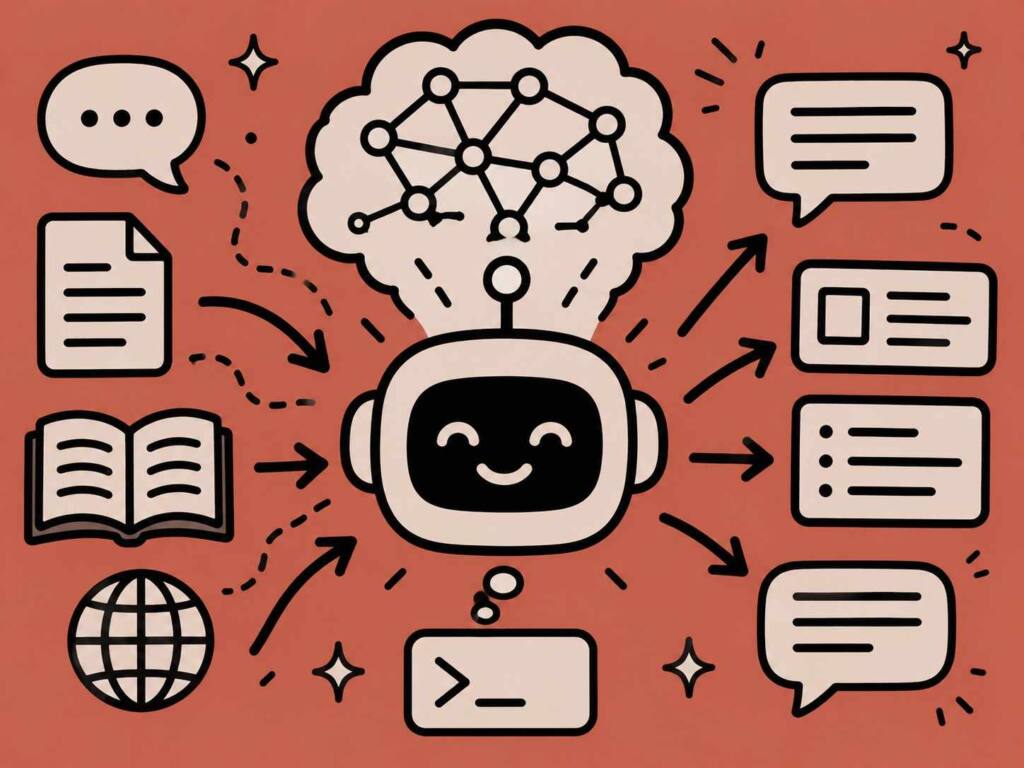
What is an LLM? A clear 2026 guide to how large language models work, why they hallucinate, how they’re trained, and the difference between an LLM and ChatGPT.
The plain-English explanation of how large language models actually work, why they sometimes lie with confidence, and what they can and cannot do.
Ask a large language model a question and you get back fluent, confident, often correct text in a second or two. Ask it the same question tomorrow and the wording changes. Push it on something obscure and it may invent a fact so smoothly you would never guess it was made up. All three behaviors come from the same simple mechanism, and once you understand that mechanism, the whole technology stops feeling like magic and starts making sense.
So here is the real answer to what is an LLM, without the jargon wall most explainers hide behind.
What is an LLM, in one honest sentence
If you want the shortest possible answer to what is an LLM, here it is: an LLM is a very large neural network trained on enormous amounts of text to do one narrow thing extremely well, predict the next chunk of text given everything before it. That is the entire core function. Everything else, the essays, the code, the translation, the apparent reasoning, falls out of doing that one prediction job at massive scale.
The name unpacks cleanly. “Large” refers to two things at once: the mountain of training text, often trillions of words pulled from books, websites, and code, and the number of internal settings the model tunes during training, which now runs into the hundreds of billions or more. “Language” is the medium it works in. “Model” means it is a statistical system that learned patterns from data rather than a program someone wrote rule by rule.
That last distinction matters more than it sounds. Nobody hand-coded grammar into an LLM. It absorbed grammar, facts, writing styles, and reasoning patterns by reading and re-reading text until it could predict what comes next. The rules are in there, but they were learned, not typed.
What is an LLM made of? Parameters, tokens, and weights
A few terms come up constantly once you start reading about these systems, and knowing them turns most LLM explainers from noise into signal.
Parameters are the internal numbers the model adjusts during training, the dials it turns to get better at prediction. When you read that a model has 175 billion or 400 billion parameters, that count is a rough proxy for capacity, though not a perfect one. More parameters can mean more capability, but architecture and training quality matter just as much, which is why a well-built smaller model sometimes beats a clumsy larger one. Some recent designs use a mixture-of-experts approach, holding a huge total parameter count but only firing a fraction of it per query, which keeps a very large model fast and affordable to run.
Tokens are the units of text the model reads and writes, usually words or word fragments. Weights are the learned strengths of the connections inside the network, the thing pretraining is actually tuning. And the context window is the model’s working memory, the maximum amount of text it can hold in view at once. Put those four ideas together and you have the practical vocabulary for understanding what is an LLM doing when it answers you: tokenizing your input, running it through weighted connections shaped by billions of parameters, and predicting tokens back, all inside the limit of its context window.
How does an LLM actually work?
Strip away the marketing and the answer to what is an LLM doing internally has three honest stages: turning text into numbers, processing those numbers through a transformer, and predicting the next piece one step at a time.
First, the model breaks your text into tokens. A token is a small unit, often a word or a fragment of one, and a rough rule of thumb is that 1,000 tokens is about 750 words. Each token gets converted into a long list of numbers called an embedding, which places it in a kind of meaning-space where related words sit near each other. In that space, “king” and “queen” land close together, and so do “bark” and “dog” when the surrounding text is about animals rather than trees.
Second, those embeddings flow through a transformer, the architecture introduced in the 2017 paper “Attention Is All You Need”, which underpins essentially every modern LLM. The transformer’s key trick is self-attention. At each step, the model weighs how much every word should pay attention to every other word in the passage. That is how it figures out that in “the trophy did not fit in the suitcase because it was too big,” the word “it” refers to the trophy and not the suitcase. Older approaches read text strictly left to right and lost track of these long-range links. Self-attention lets the model hold the whole passage in view at once, and it lets the computation run in parallel, which is what made training on internet-scale data possible.
Third, the model predicts. It looks at everything so far, calculates a probability for every possible next token, and picks one. Then it adds that token to the sequence and does the whole thing again. And again, one token at a time, until the response is done. The model never knows the full answer in advance. It is improvising every word based on the patterns it learned, which is a genuinely useful thing to internalize about how these systems behave.
Why “it just predicts the next word” is true but misleading
You will hear skeptics wave LLMs away with “it’s just autocomplete.” They are technically right and practically wrong, and the gap between those two is the most interesting part of what is an LLM really doing under the hood.
Yes, the mechanism is next-token prediction. But to predict the next word in a sentence about, say, the cause of the 2008 financial crisis well enough to sound right, the model had to compress a staggering amount of structure about the world into its weights: how sentences flow, how arguments build, which facts tend to travel together. Prediction at that scale forces the model to build internal representations that look a lot like knowledge and a little like reasoning. Calling that “just autocomplete” is like calling a chess engine “just legal-move-picking.” Accurate, and it completely misses what the system does with the mechanism.
This is also why the same prompt can give you different answers. At each step the model is not always forced to pick the single most likely token. A setting called temperature controls how much randomness gets injected. Low temperature makes it pick the safe, probable word every time and gives consistent, sometimes dull output. Higher temperature lets it occasionally take a less likely word, which reads as more creative and varied. Same model, different dice.
How LLMs are trained, step by step
A finished model that follows your instructions politely went through several distinct phases, and they are worth separating because each one does a different job.
Pretraining is the expensive part. The model reads through its enormous text corpus and plays a fill-in-the-blank game with itself, predicting hidden tokens, checking against the real answer, and nudging its billions of internal weights to be a little less wrong each time. This is self-supervised, meaning nobody had to label the data by hand, the text is its own answer key. Pretraining is where the model picks up grammar, facts, and general competence. It is also where the cost lives: months of computation across thousands of specialized chips, which is why frontier models come from companies with deep resources.
A freshly pretrained model is knowledgeable but unwieldy. It will happily continue your text rather than answer your question. Fine-tuning fixes that. Using a smaller, curated dataset, the model is trained further to behave the way users want. Instruction tuning teaches it to treat input as a request to fulfill rather than a passage to continue. Reinforcement learning from human feedback, or RLHF, has people rank competing responses, and the model learns to prefer the ones humans rated higher. That step is most of what makes a model feel helpful, safe, and on-tone rather than like a raw text predictor.
Reasoning models add one more layer. Instead of answering immediately, they are trained to work through a problem in intermediate steps first, sometimes called a chain of thought, before committing to a final answer. That extra deliberation is why the strongest 2026 models are noticeably better at math, multi-step logic, and code than their predecessors of even a year ago.
Why LLMs confidently make things up
This is the question almost every newcomer has and almost no vendor page answers head-on, so here it is plainly. You cannot really understand what is an LLM until you understand why a confident answer and a correct answer are not the same thing.
An LLM has no built-in fact-checker and no internal “I don’t know” signal that reliably fires. Its job is to produce the most plausible-sounding continuation, and plausible is not the same as true. When you ask about something well represented in its training data, plausible and true line up and the answer is solid. When you ask about something obscure, contradictory, or simply absent from what it read, the model still produces fluent, confident text, because that is the only thing it knows how to do. The industry calls these confident fabrications hallucinations, and they are not a bug that a patch removes. They are a direct consequence of how the system works.
The practical takeaway: treat an LLM as a fast, articulate, occasionally unreliable collaborator, not an oracle. Verify anything that matters, especially specific names, numbers, dates, citations, and legal or medical claims. The fluency is exactly what makes the errors dangerous, because a wrong answer arrives wearing the same confident tone as a right one.
Two techniques reduce the problem without eliminating it. Retrieval augmented generation, or RAG, feeds the model relevant documents at question time so it answers from real source material instead of memory alone. And a larger context window, the amount of text a model can consider at once, which now reaches hundreds of thousands of tokens or more, lets you hand it the actual document rather than hoping it memorized the facts.
LLM versus chatbot versus AI: untangling the terms
People use these words interchangeably and they are not the same thing, which causes real confusion.
The LLM is the underlying engine, the trained neural network. A product like ChatGPT, Claude, or Gemini is an application built around an LLM, with a chat interface, safety guardrails, memory features, and often tools like web search or code execution bolted on. The model is the motor; the chatbot is the car. This is the single most common point of confusion when people first ask what is an LLM versus what is ChatGPT. And “AI” is the broad field that contains all of this plus much that has nothing to do with language models, from image recognition to recommendation systems. When someone says “the AI got it wrong,” they usually mean a specific LLM-powered product gave a bad answer.
What can LLMs actually do?
The reason LLMs spread so fast is that one model handles tasks that used to need separate specialized software. The genuinely useful applications cluster into a few areas.
Writing and editing is the obvious one: drafting emails, summarizing long reports into a few lines, rewriting for tone, and translating between languages with fluency older tools could not match. Code is a major one, with models writing functions, explaining unfamiliar codebases, finding bugs, and translating between programming languages. Question answering and research assistance let you interrogate dense material conversationally instead of keyword-searching. And increasingly, models act as the brain inside AI agents, systems that do not just generate text but take actions, calling tools, querying databases, and chaining steps to complete a multi-part task with limited supervision.
What they remain weak at is just as important. They struggle with truly novel reasoning far outside their training, with precise arithmetic unless given a calculator tool, and with any task where being confidently wrong is unacceptable and unverifiable. Knowing the weak spots is what separates someone who uses these tools well from someone who gets burned by them.
A short, useful history
The ideas go back decades, but the modern era has a clear hinge point. Early language systems used hand-written rules and simple statistics that captured local word patterns but lost the thread over long passages. The 2010s brought word embeddings like Word2Vec, which let models represent meaning as geometry, and sequence models that handled order better.
The real break came in 2017 with the transformer. Google’s BERT showed in 2018 how powerful transformers were at understanding language, while OpenAI’s GPT line showed how the same architecture could generate astonishingly fluent text. GPT-3 in 2020, with 175 billion parameters, made the world pay attention.
Frequently asked questions
What does LLM stand for? Large Language Model. In answering what is an LLM, “large” refers to both the massive training data and the huge number of internal parameters, “language” is the medium, and “model” means it learned patterns from data rather than following hand-written rules.
Is an LLM the same as AI? No. An LLM is one type of AI focused on language. Artificial intelligence is the much broader field that also includes image recognition, robotics, recommendation systems, and more. Every LLM is AI, but not all AI is an LLM.
Why does an LLM give different answers to the same question? Because it does not always pick the single most likely next word. A setting called temperature injects controlled randomness, so a model can phrase the same idea differently or take a more creative path on each run.
Do LLMs actually understand language? That is debated. They build rich internal representations that behave like understanding for many tasks, but they have no awareness or grounding in the world the way people do. They are extraordinarily capable pattern predictors, which is not the same as human comprehension.
Why do LLMs make up facts? An LLM generates the most plausible-sounding text, and plausible is not always true. With no built-in fact-checker, it produces fluent answers even when it lacks the information, which results in confident errors called hallucinations. Always verify anything important.
What is the difference between an LLM and ChatGPT? The LLM is the underlying trained model. ChatGPT is a product built on top of an LLM, adding a chat interface, safety guardrails, memory, and tools. The model is the engine; the chatbot is the finished vehicle.
So what is an LLM, in the end? It is a next-word predictor scaled until prediction turns into something that reads like knowledge. Hold that one idea and everything else, the brilliance and the failures alike, follows from it. Use the fluency, distrust the confidence, and verify what counts.

Ved Vyas
Writer at Fable Knows, covering AI and the technology shaping everyday life.
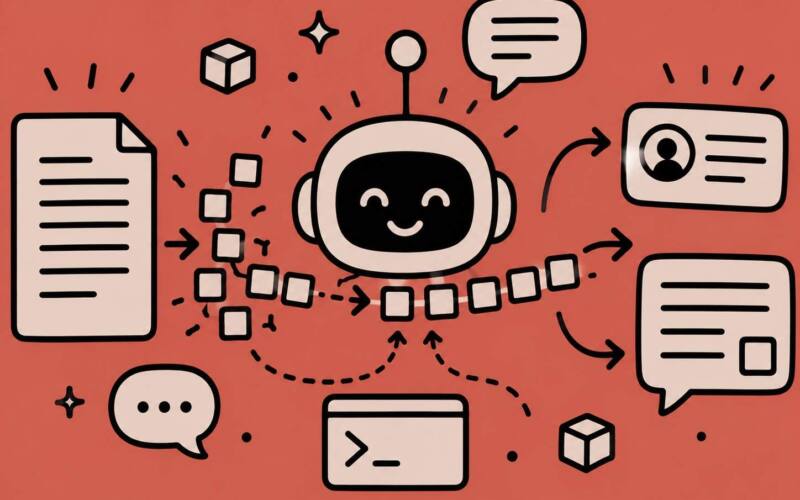
[…] A token is the quiet unit doing all the work behind every AI conversation. Learn to see text the way a model does, in chunks rather than words, and the pricing, the limits, and even the weird mistakes all start to make sense. Next time a chatbot miscounts a letter or trims a long chat, you will know exactly why.What is an LLM? […]