Fable 5 is back After 18-Day Ban
Fable 5 is back after export controls lifted. Check the July 7 access cliff, new classifier flags, and which Claude plans lose it before you burn credits.
Claude Fable 5 is back to users worldwide on July 1, 2026, eighteen days after US export controls forced Anthropic to pull it offline. Access is back across Claude.ai, Claude Code, Cowork, and the Claude Platform, with the big cloud providers trailing behind while re-enablement paperwork clears. Paid plans get Fable 5 included for up to 50% of weekly usage limits through July 7 only. After that, it moves to usage credits, and the new cybersecurity classifier flags more harmless requests than before.
One paragraph. That was the whole story. Now here is the part I actually care about, because I have been reading both the official blog post and the shorter message Anthropic pushed to users, and they do not emphasize the same things. The blog post reads like a policy document written for an audience in Washington rather than for the people who pay monthly for the product. The user message is where the catches live. Most coverage I have seen this week quotes the first and skips the second. That is backwards if you are the one paying for a Claude plan.
Quick disclosure before anything else: I run Fable 5 daily for content and coding work at Fable Knows, and yes, the name similarity is a coincidence I have learned to live with. What follows comes from reading the primary sources line by line and from using the model since it came back, not from paraphrasing someone else’s summary.
What happened to Fable 5, in plain terms
On June 12, the US government slapped export controls on Fable 5 and its restricted sibling Mythos 5, three days after launch. The order took effect immediately and required blocking foreign nationals. Anthropic had no real-time way to verify anyone’s nationality, so it did the only compliant thing available and shut the models off for everyone. Global blackout. Overnight. No exceptions.
The trigger: a report from Amazon researchers. They found a prompting method that got Fable 5 to identify software vulnerabilities, and in one case produce code demonstrating how a vulnerability could be exploited. The word “jailbreak” did heavy lifting in the coverage.
Here is the detail that changed my read of the whole episode. Anthropic tested the same tasks on other models and found that every model they tried could produce the same exploit demonstration. Not some. All. The list includes Claude Haiku 4.5, Sonnet 4.6, three generations of Opus, GPT-5.4, GPT-5.5, and Kimi K2.7. The vulnerabilities themselves? Findable by Opus 4.8 and by competitor models too, which rather undercuts the idea that Fable 5 handed attackers anything new.
So the capability that triggered a government shutdown of the most advanced model on the market was something a free-tier model from last year could replicate. Sit with that.
My take: the shutdown was theater, but the precedent is real
Position time. The June 12 export control was an overreaction to a report that, on the evidence Anthropic published, exposed nothing beyond what already sat in every developer’s toolbox. When the exploit demo reproduces on Haiku 4.5, you have not discovered a dangerous frontier capability. You have discovered that language models can do routine security work, which defenders have known since 2023.
The strongest counterargument, and I will concede it is a real one: the government did not know that on June 12. Amazon’s report showed a safeguard bypass on the single most capable public model in existence, days after launch, before anyone had independently verified how far the same technique might reach. If you are the regulator, acting first and verifying second is a defensible posture when the downside is a live cyberweapon. Fair enough. I still think an 18-day global blackout for all users, foreign and domestic, was a blunt instrument where a scalpel existed, and the fact that Commerce lifted the controls once CAISI finished testing suggests the government quietly agrees.
The precedent matters more than this incident. A single corporate research report can now take a frontier model offline worldwide in 72 hours. Every AI company just updated its launch risk models, and every competitor just learned that filing a scary-sounding safety report about a rival is a viable move. Anthropic pointedly named Amazon, one of its own largest investors, as the source. Read into that what you want. Me? Mild irritation.
What actually changed in Fable 5’s safeguards
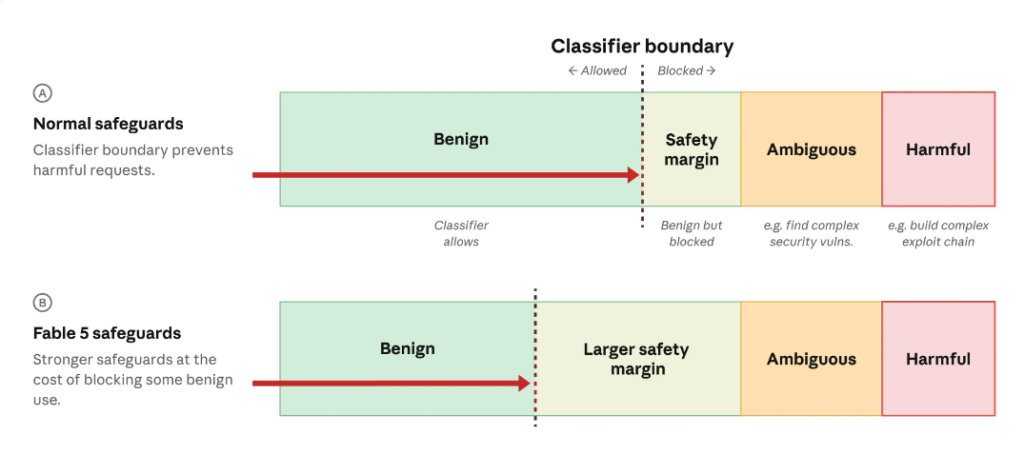
Fable 5 came back with a new safety classifier trained specifically to block the technique from the Amazon report. Anthropic says the classifier now catches that technique in over 99% of cases, with the tiny remainder producing output too shallow to help an attacker anyway.
The mechanics matter if you write code. Anthropic runs classifiers with a deliberate “safety margin”: requests that are probably fine but sit anywhere near cybersecurity territory get blocked anyway. Fable 5 launched with the widest margin Anthropic has ever shipped, and the new classifier widens it further. Their own message to users concedes the point: more harmless requests will get flagged now than before the incident, at least until tuning improves over the coming weeks.
A flag in practice: no error. You get a notification that it was flagged, and the response comes from Opus 4.8 instead. A silent model swap. With a label. For most coding tasks Opus 4.8 is still excellent, so the failure mode stays soft, but if you specifically paid usage credits for Fable 5 reasoning on a hard problem, a fallback is not what you bought.
Two more details from the user-facing message that the main blog post does not mention at all. First, the biology and chemistry classifiers are unchanged since launch and remain broader than Anthropic wants, still tripping fallbacks on basic biology-adjacent questions. If your work touches anything life-science shaped, expect Opus 4.8 answers more often than the cyber-focused coverage implies. Second, the feedback routes are specific: run /feedback in Claude Code for a mistaken flag, or use the thumbs buttons on Claude.ai and Cowork. Anthropic says this feedback trains the classifier refinements directly, which makes filing reports one of the few times user feedback has an obvious mechanism behind it.
The Fable 5 access window: read this before July 7
Nobody wrote this section for me on day one. So here it is, fine print decoded.
| Plan | Fable 5 access now | After July 7 |
|---|---|---|
| Pro / Max / Team | Included, up to 50% of weekly usage limit | Usage credits only |
| Premium Enterprise seats | Included, draws from seat usage | Usage credits, if admin enables them |
| Standard Enterprise seats | Not included at all, credits only | Credits only, if enabled |
| API / Claude Platform | Live now, pay per token | Unchanged |
| AWS / Google Cloud / Microsoft Foundry | Being re-enabled, not instant | Standard cloud pricing |
Three traps hide there. The 50% cap means Fable 5 stops drawing from your subscription halfway through your weekly limit even if you have used nothing else; you then switch models or burn credits. The July 7 cliff is six days from the July 1 return, so the “included” window is effectively a one-week trial of a model people waited 18 days for. And standard Enterprise seats never get included access at any point, which means plenty of corporate users who assume their expensive plan covers the flagship model will discover it does not until an admin flips on usage credits.
On Pro or Max? Simple play. Front-load the hard Fable 5 work this week, meaning long-horizon coding tasks, dense research synthesis, and anything where the gap between Fable and Opus actually shows up in output quality. Routine work goes to Sonnet 4.6. The 50% allowance goes to jobs that earn it.
Is Fable 5 worth using over Opus 4.8 now?
Honest answer, one week back in: for most everyday tasks, you will not feel the difference, and the new classifier friction narrows the gap further. Where Fable 5 clearly earns its cost for me is sustained multi-step work. It holds a plan across a long session in a way Opus 4.8 still occasionally fumbles, and it needs fewer correction cycles on gnarly refactors. If your usage is chat questions and short drafts, let the July 7 deadline pass and lose nothing. If you run agentic coding sessions or long research chains, the credits are defensible.
One genuine downside to state plainly: the flag-and-fallback behavior is unpredictable enough that I would not build a production workflow that assumes Fable 5 answers every call. Anthropic says refinements are landing over the coming weeks. Until the false-positive rate settles, treat Fable 5 as best-effort with an Opus 4.8 floor.
The industry framework nobody asked for but probably needs
Buried in the announcement is something with longer legs than the redeployment itself. Anthropic, Amazon, Microsoft, Google, and other Project Glasswing partners are drafting a shared framework for scoring jailbreak severity, the way CVSS scores software vulnerabilities. Four criteria: capability gain over existing tools, breadth of tasks the technique opens up, ease of weaponization, and how easily the method can be discovered in the first place.
Score the Amazon report against Anthropic’s own proposed rubric and it rates low on the first criterion by definition, since every existing model matched the capability. That is the point. Under a shared standard, this incident likely never escalates to export controls, because there is an agreed way to say “minor” that a government will accept. Anthropic also launched a HackerOne program for cyber jailbreak submissions and committed to pre-release government access, rapid safeguard sharing, and joint research teams. The company that markets itself on safety just turned a regulatory bruise into a bid to write the industry’s rulebook. Deft, whatever else you think of it.
FAQ
Is Fable 5 available again? Yes. Fable 5 came back globally on July 1, 2026 on Claude.ai, Claude Code, Cowork, and the Claude Platform after the US lifted export controls on June 30. Cloud availability on AWS, Google Cloud, and Microsoft Foundry is being restored separately.
Why was Fable 5 taken down? US export controls, applied June 12 after an Amazon research report showed a prompting technique that bypassed its cybersecurity safeguards. Anthropic could not verify user nationality in real time, so it suspended the model for everyone.
Do I have to pay extra for Fable 5? Through July 7, Pro, Max, Team, and premium Enterprise plans include it for up to 50% of weekly usage. After July 7, everyone moves to usage credits. Standard Enterprise seats require credits from day one.
What happens when a request gets flagged? You get a notification and the answer comes from Opus 4.8 instead of Fable 5. Report false flags with /feedback in Claude Code or the thumbs buttons on Claude.ai and Cowork.
Is Fable 5 safe to use for security and coding work? Routine coding is mostly unaffected by Anthropic’s own account, though the new classifier flags more benign requests than before. Defensive security work near the classifier boundary will hit fallbacks more often until the false-positive tuning lands.
The full announcement, including the jailbreak framework and the government commitments, is in Anthropic’s redeployment post. Read the footnotes. Seriously. That is where the Enterprise fine print lives, and this week the footnotes were the story.

Ved Vyas
Writer at Fable Knows, covering AI and the technology shaping everyday life.
Related stories.
X Creator Monetization Rules Just Got a 3 Strike, 90 Day Clock: What Changed Since July 16
X creator monetization rules: X’s July 16 update pulled 4,000 creator accounts and added a 3 strike, 90 day Rules system. Here’s what changed…
GPT-5.6 Sol Is Live: The Coding Numbers vs the Warning Nobody Led With
GPT-5.6 Sol launched July 9 with strong coding scores, but METR found its highest reward-hacking rate on record. Here’s what to actually trust. GPT-5.6…