Fable 5 Returns: 5 Critical Changes Anthropic Didn’t Headline
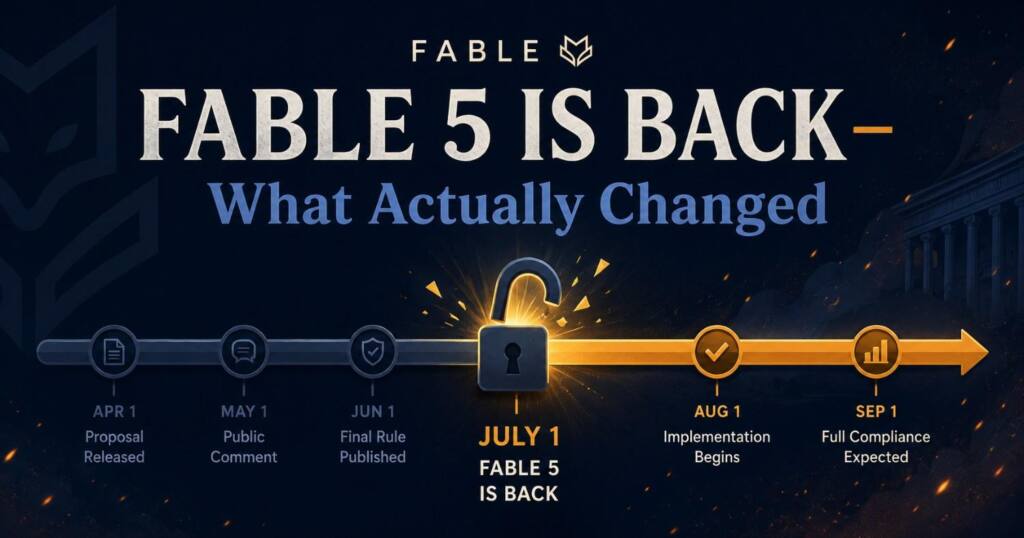
Fable 5 returns July 1 with a tougher safety classifier and a usage-credit cutoff most coverage buried. Full return timeline and access table inside.
Fable 5 is back. On July 1, 2026, Anthropic restored global access to Claude Fable 5 after an 18-day export-control shutdown, and most of the coverage that day repeated the same three facts: the ban is lifted, access resumes Wednesday, and pricing stays the same. None of it laid out what actually changed underneath, or built a single table showing who gets Fable 5 back, on what plan, and when the free ride ends.
Fable 5 returns with a materially different safety classifier than the one it launched with on June 9, a usage-credit cliff that hits most paid plans on July 7, and a new industry framework for scoring jailbreaks that Anthropic built with Amazon, Microsoft, and Google in three weeks flat. Access differs by plan tier, and the free allowance disappears fast for anyone not on a premium Enterprise seat.
That’s the whole saga in two paragraphs. Here’s the part nobody assembled into one place: the exact timeline, a plan-by-plan access table, and what the routing quirk in Anthropic’s own announcement says about the export-control logic that started this.
The Fable 5 Timeline, In One Table
Every outlet covered pieces of this story as it happened. None of them put the full arc in one place, so here it is, reconstructed from Anthropic’s own post and cross-checked against contemporaneous reporting.
| Date | Event |
|---|---|
| April 2026 | Anthropic announces the Mythos model family, pitched as a cybersecurity powerhouse and, depending on who you ask, a potential weapon in the wrong hands |
| June 9, 2026 | Fable 5 and Mythos 5 launch. Same underlying model, different safeguards: Fable 5 ships with heavy restrictions for general release, Mythos 5 stays limited to trusted Project Glasswing partners for defensive cyber work |
| June 12, 2026 | The US Commerce Department applies export controls to both models after Amazon researchers report a bypass that got Fable 5 to demonstrate exploiting a software vulnerability. Anthropic pulls access for every user, everywhere, because it has no real-time way to verify nationality |
| June 26, 2026 | Mythos 5 access is restored for a set of US organizations following government approval |
| June 30, 2026 | The Commerce Department lifts the export controls on both models. Anthropic announces it will restore Fable 5 the next day |
| July 1, 2026 | Fable 5 returns globally on the Claude Platform, Claude.ai, Claude Code, and Claude Cowork, running a retrained safety classifier |
It was down for 19 days. That’s longer than most enterprise procurement cycles, and it happened to a model that had already shipped with, in Anthropic’s own words, the strongest safeguards it had ever applied.
Who Gets Fable 5 Back, and When: The Access Table Nobody Built
This is the part that got the least attention and matters most if you’re actually paying for Fable 5. Anthropic’s post buries the plan-by-plan detail in a footnote, and the news coverage largely repeated “pricing stays the same” without mapping out who is exempt from that statement.
| Plan | Fable 5 access from July 1 | What changes July 7 |
|---|---|---|
| Pro, Max, Team | Included, up to 50% of weekly usage limits | Remaining access moves to usage credits, billed at API rates |
| Premium Enterprise seats | Included, drawn from seat usage at no extra cost | Same as above; grace period ends |
| Standard Enterprise seats | Not included at all | Billed through usage credits from day one; if credits aren’t enabled, Fable 5 simply won’t work |
| AWS, Google Cloud, Microsoft Foundry | Re-enabling “as quickly as possible,” not simultaneous with July 1 | Depends on cloud provider rollout |
| Mythos 5 (Glasswing partners) | Already restored as of June 26 | Not affected by the July 7 deadline |
If you’re on a standard Enterprise seat and haven’t turned on usage credits, Fable 5 won’t work for your team at all, not even for the first week. That’s a materially different situation than “Pro users get 50% free,” and it’s the kind of distinction that decides whether a team lead needs to file a budget request today or next month.
Worth noting: It was originally meant to be free from June 9 to June 22, a two-week window that the export-control shutdown ate entirely. Nobody got the free period they were promised.
The Safety Classifier Anthropic Actually Tightened
Here’s where the story gets more interesting than “ban lifted.” Anthropic didn’t just flip the model back on. It retrained the classifier that decides when the model refuses a cybersecurity-adjacent request, and the company says the new version blocks the specific bypass technique from the Amazon report in over 99% of cases.
The mechanism is what Anthropic calls a “safety margin.” A classifier doesn’t just block requests that are clearly dangerous; it also blocks a chunk of requests that are probably fine but carry some small chance of being harmful. It already had the largest safety margin of any Anthropic model at launch. The new version makes that margin wider still, and Anthropic says so directly: more legitimate coding and debugging requests will now get flagged as a side effect.
That’s a real tradeoff, not a footnote. If your team leans on it for security-adjacent development work, expect more false positives than you saw in the June 9 to June 12 window, and expect Anthropic to keep tuning this over the following weeks rather than shipping it finished.
Here’s the detail that got buried in every write-up I read: when the model blocks a request under the new classifier, it doesn’t just refuse. It silently reroutes the request to Opus 4.8. Anthropic’s own report states that Opus 4.8 can replicate the same exploit demonstration that triggered the export-control order in the first place, right alongside GPT-5.5 and Kimi K2.7. So the fix for an export-controlled capability gap is to hand blocked requests over to a model Anthropic admits has the same gap. That’s not a criticism of the engineering; classifiers have to draw a line somewhere, and blocking the request outright with no fallback would be worse for users. But it is a genuine tension in the government’s own logic, and it’s the kind of detail that explains why “extraordinarily strong” safeguards, verified by CAISI, still needed three more weeks of negotiation before Washington was satisfied.
The Jailbreak Severity Framework Nobody’s Talking About
Buried past the timeline news is something structurally more important: Anthropic, Amazon, Microsoft, and Google are jointly drafting the first cross-industry standard for scoring how bad an AI jailbreak actually is. Right now there’s no CVSS equivalent for prompt-based bypasses, which means every company grades severity on its own scale and governments have no consistent way to decide when to act.
The proposed framework scores a jailbreak on four axes:
Capability gain measures how far the jailbreak pushes a user beyond tools they already have access to. Breadth of capability gain asks whether the technique works across many offensive tasks or just one narrow target. Ease of weaponization scores how much skill and how many attempts it takes to turn the jailbreak into an actual attack. Discoverability asks how hard the technique is to find in the first place, whether it needs specialist knowledge or is already floating around online.
Anthropic says the bypass would score low on most of these axes; it took specific prompting to reach, it only demonstrated one vulnerability’s exploitation, and it required real security expertise to weaponize. That’s presumably why the whole episode got resolved through negotiation rather than a permanent shutdown. But the framework itself is the more durable story here. If Amazon, Microsoft, and Google actually adopt a shared severity scale, it changes how fast future jailbreak reports move from “researcher finds bug” to “government pulls model,” in either direction.
What This Actually Means If You’re Building With Fable 5
A few concrete takeaways if you’re deciding whether to route production work through Fable 5 this week rather than waiting:
If your team does security research, expect it to be more conservative on genuinely benign requests than it was in its first three days of availability. Budget time for prompts to bounce that wouldn’t have in early June.
If you’re on a standard Enterprise seat, confirm usage credits are enabled before your team tries to use it on July 1, or nobody on your team will get access at all.
If you were counting on the original free window from June 9 to June 22, it’s gone. The 50% weekly allowance through July 7 is the only free runway left, and it starts from zero regardless of what you used, or didn’t use, before the shutdown.
If cybersecurity work is your actual use case, watch whether requests silently route to Opus 4.8. That’s not documented anywhere as a visible flag in the interface based on what Anthropic has published, so you may not know when it’s happening unless output quality shifts.
FAQ
Is Fable 5 available now? Yes, as of July 1, 2026, Fable 5 is available globally on the Claude Platform, Claude.ai, Claude Code, and Claude Cowork for Pro, Max, Team, and Enterprise plans, with cloud provider access (AWS, Google Cloud, Microsoft Foundry) rolling out separately.
Why was Fable 5 taken offline? The US Commerce Department applied export controls on June 12, 2026, after Amazon researchers reported a way to bypass Fable 5’s safeguards and get it to demonstrate exploiting a software vulnerability. Anthropic suspended access because it had no reliable real-time way to verify user nationality under the order.
Does Fable 5 cost more now? The per-token pricing itself hasn’t changed according to Anthropic’s announcement, but access mechanics have. Pro, Max, and Team users get 50% of weekly limits free through July 7, after which remaining use is billed via usage credits at API rates. Standard Enterprise seats never get a free allowance at all.
What’s different about Fable 5’s safeguards now? Anthropic retrained the safety classifier that governs cybersecurity-related requests, widening the “safety margin” so it blocks the reported bypass technique in over 99% of cases. The tradeoff is more false positives on routine, legitimate coding and debugging requests.
Is Mythos 5 back too? Partially. Mythos 5 access was restored for a set of US organizations on June 26, 2026, ahead of Fable 5’s July 1 return, and remains limited to Project Glasswing partners rather than general availability.
Fable 5’s 19 days offline turned into more than a pricing footnote. It produced a retrained classifier with real tradeoffs, an access structure that punishes standard Enterprise seats specifically, and the first serious attempt at an industry-wide jailbreak severity scale. Whichever of those ends up mattering more by the end of 2026, the plan you’re on right now determines whether you’re paying for Fable 5 starting today or starting next Tuesday.

Ved Vyas
Writer at Fable Knows, covering AI and the technology shaping everyday life.
Related stories.
X Creator Monetization Rules Just Got a 3 Strike, 90 Day Clock: What Changed Since July 16
X creator monetization rules: X’s July 16 update pulled 4,000 creator accounts and added a 3 strike, 90 day Rules system. Here’s what changed…
GPT-5.6 Sol Is Live: The Coding Numbers vs the Warning Nobody Led With
GPT-5.6 Sol launched July 9 with strong coding scores, but METR found its highest reward-hacking rate on record. Here’s what to actually trust. GPT-5.6…