Mythos 5 Is Back: US Frees Anthropic’s AI for 100+ Firms
Mythos 5 is cleared for 100+ US institutions after a 12-day block. See why the government froze Anthropic’s model, what triggered it, and what’s still restricted.
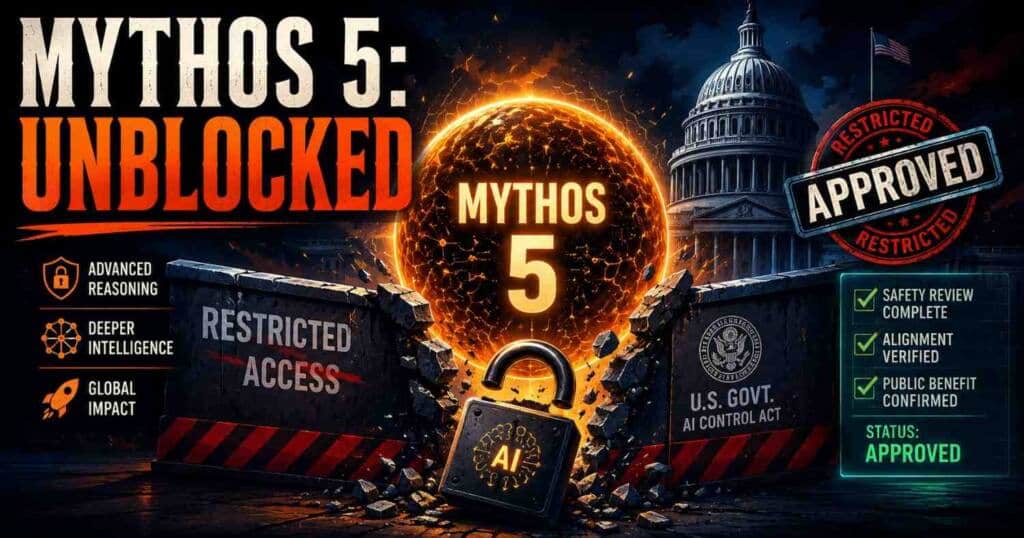
Twelve days after the U.S. government pulled the plug on Anthropic’s most powerful AI model, it switched the lights back on. On Friday, Commerce Secretary Howard Lutnick sent Anthropic a letter clearing Mythos 5 for release to more than 100 American institutions, ending a two-week standoff that had taken the model completely offline and, for a stretch, made the most capable system in Anthropic’s lineup unavailable even to the company’s own foreign-national engineers. Then it was back. Twelve days, start to finish.
Here is what actually happened, why the government blocked it in the first place, what is still frozen, and why this twelve-day round trip is the more important story than the model itself.
What the government just decided
The short version: Mythos 5 is back, but on Washington’s terms. Lutnick’s letter told Anthropic’s chief compute officer Tom Brown that “appropriate safeguards are in place to permit certain trusted partners to access the Claude Mythos 5 Model.” Entities named in an attached Annex A no longer need an export license to use it. Everyone else still does.
Anthropic confirmed it fast. In its statement on X, the company said the government notified it that Mythos 5, described as its strongest cybersecurity model, can be redeployed to a set of US organizations that operate and defend critical infrastructure. It framed the news as a partial win. The company said it is provisioning the approved providers as quickly as it can while pushing to expand the list further and to bring Fable 5 back for general use.
Read the letter closely and one line stands out. Lutnick reserved the right to “reevaluate and adjust the scope of license requirements” if circumstances change, and he can amend the approved partner list at any time. So this is not a clean reversal. It is a leash with some slack let out, and the government is still holding the other end.
Why Mythos 5 got blocked in the first place
To understand the release, you have to understand the block. On June 12, the same administration ordered Anthropic to suspend all foreign-national access to Mythos 5 and its weaker sibling Fable 5, including access by Anthropic’s own foreign-national employees. Faced with that, Anthropic did the only thing it could and disabled both models for everyone. The most powerful AI model widely available to consumers went dark overnight.
The trigger was a security scare. According to multiple reports, the alarm started when Amazon CEO Andy Jassy warned Treasury Secretary Scott Bessent that the models could be jailbroken and turned to malicious use. A frontier model that finds and exploits software vulnerabilities faster than any human team is exactly the kind of capability that makes a cyber defender’s job easier and a cyber attacker’s job much easier too. That dual-use edge is the whole anxiety.
There was a second concern, and it is the one that probably mattered more. As Semafor first reported, Washington worried that Mythos 5 had reached partners too closely linked to China, with reporting pointing to a South Korean telecommunications provider. Once national security officials believe a frontier capability may have leaked toward a strategic rival, the response stops being a polite policy conversation and starts being an export-control order. That is what happened here.
What makes Mythos 5 worth fighting over
It helps to know what kind of model triggers a federal export order. Mythos 5 is not a chatbot upgrade. It sits in a capability tier Anthropic calls Mythos-class, a level above the Opus-class models most people have used, and its defining strength is cybersecurity. The model is unusually good at reading code, finding the flaws in it, and reasoning about how those flaws could be chained into a working exploit.
That is a defender’s dream. A bank, a power utility, a hospital network, any of them can point Mythos 5 at their own systems and surface vulnerabilities before a real attacker does. Speed is the whole value. A model that audits a sprawling codebase in hours, work that would take a human red team weeks, genuinely shifts the balance toward the people trying to protect critical infrastructure.
The same capability is also an attacker’s dream, and that is the rub. The exact skill that lets Mythos 5 patch a hospital before it gets breached could, in the wrong hands, help breach that hospital instead. There is no clean technical line between the two uses. The model does not know whether the person prompting it wants to defend a network or dismantle one. That is why the government cares who is on the list, and why “trusted partners” is the entire ballgame. Access is the control, because the capability itself cannot be made one-directional.
This is the deeper reason the block happened and the deeper reason the release is narrow. You cannot neuter the offensive use without crippling the defensive use, so instead of restricting what the model can do, the government restricts who can hold it. Annex A is not a technical safeguard. It is a trust list. And trust lists, unlike code, can be rewritten on a Friday afternoon.
What is still frozen: the Fable 5 problem
Here is the catch most coverage buries. The letter says nothing about Fable 5.
Fable 5 is the weaker, consumer-facing version of Mythos, the model that briefly gave the public access to Mythos-class capability. It got blocked alongside Mythos on June 12, and it is still blocked now. People close to the talks say the two sides are moving toward releasing Fable as well, but nobody has put a date on it.
The split makes a strange kind of sense. Mythos 5 is going to a vetted, named list of critical-infrastructure defenders and government agencies, the kind of users you can put in an annex and monitor. Fable 5 was built for general public use, which is exactly the access pattern the government got nervous about. Clearing a model for 100 named institutions is a control problem you can solve. Clearing one for everybody is not, at least not under whatever framework is being assembled right now. So Mythos comes back to a guest list while Fable waits in a hallway with no clock on the wall.
This is not just an Anthropic story
The timing tells you this is bigger than one company. The very same day Lutnick cleared Mythos 5, OpenAI released its new GPT-5.6 models to a short list of government-approved partners, roughly 20 companies whose participation had been shared with Washington. Two frontier labs, one day, the same gatekeeping pattern.
That is not coincidence. It is the shape of a new regime. For most of the past year the Trump administration took a deliberately hands-off approach to AI, prioritizing the goal of keeping US labs ahead of their Chinese competitors over the instinct to regulate them, treating speed to market as a national asset rather than a risk to be managed. The Anthropic block changed that. So did the request that OpenAI throttle its own launch. Washington is now treating the most capable American models as products that need government sign-off before wide release, the way it already treats advanced chips or weapons-adjacent technology.
Commerce is even bragging about the speed. A department spokesman pointed to how fast the government moved to address its concerns about Anthropic, two weeks from block to partial clearance. Frame that as you like. The labs see lost time in a race measured in weeks. The government sees a security apparatus that can act before harm, not after. Both readings are true, and that tension is going to define the next year of AI policy.
The part nobody can answer yet
For all the detail in Lutnick’s letter, the most important questions are unanswered. What specific safeguards did Anthropic actually put in place to satisfy the government? Nobody outside the room knows. How will the “trusted partner” criteria be applied consistently to the next model, and the one after that? Unwritten. If your company is not on Annex A, when do you get access, and what do you have to prove to get on the list? No public answer.
That uncertainty is the real product of this week. The first-ever case of the US imposing and then lifting export controls on a specific frontier model in under two weeks just set a precedent, and the rulebook behind it does not exist yet. It is being written one letter at a time, in private, under deadline, by officials improvising a framework for a technology that did not exist in its current form a year ago and will have changed again by the time any framework is finished. Allied governments and foreign companies that depend on these models are watching from outside the glass. They are newly aware that their access now runs through decisions made in Washington.
For anyone building on frontier AI, the lesson is uncomfortable but clear. Model availability is no longer a pure product decision made by the lab. It is now partly a geopolitical decision made by a government that has shown it will flip the switch in either direction, fast, when it decides national security is on the line. Mythos 5 going dark and coming back in twelve days is the proof of concept.
What to watch next
Three things will tell you where this goes. First, Fable 5: a release date, or continued silence, signals how comfortable the government is with broad public access to Mythos-class capability. Second, the framework: whether Commerce publishes consistent, written criteria for “covered models” and “trusted partners,” or keeps ruling case by case through private letters. Third, the allies: how the EU and other partners respond to a world where their access to top-tier AI depends on a US export determination.
None of those are settled. What is settled is that the era of frontier models shipping straight to the public, on the lab’s schedule alone, is over for the most capable systems. Mythos 5 is back. The rules that brought it back, and could pull it again, are still being invented.
Frequently asked questions
Is Mythos 5 available to the public now? No. Mythos 5 was cleared only for a named list of more than 100 trusted US institutions, including critical-infrastructure operators and government agencies. General public access has not been restored, and the approved list can be amended by the Commerce Secretary at any time.
Why did the US government block Mythos 5? On June 12 the government ordered Anthropic to cut off foreign-national access over national security concerns. Reports point to two triggers: a warning from Amazon that the models could be jailbroken for malicious use, and worries that Mythos 5 had reached partners linked to China.
What is the difference between Mythos 5 and Fable 5? Mythos 5 is Anthropic’s strongest cybersecurity model. Fable 5 is a weaker version built to bring Mythos-class capability to the general public. Both were blocked on June 12. Mythos 5 has now been partially cleared, while Fable 5 remains restricted with no announced release date.
Who approved the release of Mythos 5? Commerce Secretary Howard Lutnick, in a letter to Anthropic’s chief compute officer Tom Brown, determined that appropriate safeguards were in place for trusted partners to access the model. The named entities no longer require an export license.
How does this connect to OpenAI’s GPT-5.6? On the same day, OpenAI released its GPT-5.6 models to about 20 government-approved partners. The parallel timing signals a broader pattern of the US government acting as a gatekeeper for frontier AI model releases, not a one-off action against Anthropic.
Read about claude sonnet 5

Ved Vyas
Writer at Fable Knows, covering AI and the technology shaping everyday life.
Related stories.
Fable 5 Return: 5 Critical Things the Headlines Are Skipping
The Fable 5 return is close. What comes back, and at what price, is the part nobody is reporting clearly. Fifteen days after the…
GPT-5.6 Is Locked: 3 Powerful Models Only 20 Firms Can Use
OpenAI shipped its strongest model yet on Friday, and almost nobody can use it. GPT-5.6 launched June 26 as a limited preview locked to…