Claude Sonnet 5 Slug Spotted: What the Leak Really Means and Why You Should Wait Before Getting Excited
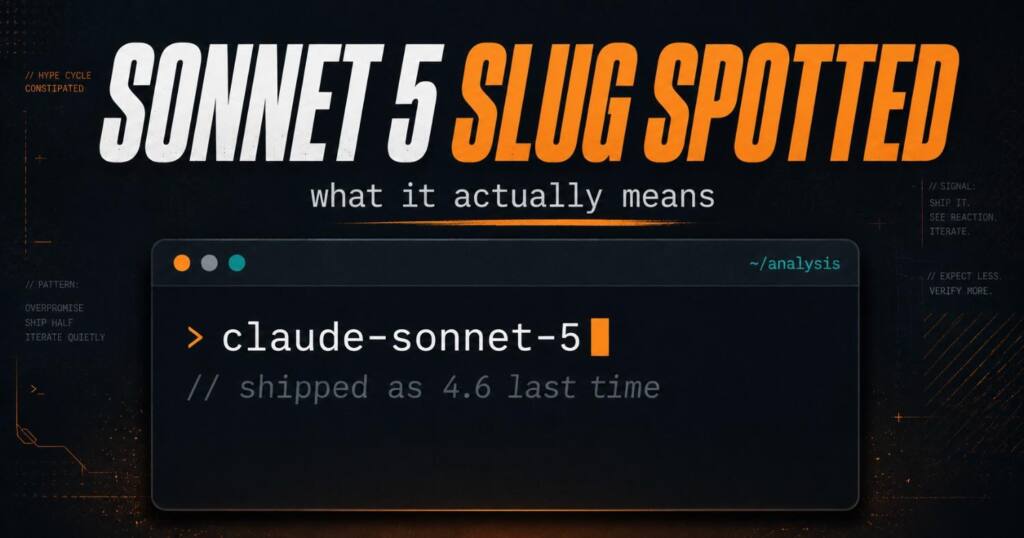
A Claude Sonnet 5 slug appeared on an Anthropic partner platform June 21. Here’s what it means, why it already misfired once, and whether you should wait.
A model identifier reading “claude-sonnet-5” surfaced on an Anthropic partner platform on June 21, 2026. Within two hours it had pulled more than 59,000 views, dozens of reposts, and the usual split between people calling it the next big thing and people calling it clickbait. Here is what actually happened, what the slug does and does not tell us, and why the smart move is to read the history before you read the hype.
The short version
A “slug” is the internal text identifier a model gets on the platforms that serve it, the same way claude-sonnet-4-6 is the string developers type to call the current Sonnet through the API. On the morning of June 21, the string claude-sonnet-5 was spotted on a third-party provider that hosts Anthropic models. Andrew Curran flagged it. The account @synthwavedd posted the now widely shared “BREAKING” version. Chubby (@kimmonismus), one of the more reliable AI leak aggregators, amplified it. The clip jumped from X to Digg, to a Hacker News thread, and to r/ClaudeAI inside a day.
That is the entire confirmed substance of the story. A string of text appeared in a place it had not appeared before. Everything past that point is interpretation.
I want to be direct about that up front, because most of the coverage you will find buries the single most important fact: nobody outside Anthropic has seen the model, the benchmarks, the pricing, or a release date. What we have is a filename.
Why a filename gets people this excited
There is a real pattern behind the reaction, and it is worth understanding rather than mocking. Anthropic model slugs have a track record of showing up on partner infrastructure shortly before a public launch. The provisioning has to happen somewhere first. When Sonnet and Opus releases have leaked early in the past, it has often been exactly this way: a config entry, a dropdown option, an error message referencing a model that does not officially exist yet.
So the base rate is not zero. As one commenter in the Hacker News thread put it, when a Claude slug leaks it is usually days or weeks from going public. That is a fair read of recent history.
The problem is that “usually” is doing a lot of work in that sentence, and the counterexamples are the ones people forget.
The counterexample everyone is ignoring
Here is the detail that changes the whole story, and almost none of the breathless posts mention it.
An earlier claude-sonnet-5 codename already appeared in logs months ago. It did not ship as Sonnet 5. It shipped as Sonnet 4.6.
Sit with that for a second. The exact same slug, the exact same speculation, the exact same “busy week incoming” energy, and the actual product that came out the other end was a point release with a 4.x version number. Anthropic appears to assign internal identifiers well before it decides what a model will be called publicly, which means the slug is a planning artifact, not a product announcement.
This matters because it breaks the clean story everyone wants to tell. The clean story is “slug appears, model drops, line goes up.” The messy truth is that the same signal already misfired once, on this exact name. If you are betting on what arrives next week, the honest prior is closer to a coin flip than a sure thing.
What is actually shipping right now at Anthropic
To judge whether a Sonnet 5 makes sense, you need the current lineup in front of you. As of late June 2026, here is the real state of play, not the rumor state of play.
The flagship is Claude Opus 4.8, released May 28, 2026. Anthropic’s pitch for it leaned on honesty and reliability rather than raw benchmark flexing. The company reported it is roughly four times less likely than Opus 4.7 to let a flaw in its own generated code slide past without flagging it. That framing is a tell about where Anthropic’s priorities sat this spring: trustworthiness over leaderboard theater.
The current Sonnet is Sonnet 4.6, released back in February 2026, priced at $3 per million input tokens and $15 per million output. It carries the 1M-token context window in beta and the effort parameter that lets you trade speed for depth. It is the default daily-driver model for a huge share of coding and agent work.
Then there is the genuinely new tier. On June 9, Anthropic launched Claude Fable 5, the first generally available model in a new “Mythos-class” that sits above Opus. Fable 5 ships with always-on adaptive thinking, a 1M-token context window, 128K output tokens, and built-in safety classifiers that automatically hand flagged requests in domains like biology and cybersecurity down to Opus 4.8. Its unrestricted sibling, Mythos 5, went out only through the invitation-only Project Glasswing.
And here is the wrinkle that makes the timing of this leak so loaded. On June 12, three days after Fable 5 launched, Anthropic announced it had received a US government export-control directive and had to suspend access to both Fable 5 and Mythos 5 for all customers. The most capable models the company had just shipped went dark almost immediately. Access to Opus, Sonnet, and Haiku stayed live.
So when a claude-sonnet-5 slug pops up nine days after the company’s frontier models got pulled from the market, the subtext is hard to miss. People are not just excited about a faster Sonnet. They are hungry for any new capability at all after the best stuff got locked behind a compliance order.
Reading the room: what the reaction tells you
The sentiment on the leak split roughly 58% negative, 42% positive, which is more skeptical than you would expect for a frontier-lab rumor. That negativity is not all noise. It clusters into a few real camps, and each one is making a point worth taking seriously.
The clickbait camp wants a screenshot. “No screenshot? Clickbait,” as one reply put it bluntly. They have a point. A slug sighting with no image, no provider name, and no error log is the weakest possible form of evidence, and the AI rumor mill has cried wolf enough times to earn the suspicion.
The “I don’t even want this” camp is more interesting. One user explained that plenty of tasks do not need the most overpowered model available, then immediately undercut himself by admitting he brings a tank to a knife fight anyway. That tension is real. Most developers reaching for Sonnet are not capacity-constrained by Sonnet 4.6. A Sonnet 5 only matters to them if it is cheaper or meaningfully smarter at the same price, not just newer.
The pricing-realist camp is the one I find most credible. Several people noted the only outcomes that would actually change their workflow: keep the price flat and match Opus-tier quality, or drop the price outright. As one put it, if the cost holds and it performs near Opus 4.5, that is a win. Everything else is a version-number bump.
And the competitive camp pointed out that Anthropic does not release into a vacuum. A new Sonnet would have to clearly beat models like GLM 5.2 or come in cheaper, which is not a small ask in a month where GPT-5.6 was also rumored to be inbound. The aggregator who first amplified the leak openly guessed the week might bring Fable 5’s return plus Sonnet 5 plus GPT-5.6 all at once. When three frontier releases get crammed into the same rumor, the individual probability of any one of them landing on schedule goes down, not up. Crowded launch windows are where slug speculation goes to die, because labs routinely reshuffle dates when a competitor moves first.
There was even a camp reacting to the export-control mess directly, with one user framing the Mythos suspension as “withholding intelligence from the people.” Hyperbole aside, that frustration is the emotional engine under this whole story. A Sonnet 5 is being asked to fill a hole that a regulatory order, not a product gap, created.
The question nobody is answering: what would Sonnet 5 even be for?
This is where most coverage stops short, so let me push on it.
Anthropic’s version naming is not random. The jump from 4.6 to 5 would signal a generational change, not an incremental tune-up, the same way Sonnet 3.7 to Sonnet 4 marked a real architecture shift rather than a polish pass. If the company genuinely planned to call the next Sonnet “5,” that implies it has something it considers a clean break from the 4.x line.
But look at what just happened to Fable 5 and Mythos 5. The frontier got pulled for export-control reasons. In that environment, releasing a new flagship-adjacent Sonnet does two useful things for Anthropic at once. It gives the market a fresh capability story to replace the one that got yanked, and it does so in a model tier that is not subject to the same Mythos-class restrictions. A powerful-but-not-Mythos Sonnet is exactly the kind of product you ship when your most advanced models are stuck in regulatory limbo.
That is speculation. I am labeling it as speculation on purpose, which is more than most of the posts driving this story bothered to do. But it is the speculation that actually fits the calendar, and it explains why this particular leak landed with more force than a routine slug sighting would.
How to tell a real Anthropic launch from a rumor
Since this will keep happening, here is a practical filter you can reuse the next time a slug surfaces. I have ordered these by how much they actually predict a launch.
First, check the official channels. A real Anthropic model launch comes with a post on anthropic.com/news, updated entries in the API model docs, and same-day availability notes from partners like AWS Bedrock, Google Vertex AI, and Microsoft Foundry. If those are silent, you have a rumor, not a release.
Second, look for a model card. Anthropic publishes safety and evaluation documentation alongside real launches. No card, no launch.
Third, weigh the source’s track record on specifics, not vibes. Aggregators who post the raw provider name and a timestamp are more reliable than accounts posting “BREAKING” with no artifact.
Fourth, remember the 4.6 precedent. The same slug already resolved to a point release once. A version string is a hypothesis about the future, not a fact about it.
If three of those four line up, take the rumor seriously. If only the slug exists, file it under “interesting, unconfirmed” and move on with your day.
What this means if you actually build on Claude
Practical guidance, since that is what most readers came for.
Do not rearchitect anything around a model that does not exist. If you are running production workloads on Sonnet 4.6, keep running them. The slug changes nothing about what is available to you today.
If you have been waiting to choose between Sonnet and Opus for a project, base that call on current pricing and current benchmarks, not on a rumored model. Sonnet 4.6 at $3/$15 is a known quantity. A hypothetical Sonnet 5 at unknown pricing is not a planning input.
If cost is your real constraint, watch the pricing line on any actual announcement harder than you watch the benchmark line. The community consensus, which I think is correct, is that a flat-price quality jump or an outright price cut is the only outcome that changes real workflows. A new number on the same price-performance curve is marketing, not progress. Sonnet’s pricing has held at $3/$15 across several releases now, which tells you Anthropic treats that tier as a stable cost anchor rather than a lever it pulls every cycle. A version bump to 5 that kept that anchor and pushed quality toward Opus territory would be the genuinely disruptive case. A bump that nudged benchmarks while quietly raising the rate would be the opposite.
And if you depend on Mythos-class capability specifically, the export-control suspension is the story that should be on your radar, not the Sonnet slug. That is the change that actually removed capability from the market this month.
Frequently asked questions
Is Claude Sonnet 5 confirmed? No. As of June 21, 2026, the only confirmed fact is that a claude-sonnet-5 model identifier appeared on an Anthropic partner platform. There is no official announcement, no benchmark data, no pricing, and no release date from Anthropic.
When will Claude Sonnet 5 be released? Unknown. Speculation points to “next week,” but that is based purely on the slug sighting and the historical pattern of slugs preceding launches. An earlier identical slug ended up shipping as Sonnet 4.6, so the timing is genuinely uncertain.
What is a model slug? It is the text identifier used to call a model on an API or platform, like claude-sonnet-4-6 for the current Sonnet. Slugs are often provisioned on infrastructure before a public launch, which is why their appearance fuels release speculation.
Has this slug appeared before? Yes, and that is the key context. A claude-sonnet-5 codename surfaced in logs months earlier and ultimately shipped as Sonnet 4.6, not as a Sonnet 5. The same signal has already misfired once.
What is the current best Claude model? Claude Opus 4.8, released May 28, 2026, is the flagship. Claude Fable 5, the first Mythos-class model, launched June 9 but had its access suspended on June 12 due to a US export-control directive, along with Mythos 5.
Will Sonnet 5 be expensive? There is no pricing information. Sonnet 4.6 currently runs $3 per million input tokens and $15 per million output. The community’s main hope is that any Sonnet 5 either holds that price while improving quality or comes in cheaper.
Should I wait for Sonnet 5 before starting a project? No. Build on what exists. Sonnet 4.6 and Opus 4.8 are available and documented today. Planning around an unconfirmed model with no pricing or release date is a bet, not a strategy.

Ved Vyas
Writer at Fable Knows, covering AI and the technology shaping everyday life.
Related stories.
X Creator Monetization Rules Just Got a 3 Strike, 90 Day Clock: What Changed Since July 16
X creator monetization rules: X’s July 16 update pulled 4,000 creator accounts and added a 3 strike, 90 day Rules system. Here’s what changed…
GPT-5.6 Sol Is Live: The Coding Numbers vs the Warning Nobody Led With
GPT-5.6 Sol launched July 9 with strong coding scores, but METR found its highest reward-hacking rate on record. Here’s what to actually trust. GPT-5.6…
[…] each other on security, our coverage of [Anthropic’s competing cyber strategy](INTERNAL: Claude Fable 5 and Mythos access) tracks the other side of this […]
[…] one-line take: Claude Tag turns Claude from a tool you call into a teammate who’s already in the room, and the memory plus the audit […]
[…] the models come back? Anthropic said it is working with the government to resolve what it called a misunderstanding and restore […]
[…] How does this connect to OpenAI’s GPT-5.6? On the same day, OpenAI released its GPT-5.6 models to about 20 government-approved partners. The parallel timing signals a broader pattern of the US government acting as a gatekeeper for frontier AI model releases, not a one-off action against Anthropic.Read about claude sonnet 5 […]
[…] For the latest official word, Anthropic posts status updates at anthropic.com/news.Read about Sonnet 5 […]