Claude Tag: 4 Powerful Ways Anthropic’s AI Joins Your Slack in 2026
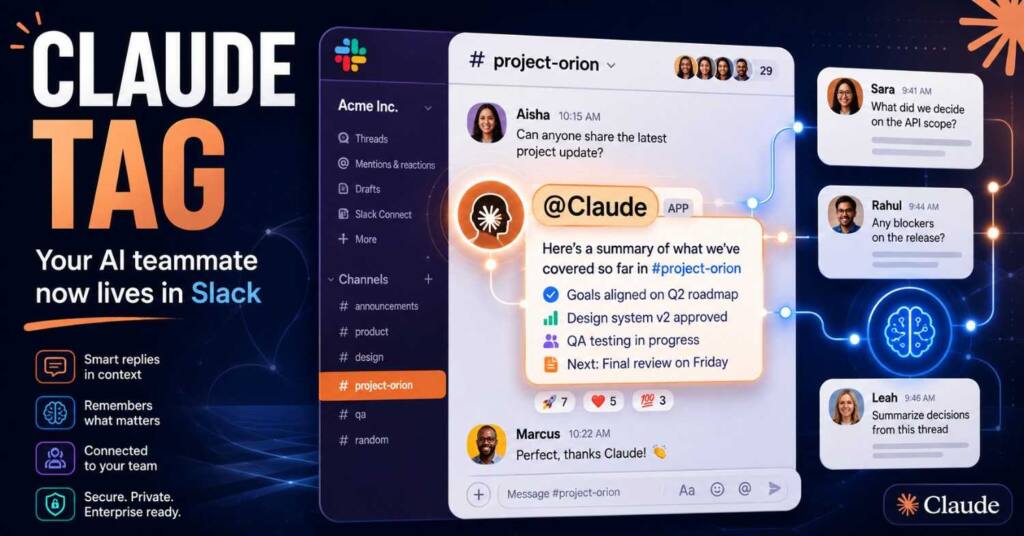
Claude Tag puts Anthropic’s AI inside Slack as a teammate that remembers context, acts on its own, and bills by usage. See setup, cost, and the migration date.
Anthropic just put an AI teammate inside Slack and started letting it remember things. Not a chatbot you ping for a quick answer. A coworker that follows your channels, keeps context for days, and pings you back when a thread goes quiet.
That product is Claude Tag. It shipped June 23, 2026. If you run a team on Slack, this is the launch worth ten minutes of your attention this week, because it changes the unit of work from a person asking a question to a team handing off a job.
Here’s the short version of why it matters, then everything you actually need to set it up, control the cost, and decide whether to migrate.
What Claude Tag actually is
Claude Tag is Anthropic’s way of dropping Claude into your team’s Slack as a working member rather than a lookup tool. You type @Claude in a channel, hand it a task in plain language, and it breaks that task into stages and works through them with whatever tools you’ve connected. When it finishes, it replies in the thread with what it built.
The difference from the old Claude in Slack app comes down to one word: memory. The previous integration answered whatever you asked and then forgot you existed. Claude Tag follows along in its channels, builds context about the work, and stops making you re-explain the project every single morning. Anthropic frames it as the next step in the evolution of Claude Code, a version of the model that is more proactive and built to work with a whole team instead of one person in one chat.
It runs on Opus 4.8. It’s in beta right now for Claude Enterprise and Team customers, and it lives in Slack first because that’s where collaborative work already happens. Anthropic has said it wants to expand to other places teams work, but Slack is the starting line.
One number from the announcement stuck with me. Anthropic says 65% of its own product team’s code is now created by the internal version of Claude Tag. That’s not a vendor flexing a demo. That’s a company telling you how it actually ships software now.
The four things that make it different
Tagging Claude in Slack isn’t new. What changes the feel of it is a set of behaviors that move it from “tool you summon” to “teammate who’s already here.”
It’s multiplayer. Inside a given channel, there’s one Claude that everyone talks to. Anyone can see what it’s working on and pick up the conversation from where the last person dropped it. That sounds small. It isn’t, once you’ve watched a teammate hand off a half-done task at 6pm and someone in another timezone finish it the next morning without a single status meeting in between.
It learns over time. As Claude follows its channel, it stops needing the backstory. Grant it permission and it can pull context from other channels and data sources too, so it has the tacit knowledge a good colleague picks up by hanging around. It won’t report from private channels, which is the boundary you’d want it to respect.
It takes initiative. Turn on “ambient” mode and Claude keeps you posted on things it thinks you need to know, flagging relevant information from across its channels and connected tools and chasing threads or tasks that went quiet without anyone asking it to. This is the part that feels genuinely different. Most AI tools wait. This one nudges.
It works asynchronously. Set it a task and go do something else while it runs. It can even schedule work for itself and pursue a project over hours or days. Anthropic says its own teams now spend much more time delegating to many Claudes in parallel, which is a strange sentence to read and a stranger one to imagine as a normal workday.
You can also DM it. In a direct message it responds privately using your own connected tools, the personal stuff you’ve set up on your account.
How channel tagging differs from a DM
This trips people up, so it’s worth being plain about it. There are two modes, and they bill differently and use different identities.
When you tag @Claude in a channel, it acts under your organization’s identity, using the tools and access an admin set up for that channel, and the work is billed to the organization. DM @Claude instead and it uses the capabilities you’ve enabled on your own account, like web search and your personal connectors, and that work bills to you. Same model, different identity, different invoice.
There’s also a third surface most coverage skips: an AI assistant panel. Click the Claude icon in Slack’s assistant header and a panel opens on the right side of your window, so you can reach Claude from anywhere in the app without jumping to a specific channel.
Setting up Claude Tag, step by step
Anthropic built this for organizations, so access to sensitive data and tools is tightly controlled by design. Only a Primary Owner or Owner can set it up. The Admin role can’t, which surprises people, so check who actually holds Owner before you go promising your team a Friday rollout that nobody with the right permissions can actually perform.
After the Claude app is installed, the setup runs in four moves:
- Pair Claude Tag with your Slack workspace.
- Give Claude access to the tools and repositories it should use.
- Set a limit on your organization’s monthly spend.
- Test Claude in a private channel to confirm it works before you let the whole company loose on it.
Think of the setup as creating separate Claude identities for separate uses. Everything, including memory, stays scoped to the channels an admin defines. A Claude set up for sales work won’t pass memories to one set up for engineering, and engineers won’t get access to sales data or tools through it. That separation is the whole security model, and it’s the reason this can go into a real company instead of just a startup’s open channel.
Once permissions are set, everyone can start tagging right away. No per-person setup. The channel is ready, the team is ready.
What it costs and how to keep the bill sane
Claude Tag is consumption-based. You pay for usage, not per seat, which is a meaningful distinction if you’ve ever watched a per-seat tool’s invoice balloon as headcount grows. Spend tracks what the model actually does.
Owners control cost from the admin console with a few levers. There’s an organization-wide limit, a hard cap on total Claude Tag spend that simply can’t be exceeded. There are per-channel limits you can set on top of that cap, and new channels inherit a default. Admins get threshold alerts at 75% and 95% of any limit, and a per-channel spend breakdown sits on the same page so nothing is a mystery at month end.
The behavior at the limit is the part I like. Work that would push past a limit gets declined, never silently cut short halfway through a task. A blocked person can request more from their admin without leaving Slack, and the alert tells them whether the limit or the available balance caused the block. No half-finished output. No guessing why Claude stopped.
To get the whole company trying it, Anthropic is issuing an introductory launch credit to eligible Enterprise and Team organizations. So the first taste is on the house, within reason.
Permissions, memory, and the audit trail
Access works in three nested levels, and each one inherits the permissions and memory of the level above. Organization-wide credentials and repositories apply everywhere Claude Tag is installed. Workspace access applies to every public channel in a Slack workspace and inherits the org-wide grants. Private channel access adds extra credentials or repositories on top, which is how you keep sensitive connections scoped to a smaller group. A channel set up for legal work keeps its tools and memory walled off from an engineering channel.
Memory is held per channel and per workspace, and admins can view, edit, and delete it. That matters for anyone who’s nervous about an AI quietly accumulating company knowledge it shouldn’t.
The audit story is genuinely thorough. An Audit view under Organization settings lists every scheduled and one-time task across the org, plus every network call made under the agent’s identity. Each action is also traceable in the tool where it happened. Slack posts come from the Claude app, and commits and pull requests show the Claude GitHub App as the author with a link back to the Slack thread that kicked them off. In any channel you can literally ask “@Claude what triggers do you have set up here?” to see and switch off standing work. That last one is the kind of control most agent products forget to ship.
The migration deadline you can’t ignore
If your team already uses Claude in Slack, here’s the date to write down. Claude in Slack switches over to the Claude Tag experience on August 3, 2026. Administrators can opt in to migrate within a 30-day window, and Claude Tag replaces the existing app rather than running beside it.
So this isn’t a “maybe we’ll try it next quarter” launch for existing users. The old app has a clock on it. If you’re on Claude in Slack today, the practical move is to read the official Claude Tag setup documentation, confirm who your Primary Owner is, and run a private-channel test well before August.
Where this fits in the enterprise AI fight
Claude Tag didn’t ship in a vacuum. The reason it exists is the same reason every big lab is suddenly obsessed with the same thing: context. A model that knows nothing about your company is a clever intern on day one, forever. A model that remembers your projects, your tools, and your decisions is something closer to staff.
Anthropic isn’t alone in chasing that. Microsoft has Graph, surfaced through Copilot and Work IQ. Glean is building an intelligence layer that sits between the model and your enterprise data, while Snowflake and Databricks are positioning their platforms as the back end that holds the tacit organizational knowledge agents tap into. Everyone is racing to own the context layer. Whoever owns it owns the workflow.
The timing also lines up with Anthropic’s business. The company confidentially filed for an IPO expected later this year, and enterprise revenue is steadier than consumer revenue. By Ramp’s AI Index, drawn from spending data across more than 50,000 US companies, Anthropic pulled ahead of OpenAI in May, with 34.4% of firms holding a Claude subscription against 32.3% on OpenAI’s tools, and Ramp credits Claude Code as the main engine of that growth. Claude Tag is the logical next push: take the thing driving adoption and wire it into the place teams already live.
If you want the broader backdrop on how Anthropic’s frontier models keep escalating, our breakdown of [Claude Fable 5](INTERNAL: Claude Fable 5) covers the capability tier sitting above the Opus model that Claude Tag runs on.
Honest limitations worth naming
I’m not going to pretend this is finished. It’s beta, and beta means rough edges.
It’s Slack-only for now. If your team lives in Microsoft Teams or Google Chat, you’re waiting, and “the goal is expansion” is not a ship date.
It’s Enterprise and Team only. Solo users and Pro subscribers don’t get it yet. This is squarely an org product.
Consumption pricing cuts both ways. Pay-for-usage is fair when usage is light and genuinely scary when an ambient agent is humming across a dozen busy channels. The spend caps exist precisely because this is a real concern, and the smart move is to set conservative per-channel limits first and loosen them once you see the actual burn.
And there’s the quieter point the TechCrunch coverage made plainly: an always-on agent learning your company one Slack message at a time is, by design, building a deep map of how your organization works. That’s the feature. It’s also a thing worth a deliberate conversation with whoever owns security and data governance before you flip on ambient mode across sensitive channels. The per-channel scoping and audit log are built for exactly that conversation. Use them.
Should you turn it on?
If you’re on Claude Enterprise or Team and you already use Claude in Slack, you don’t really have a “no” option past August 3, so the real question is how fast you move and how tightly you scope it. Start with one channel, set a low spend cap, keep ambient mode off until you trust it, and widen from there.
If you’re evaluating Anthropic for the first time, Claude Tag is a strong reason to look, but the honest entry point is still Claude Code for most teams, since that’s what’s actually driving the adoption numbers. Claude Tag is the multiplayer layer on top of that momentum. For a sense of how the orchestration-and-agents trend is playing out across the industry, our piece on [Sakana Fugu](INTERNAL: Sakana Fugu) covers the model-coordination angle from a different direction.
The one-line take: Claude Tag turns Claude from a tool you call into a teammate who’s already in the room, and the memory plus the audit controls are what make that idea safe enough to put in a real company. Whether that’s exciting or unsettling probably depends on how you feel about an AI that remembers what you said three days ago. It’s both, honestly.
Frequently asked questions
What is Claude Tag?
Claude Tag is Anthropic’s Slack-based AI teammate, launched June 23, 2026. You tag @Claude in a channel to hand it a task, and it works under your organization’s identity, remembers context across days, and can follow up on its own. It runs on Opus 4.8 and is in beta for Claude Enterprise and Team plans.
How is Claude Tag different from the old Claude in Slack?
It’s the next generation of the same experience in the same place. The big additions are persistent memory across days, the ability to schedule its own follow-ups, proactive ambient check-ins, and acting under its own scoped identity. The old Claude in Slack app switches over to Claude Tag on August 3, 2026.
How much does Claude Tag cost?
It’s consumption-based, so you pay for usage rather than per seat. Owners set an organization-wide hard cap plus optional per-channel limits, get alerts at 75% and 95%, and see a per-channel spend breakdown. Eligible Enterprise and Team orgs get an introductory launch credit to try it.
Who can set up Claude Tag?
Only a Slack workspace’s Primary Owner or Owner can set up access and channels. The Admin role can’t. Channel tagging is billed to the organization, while direct messages with Claude are billed to your own Claude account.
Is Claude Tag secure for sensitive data?
Access and memory are scoped per channel, so a Claude set up for one team can’t pull data or memories from another. Admins can view, edit, and delete what it remembers, and an audit view logs every task and network call, with actions traceable back to the Slack thread that started them. It does not report from private channels.
Does Claude Tag work outside Slack?
Not yet. It launched on Slack first, and Anthropic has said it intends to expand to other places teams work, but there’s no announced date for other platforms.

Ved Vyas
Writer at Fable Knows, covering AI and the technology shaping everyday life.
Related stories.

Seedance 2.5: 5 Powerful Upgrades Confirmed for July 2026
Seedance 2.5 is confirmed: ByteDance revealed 30-second clips, 50 reference inputs, and an early July launch. See every upgrade and what it means. (154…
GPT-5.5-Cyber: 7 Powerful Upgrades Beating Mythos 5 in 2026
OpenAI’s GPT-5.5-Cyber model just took back the security crown, and the fixing pipeline matters more than the score. On June 22, 2026, OpenAI stopped…