SpaceX Bought Cursor for $60 Billion. The Real Buyer Is xAI.
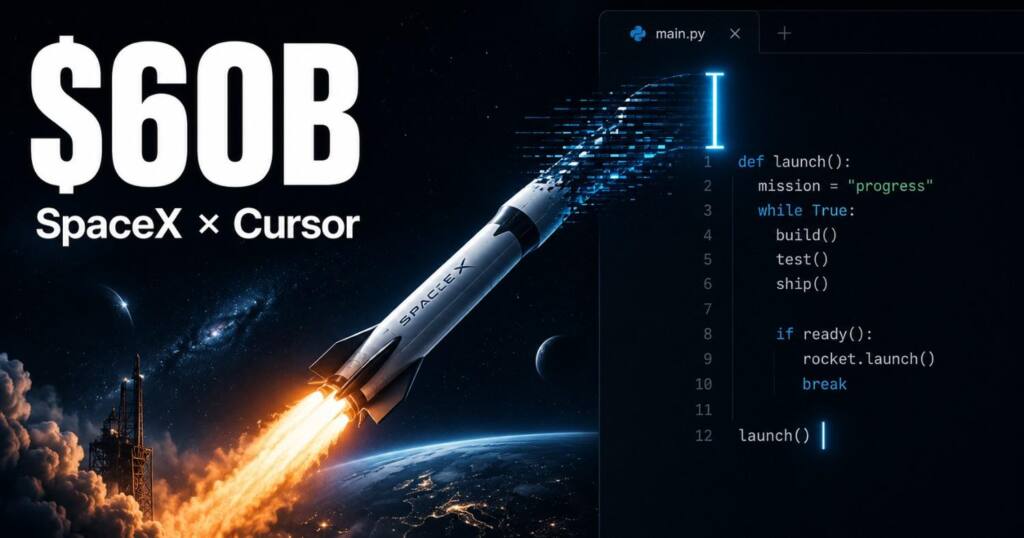
On Tuesday, SpaceX confirmed it is acquiring Anysphere, the startup behind the AI coding tool Cursor, in an all-stock deal worth $60 billion. The number alone would be the headline on any normal week. This was not a normal week. The announcement landed four days after SpaceX went public in a Nasdaq debut that valued the company north of $2 trillion and briefly turned Elon Musk into the world’s first trillionaire on paper.
So the sequence matters. Go public on Friday. Spend $60 billion of freshly minted public stock on the following Tuesday. If you want to understand this deal, start there, because the timing is the strategy.
What actually happened
Anysphere builds Cursor, an AI coding assistant that writes, edits, and debugs software alongside human developers. The company launched in 2022. By this spring it was posting roughly $2.6 billion in annualized business-to-business revenue, with enterprise sales climbing fast. Those are not startup numbers. That is a real software business with real corporate customers paying real money.
SpaceX is buying all of it with stock. The merger is expected to close in the third quarter of 2026.
Here is the part the one-paragraph news alerts skipped. SpaceX did not decide to buy Cursor on Tuesday. It locked the company up back in April, before the IPO, with a deal structure that reads more like a chess move than a partnership. SpaceX secured an option: either acquire Cursor for $60 billion in stock later in the year, or walk away and pay a $10 billion breakup fee. Read that again. The penalty for not buying Cursor was ten billion dollars. That clause did two things at once. It signaled to the market that SpaceX was serious about AI ahead of its IPO roadshow, and it effectively froze Cursor in place.
Why did freezing it matter? Because Cursor was days from closing its own $2 billion funding round, led by Andreessen Horowitz, Thrive, and Nvidia, at a $50 billion valuation. SpaceX’s offer arrived and preempted the whole thing. A $60 billion buyout beats a $50 billion fundraise, and the founders took the exit. The venture round never closed.
Why a rocket company wants a code editor
It does not, really. xAI does.
This is the piece that makes the deal legible. In February, SpaceX merged with xAI, Musk’s artificial intelligence company and the maker of the Grok chatbot. So when “SpaceX” buys an AI coding startup, the operative buyer is the AI division now sitting inside SpaceX. That division has a problem. In the one corner of AI where companies have found clear commercial traction, automated coding, xAI has been losing. OpenAI’s Codex, Anthropic’s Claude, and Cursor itself have spent two years pulling developers in. Grok has not been part of that conversation.
You can close a gap like that two ways. Build for years and hope to catch leaders who are also sprinting, or buy the company that already won the customers. Musk chose the checkbook. Cursor brings xAI an installed base of paying developers, $2.6 billion in revenue, and a product enterprises already trust. xAI brings Cursor something it was short on: compute. SpaceX has been pouring capacity into data centers, and Cursor’s models will get access to it.
That trade, distribution and revenue in one direction, raw compute in the other, is the actual logic of the deal. The rocket branding is a coincidence of corporate structure.
The $26 trillion number nobody should take literally
During its IPO process, SpaceX told investors it sees an addressable market for AI products worth $26 trillion. For scale, that is roughly the entire annual output of the United States economy.
I would treat that figure the way you treat a fishing story. It is technically a number, and it tells you something true about the teller’s ambition, but it is not a forecast you can bank. Calling your addressable market “the size of US GDP” is a way of telling public investors there is no ceiling here, spend accordingly. The $60 billion Cursor deal is the first concrete thing SpaceX has done to make that pitch look real. Buying actual revenue is more convincing than quoting a trillion-dollar slide.
The part SpaceX would rather you not dwell on
The AI division doing this shopping has had a rough year. It has been restructuring after a string of controversies, including its tools being used to generate non-consensual deepfakes of women and, in some reported cases, children. That is not a footnote. It is the context in which a struggling unit is being handed a $60 billion acquisition to fix its standing.
Buying Cursor does not erase those problems. Enterprise coding customers and content-moderation failures live in different parts of the business, and an acquisition that boosts the former does nothing for the latter. If anything, bolting a respected developer tool onto a division known lately for safety failures raises a fair question for Cursor’s existing customers: do you want your codebase flowing through infrastructure owned by that parent company? Some will not care. Some enterprise security teams absolutely will.
What it means if you actually use Cursor
If Cursor is in your daily workflow, the honest answer is that nothing changes tomorrow. Deals like this take quarters to close and longer to integrate. Your editor will keep working.
The medium-term questions are the ones worth watching:
Model lock-in. Cursor’s appeal has partly been that it lets you choose your model, including Claude and GPT. Under xAI ownership, expect pressure, subtle or otherwise, to route you toward Grok. Watch whether model choice stays open or quietly narrows.
Pricing. New owners with a $26 trillion market story tend to monetize. Free and cheap tiers are where acquisitions go to get squeezed.
Data. Where your code goes, and who can see it, is now governed by a different company with a different track record. Read the terms when they update. They will update.
None of this means you should panic-migrate. It means you should stop assuming Cursor is the independent tool you signed up for in 2022. It is now a line item inside a $2 trillion conglomerate.
The bigger signal
Strip away the specifics and this deal is a demonstration of something larger. The moment SpaceX had publicly traded stock, it started spending that stock to buy AI companies. That is the Tesla-era Musk playbook running again: use a sky-high market cap as a currency, acquire your way into a market you are behind in, and let the narrative do the financing.
The breakup-fee maneuver in April, the merger with xAI in February, the IPO on Friday, the $60 billion check on Tuesday. Lined up, they are not separate events. They are one continuous move to turn a launch company’s balance sheet into an AI acquisition engine. Cursor is the first big purchase. It will not be the last.
A rocket company bought a code editor. What it really bought was a head start in a race it was losing, and it paid with money that did not exist a week ago.
FAQ
How much did SpaceX pay for Cursor?
$60 billion, in an all-stock deal. The acquisition is for Anysphere, the company that makes Cursor.
When will the deal close?
SpaceX expects the merger to close in the third quarter of 2026.
Why is SpaceX, a space company, buying an AI startup?
Because SpaceX merged with Musk’s AI company xAI in February 2026. The AI division inside SpaceX is the real buyer, and it wants Cursor’s revenue, enterprise customers, and developer base to catch up in the AI coding market where Grok has lagged.
Was Cursor for sale?
Not exactly. Cursor was about to close a $2 billion funding round at a $50 billion valuation, backed by Andreessen Horowitz, Thrive, and Nvidia. SpaceX preempted that raise with a $60 billion buyout offer first floated in April, paired with a $10 billion breakup fee that effectively locked Cursor up.
Will Cursor still support models like Claude and GPT?
Unclear. That is the open question for users. Cursor’s multi-model flexibility has been part of its appeal, and xAI ownership creates an obvious incentive to favor Grok over time.
Does this affect Cursor users right now?
No immediate change. The deal has not closed. Watch for shifts in pricing, model availability, and data terms over the coming quarters.

Ved Vyas
Writer at Fable Knows, covering AI and the technology shaping everyday life.
Related stories.
X Creator Monetization Rules Just Got a 3 Strike, 90 Day Clock: What Changed Since July 16
X creator monetization rules: X’s July 16 update pulled 4,000 creator accounts and added a 3 strike, 90 day Rules system. Here’s what changed…
GPT-5.6 Sol Is Live: The Coding Numbers vs the Warning Nobody Led With
GPT-5.6 Sol launched July 9 with strong coding scores, but METR found its highest reward-hacking rate on record. Here’s what to actually trust. GPT-5.6…