GLM-5.2: The Proven Open Model 6x Cheaper Than GPT-5.5
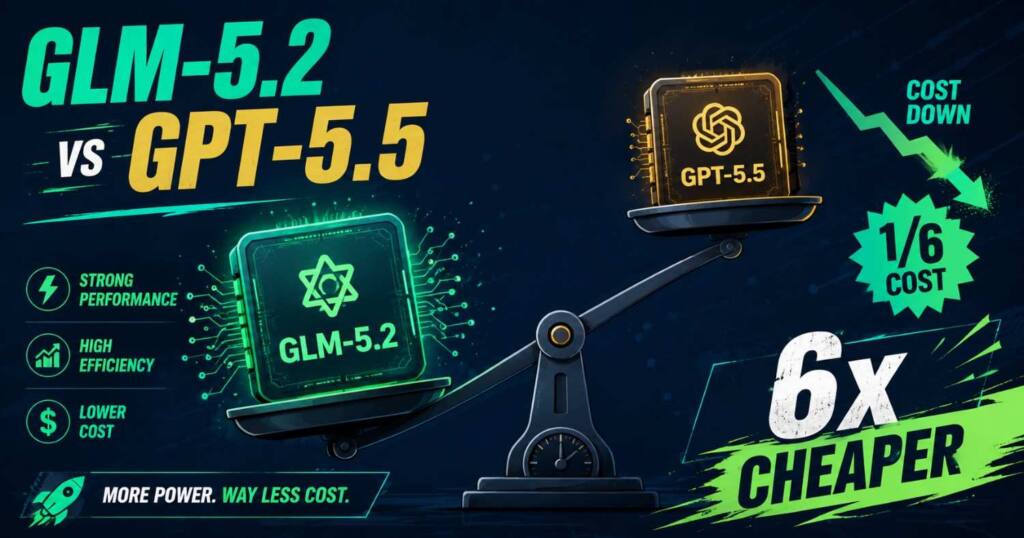
GLM-5.2 beats GPT-5.5 on coding benchmarks at a sixth of the price. See the honest numbers, the real cost math, and how to run the open model yourself.
On June 16, 2026, a Chinese lab shipped the thing the closed labs were hoping nobody would build this year. A frontier-grade coding model you can download, run on your own machines, and ship inside a commercial product with almost no strings attached. GLM-5.2 from Z.ai beats GPT-5.5 on several coding benchmarks that actually matter. It does it at roughly one-sixth the cost to run. If you write code or pay the people who do, this is the release that changes your invoice, not just the leaderboard.
Here is the honest version. What shipped, where the numbers hold, where the marketing runs ahead of reality, and whether you can really run this thing yourself.
What GLM-5.2 Actually Is
GLM-5.2 is the flagship model from Z.ai, the lab formerly known as Zhipu AI, a 2019 spinout from Tsinghua University. It is a Mixture-of-Experts design with somewhere between 744 and 753 billion total parameters, but it fires only about 40 billion of those on any single query. That routing is why a model this large answers at a reasonable speed and price. Each request gets sent to the slice of the network best suited to it, instead of waking all 753 billion parameters to fix one null pointer.
“Open weights” is the part people skim past, so be precise about it. The trained weights are public. You can download them, run them on your own hardware without calling anyone’s API, fine-tune them on your own data, and inspect the architecture. What you do not get is the training data or the training code, and the license still governs commercial use. In GLM-5.2’s case that license is a plain MIT one, live on Hugging Face under zai-org/GLM-5.2, with no acceptable-use bureaucracy bolted on. You can run it locally, modify it, and ship it commercially without asking permission.
The headline spec is context. GLM-5.2 ships with a usable 1 million token window, up from 200,000 in GLM-5.1. The word “usable” is doing real work there. Plenty of models claim a big context number and then forget what you told them past the halfway mark. Z.ai trained specifically on long, messy coding-agent trajectories so quality holds deep into a million-token task. You can drop a mid-sized codebase into one reasoning pass and have it stay coherent.
It also adds effort levels. Pick High for a balance of speed and quality, or Max when a problem is genuinely hard and worth more compute. That control matters because you pay for those tokens, and most tasks do not need maximum effort.
The GLM-5.2 Benchmark Numbers, Read Honestly
Most coverage this week quoted the wins and skipped the losses. The losses tell you just as much about where this model fits, so here are both.
The wins are real. On SWE-bench Pro, which throws real-world engineering tasks at a model, it scored 62.1 against GPT-5.5’s 58.6 and its own predecessor’s 58.4. On Terminal-Bench 2.1 it hit 81.0, up from 62.0 for GLM-5.1, making it the first open-weights model past 80 on that test and within a few points of Claude Opus 4.8 at 85.0. On FrontierSWE, which measures hours-long open-ended projects, it reached 74.4, ahead of GPT-5.5 at 72.6 and a single point behind Opus 4.8 at 75.1. On MCP-Atlas tool use it scored about 77, and on Humanity’s Last Exam with tools it hit 54.7, ahead of GPT-5.5’s 52.2.
Now the part nobody headlined. On the longest, hardest tests, Opus 4.8 is still clearly ahead. On SWE-Marathon, an ultra-long-horizon benchmark covering things like building compilers and optimizing kernels, the model scored 13.0 against Opus 4.8’s 26.0. Opus literally doubled it. On Tool-Decathlon and NL2Repo the gap is similar.
| Coding benchmark | GLM-5.2 | GPT-5.5 | Claude Opus 4.8 |
|---|---|---|---|
| SWE-bench Pro | 62.1 | 58.6 | 69.2 |
| Terminal-Bench 2.1 | 81.0 | 84.0 | 85.0 |
| FrontierSWE | 74.4 | 72.6 | 75.1 |
| MCP-Atlas | 76.8 | 75.3 | 77.8 |
| SWE-Marathon | 13.0 | 12.0 | 26.0 |
| HLE (with tools) | 54.7 | 52.2 | 57.9 |
So here is the summary the marketing dances around. GLM-5.2 is the second-best coding model in the world on long-horizon work. Second means second to Opus 4.8, which still owns the messiest, longest tasks. On the mid-length work that fills most real development days, GLM-5.2 trades blows with the frontier and beats GPT-5.5. On marathon tasks the gap is real and you will feel it. That distinction is the difference between a useful decision and a hyped one.
Why GLM-5.2 Costs a Sixth of GPT-5.5
Benchmarks get headlines. The pricing table changes behavior.
GLM-5.2 runs about $1.40 per million input tokens and $4.40 per million output, so call it $5.80 combined. GPT-5.5 charges $5.00 input and $30.00 output, around $35 per million. That is roughly six times more expensive for performance that, on a lot of coding work, is comparable or worse. Against Opus 4.8 at $5 input and $25 output, GLM-5.2 undercuts dramatically while landing within a point on several benchmarks.
Put it in concrete terms. Say an agent chews through 50 million input tokens and generates 10 million output over a heavy month on a large repo. On GLM-5.2 that is roughly $70 plus $44, about $114. The same volume on GPT-5.5 runs around $250 plus $300, about $550. Same work. A fifth of the bill. Scale that across a team running agents all day and the annual gap turns into headcount-sized money. For a solo builder it is the difference between a line item you barely notice and one you ration token by token.
Because the weights are MIT, there is a second pricing path the API numbers miss entirely. With the hardware, you self-host and pay only compute and electricity, no per-token meter. That is the thing closed labs have been bracing for. Not a model that wins every benchmark, but one that gets close enough on open weights that price becomes the whole conversation. If you want hosted access without managing infrastructure, Z.ai also sells a GLM Coding Plan starting near $12.60 a month for Lite, $50.40 for Pro, and $112 for Max, billed annually.
How to Run GLM-5.2 Yourself
Here is where most write-ups get lazy and just say “you can’t run a 753B model at home.” That is half wrong, and the half that is right is more interesting than it sounds.
The full GLM-5.2 weights are about 1.5TB, so no, you are not loading the raw model on a laptop. But quantized versions change the math. Unsloth’s dynamic GGUF builds shrink it hard. The 2-bit quant lands around 245GB on disk and fits a 256GB unified-memory Mac, or a single 24GB GPU paired with 256GB of system RAM using MoE offloading. The 1-bit quant fits in about 223GB. An 8-bit build needs roughly 810GB. So self-hosting is realistic for a workstation with serious memory, not a gaming rig.
The obvious worry with a 1-bit model is that it must be garbage. It is not. The reason is worth understanding. On top-1 accuracy the 1-bit quant scores around 76.2% while being 86% smaller than the full model, and the 2-bit hits about 82%. That 76% does not mean the model is wrong a quarter of the time or 24% dumber. “The capital of France is” still returns Paris at 100%. The 76% reflects how the model picks among interchangeable filler and stop words across a whole corpus, where several choices are all correct anyway. No gibberish. Just slightly different, still valid, phrasing.
The fastest way in is Ollama. One command, ollama run glm-5.2:cloud, and you are talking to it, and you can launch it straight into Claude Code, Codex, OpenClaw, or OpenCode with a single line each. For a fully local setup, llama.cpp or Unsloth Studio loads the GGUF directly, with recommended settings of temperature 1.0 and top_p 0.95. To stretch the context on consumer memory, quantize the KV cache; a q4_1 cache buys you roughly three times the context length for the same memory. Reasoning is on by default, and you can flip between High, Max, and no-thinking with a flag or a toggle.
What Makes GLM-5.2 Fast: IndexShare and Multi-Token Prediction
Two architecture pieces explain how a million-token window stays fast and affordable.
The first is IndexShare. At long context, sparse-attention models burn a lot of compute deciding which earlier tokens matter. IndexShare reuses one lightweight indexer across every group of four sparse-attention layers instead of computing a fresh one each time. At the full 1 million token length, Z.ai says that cuts per-token compute by 2.9 times. That single trick is much of why the long context is cheap enough to actually use.
The second is an improved multi-token prediction layer for speculative decoding. The model guesses several tokens ahead and verifies them in a batch, and the upgrade raises how many guesses get accepted by up to 20%. More accepted guesses means faster generation at the same quality. You do not need to care about either to use it, but they explain why the pricing is built into the architecture rather than a loss Z.ai is eating to buy market share. Worth knowing too: the GLM-5 line has been trained largely on non-Nvidia hardware, with GLM-5.1 reportedly trained entirely on Huawei Ascend chips, which matters for anyone thinking about supply-chain resilience.
Should You Switch to GLM-5.2?
Here is the decision, stripped of cheerleading.
Switch if your coding workload is high-volume and cost-sensitive, if most tasks are short-to-medium rather than hours-long marathons, or if open weights and self-hosting matter for compliance or supply-chain reasons. For a huge share of real development you will not notice a quality drop, and you will notice the bill. The timing helps too. A recent export control directive restricted foreign nationals from using one of Anthropic’s models, and that kind of geographic fencing makes enterprise buyers nervous about building on a model they might lose access to. An MIT-licensed open model sidesteps all of it.
Stay on Opus 4.8 if your work lives at the extreme end of long-horizon difficulty, the compiler-building, kernel-optimizing, multi-hour autonomous tasks where the benchmark gap is widest. If you are paying for the top one or two percent of capability and that margin pays for itself, GLM-5.2 is not yet a clean swap there.
Run both if you are doing this seriously. The smartest setup right now is routing. Send the bulk of your volume to GLM-5.2 for cost and escalate only the hardest tasks to Opus. The price spread is large enough that even a crude split saves real money while keeping a frontier model on call.
One caution. Benchmark scores depend heavily on the test scaffold and the exact prompting used to produce them, so treat any single leaderboard row as a starting point rather than a verdict. The numbers above come from Z.ai’s own evaluations and early third-party testing. They are credible and broadly consistent across sources. Still, your results on your codebase with your tooling are the only benchmark that actually decides this for you. Run a real task through it before you migrate anything important. For the full reasoning and agentic numbers, the official Z.ai documentation and the Unsloth GGUF page are the primary sources, and it is worth reading our earlier breakdown of [where the open and closed frontier stood last quarter](INTERNAL: GLM-5.1 or Claude Opus 4.8 comparison post).
GLM-5.2 FAQ
Is GLM-5.2 really free to use? The weights are free under MIT, so there is no licensing cost. You still pay for the hardware to run it, or for API access at about $1.40 per million input tokens and $4.40 per million output if you do not self-host.
Can I run GLM-5.2 on my own computer? A 2-bit quant fits a 256GB unified-memory Mac or a 24GB GPU with 256GB of RAM and MoE offloading. The full 1.5TB model needs enterprise clusters. Most individuals will use the API or Ollama, but a well-specced workstation can run a quantized build locally.
Does GLM-5.2 beat Claude Opus 4.8? On some benchmarks it comes within a point, like FrontierSWE at 74.4 versus 75.1. On the hardest long-horizon tests like SWE-Marathon, Opus is still well ahead, sometimes double. GLM-5.2 is best read as the strongest open model and a close second overall, at a fraction of the price.
How big is the context window, really? One million tokens, trained to hold quality across that full length rather than just accept more input. That is up from 200,000 in GLM-5.1, enough to reason over an entire mid-sized codebase in one pass.
What coding tools support it? GLM-5.2 shipped with day-one support for more than 20 environments, including Claude Code, Cline, Kilo Code, OpenClaw, Codex, and OpenCode. Ollama runs it with one command.
What does a 1-bit quant cost you in quality? Less than the number suggests. The 1-bit build scores about 76.2% top-1 accuracy while being 86% smaller, and most of that gap is interchangeable phrasing, not wrong answers. For serious out-of-distribution work, a 4-bit or 5-bit build is closer to lossless.

Ved Vyas
Writer at Fable Knows, covering AI and the technology shaping everyday life.
Related stories.
X Creator Monetization Rules Just Got a 3 Strike, 90 Day Clock: What Changed Since July 16
X creator monetization rules: X’s July 16 update pulled 4,000 creator accounts and added a 3 strike, 90 day Rules system. Here’s what changed…
GPT-5.6 Sol Is Live: The Coding Numbers vs the Warning Nobody Led With
GPT-5.6 Sol launched July 9 with strong coding scores, but METR found its highest reward-hacking rate on record. Here’s what to actually trust. GPT-5.6…
[…] June 20, 2026, something happened that the closed AI labs have been quietly dreading. GLM-5.2, the open-weights model from Z.ai, climbed to first place on Design Arena’s single-round HTML […]
[…] Read about GLM 5.2 here […]