Apple Price Hike: 7 Brutal Increases as Chip Costs Soar
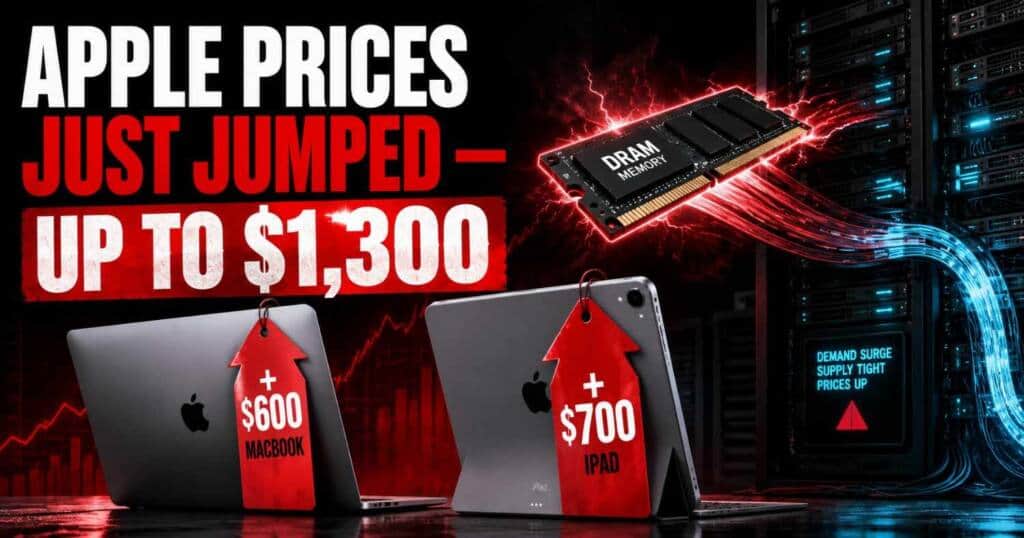
The Apple price hike raised Mac, iPad, and Xbox prices up to $1,300. See exactly what changed, why memory chips are to blame, and what to buy now.
On June 25, 2026, Apple did the thing it had spent months promising it would not do. It raised prices. Not a quiet $50 nudge on one accessory, but increases of $100 to $1,300 across Macs, iPads, and home gear, live worldwide the moment the online store flickered back up. The Apple price hike landed the same day Microsoft confirmed an Xbox increase, and both companies pointed at the same culprit. Memory chips have gone vertical, and the AI boom is the reason.
If you were planning to buy a MacBook, an iPad, or a console this year, this is the news that changes your math. Here is exactly what moved, why it moved, and what to actually do about it.
What the Apple Price Hike Actually Changed
Apple raised prices across its Mac and iPad lines, plus the HomePod, Apple TV, and Vision Pro. It left the iPhone, Apple Watch, and AirPods untouched for now. The increases were not subtle, and a few of them reset what “entry level” even means for the brand.
| Product | Old price | New price | Increase |
|---|---|---|---|
| MacBook Neo (entry) | $599 | $699 | +$100 |
| MacBook Air (512GB) | $1,099 | $1,299 | +$200 |
| MacBook Pro (1TB) | $1,699 | $1,999 | +$300 |
| iPad Air | $599 | $749 | +$150 |
| iPad Pro | $999 | $1,199 | +$200 |
| Mac Studio M3 Ultra | $3,999 | $5,299 | +$1,300 |
The Mac Studio took the worst of it, jumping $1,300 in a single stroke. The one that stings most for ordinary buyers is the MacBook Neo. Apple launched it in March at $599 specifically to fight cheap Windows laptops and Chromebooks, and it worked. Months later this Apple price hike erased that edge, pushing the Neo to $699 and handing Dell’s new $699 XPS 13 a fair fight it did not have a week ago. For a value pick, that single Apple price hike is the difference between a clear win and a coin flip.
Apple did not pretend the news was pleasant. The company said it had shielded customers from rising component costs for as long as it could, then admitted it had reached a point where it had to start raising prices. Apple called the demand spike an unprecedented challenge for the whole consumer electronics business, and added a line that tells you how fast this hit. In its words, it had never seen a component price climb this much, this quickly. That sentence is the real story behind the Apple price hike.
Why the Apple Price Hike Happened: RAMageddon
Here is the part the headlines skip. This is not a tariff story or a manufacturing hiccup. It is a deliberate reallocation of the world’s chip-making capacity, and Apple is just the most visible company caught in it.
Three firms, Samsung, SK Hynix, and Micron, make roughly 95 percent of the world’s DRAM, the working memory inside every phone, laptop, and console. Over the past year they have steered their fabs toward high-bandwidth memory, the stacked chips that feed AI accelerators in data centers. The reason is pure margin. One gigabyte of HBM eats about four times the wafer area of standard DRAM, and the data-center buyers signing long-term contracts pay premiums that consumer memory cannot match. Every wafer sold to an Nvidia server is a wafer that never becomes a memory stick for your laptop.
The result has a nickname now. RAMageddon. According to industry tracker TrendForce, DRAM contract prices rose as much as 98 percent in the first quarter of 2026, with another 58 to 63 percent climb forecast for the current quarter. Memory that used to be 15 to 18 percent of a PC’s build cost has ballooned toward 35 percent at companies like HP. AI workloads are expected to swallow around 20 percent of all DRAM wafer capacity this year. That is the engine behind the Apple price hike, and behind every other one coming. For the full supply picture, IDC’s memory shortage analysis lays out how AI reallocation pulled the floor out from under consumer chips, and our own
Tim Cook had been warning about this for weeks. In an interview before the increases, he said the situation had become unsustainable and that he had never seen anything like it in over forty years. When the supply chain that the rest of the industry envies cannot absorb the blow, that tells you the squeeze is real. The Apple price hike is what happens when even the strongest buyer runs out of room.
Microsoft, Dell, and Everyone Else
Apple grabbed the headlines, but it is not alone, and it was not even first.
Microsoft confirmed it would raise the price of its 512GB and 1TB Xbox consoles by $100 and $150 respectively, effective in August. The company said console storage and memory prices had already risen more than 2.5 times, and warned of another possible doubling by late 2027. Consoles get hit especially hard because they are sold on thin margins to begin with, so there is nowhere to hide the cost. If you read the Apple price hike as a one-off, Microsoft’s move on the same afternoon should correct that.
The PC makers are already moving too. Dell, HP, Lenovo, and Acer have all signaled or enacted increases, with Acer’s chairman saying the bill of materials on several products had risen so much that raising prices was the only option left. Some brands are taking a quieter route, freezing or cutting memory specs instead of lifting the sticker. IDC expects upcoming flagship phones to stay at 12GB of RAM rather than climbing to 16GB, breaking the long habit of yearly memory bumps. New gaming handhelds are reportedly shipping with less RAM and storage than last year’s models at the same or higher prices. Even Nvidia is said to be trimming GPU production as graphics memory rides the same wave.
For DIY builders the damage is already visible at retail. A 32GB DDR5 kit that sold for $90 to $120 in 2025 now starts around $350, when it is in stock at all. Micron quietly exited consumer memory earlier this year, retiring its retail brand to concentrate on enterprise AI parts. The message across the industry is consistent, and the Apple price hike is just the loudest version of it.
What the Apple Price Hike Means for the Stock and Margins
Wall Street did not love the surprise. Apple’s stock fell more than 6 percent on the day, its steepest single-day drop since the tariff shock of April 2025. Analysts and shoppers had braced for modest, incremental adjustments. Increases of $100 to $300 across core lines read as something more aggressive, and the market reacted to the demand risk rather than the margin protection.
The companies on the other side of this trade are printing money. Micron just reported revenue more than quadrupling year over year, with gross margin jumping from 39 percent to 84.9 percent in a single year, a figure that now tops Nvidia’s. That gap is the whole story in one statistic. The same shortage forcing the Apple price hike is handing memory makers the best quarter of their lives.
Not everyone is bearish on Apple. Wedbush’s Dan Ives kept an outperform rating and a $400 target, arguing Apple’s premium customers can absorb the increases without fleeing, and that its sheer purchasing scale still buffers margins better than rivals. The bet is that people who want a Mac will pay the new price. The risk is the buyer at the bottom of the range, the one the MacBook Neo was built to win, who now has cheaper options staring back. That is the quiet danger inside this Apple price hike. It is easiest to pass along at the top of the lineup and hardest to pass along at the bottom, which is exactly where Apple has been trying to grow.
What This Apple Price Hike Means If You’re Buying
The honest advice is uncomfortable. This is unlikely to get better soon, so waiting is mostly a gamble that the shortage reverses, and almost nobody tracking it expects that in 2026.
Research firms from IDC to Counterpoint put the earliest credible normalization in late 2027, with some forecasts stretching to 2028 or beyond. New fabs from Samsung and Micron will not reach full output until then. The memory on shelves today was bought under older, cheaper contracts. Whatever replaces it will be built at higher cost, which means Black Friday pricing on memory-heavy hardware could be higher than it is right now, not lower.
So if you genuinely need a machine, buying sooner rather than later is the defensible move, and the Apple price hike does not change that logic so much as confirm it. If you are upgrading a PC, a DDR4 platform like an older Ryzen or Intel build is far cheaper than jumping to DDR5 for similar gaming performance, so this is not the year to switch just to switch. If you want a Mac and can live with a current-generation configuration, locking in today’s price beats betting against the trend. And if you can stretch the life of what you already own with a repair or a clean install, that may be the smartest play of all while this lasts.
The next thing to watch is the iPhone. This round spared it, but Counterpoint estimates the component crunch could add roughly $200 to each unit, and expects increases of about $150 to $200 across the lineup once Apple’s long-term memory contracts expire. The current Apple price hike was the warning shot. The phone is where it gets personal for most people, and you can follow how that plays out in our ongoing [Apple hardware coverage](INTERNAL: iPhone or Apple coverage post).
Apple Price Hike FAQ
Which products did the Apple price hike affect? Macs, iPads, the HomePod, Apple TV, and Vision Pro all went up, by $100 to $1,300 depending on the model. The Mac Studio M3 Ultra rose the most, from $3,999 to $5,299. The iPhone, Apple Watch, and AirPods were not changed.
Why is Apple raising prices now? Memory and storage chips have spiked because Samsung, SK Hynix, and Micron are diverting production to high-bandwidth memory for AI data centers. That left far less supply for consumer DRAM, and Apple said it could no longer shield buyers from the cost.
Did the iPhone get more expensive? Not in this round. But analysts at Counterpoint expect a roughly $150 to $200 increase across the next iPhone lineup once Apple’s older memory contracts run out, so the reprieve is probably temporary.
Is Microsoft raising prices too? Yes. Microsoft confirmed Xbox increases of $100 on the 512GB model and $150 on the 1TB model, citing the same memory crunch, with the change taking effect in August. The Apple price hike and the Xbox increase share a single root cause.
When will memory prices come back down? Most research firms point to late 2027 at the earliest, and several stretch the timeline into 2028. New manufacturing capacity takes years to come online, so prices are expected to stay high through 2026.
Should I buy now or wait? If you need the device, buying now is the safer bet, since replacement inventory will be built at higher costs and analysts expect prices to climb rather than fall this year. If you can wait years, not months, the eventual normalization might reward patience.

Ved Vyas
Writer at Fable Knows, covering AI and the technology shaping everyday life.
Related stories.

Fable 5 Return: 5 Critical Things the Headlines Are Skipping
The Fable 5 return is close. What comes back, and at what price, is the part nobody is reporting clearly. Fifteen days after the…
Mythos 5 Is Back: US Frees Anthropic’s AI for 100+ Firms
Mythos 5 is cleared for 100+ US institutions after a 12-day block. See why the government froze Anthropic’s model, what triggered it, and what’s…