How to Write Suno AI Styles That Actually Work (Without Naming Artists) in 2026
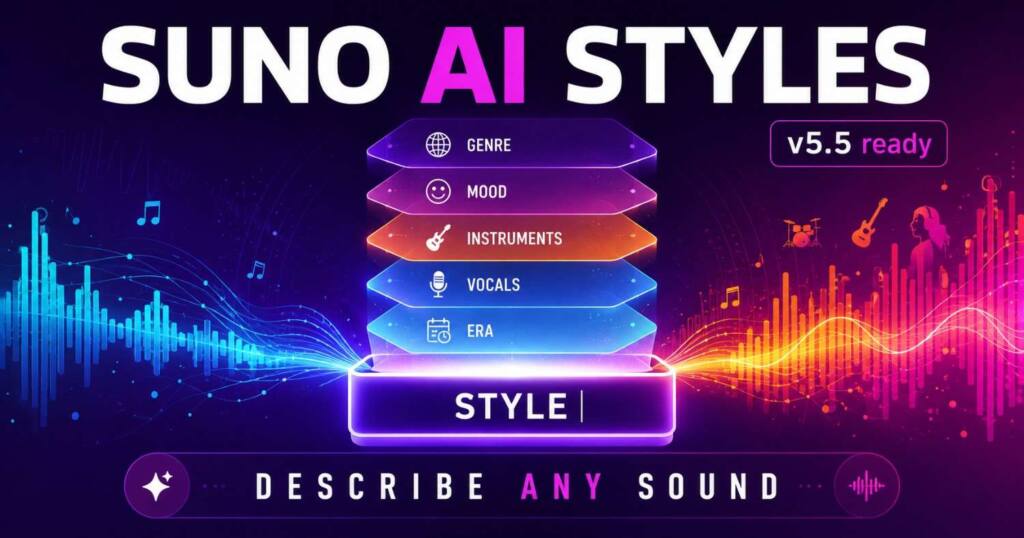
Master the Suno AI Styles field with a 5-layer formula, the genre and mood vocabulary that steers it, era cues, and why describing a sound beats naming an artist.
Stop wasting your Suno credits on unpredictable outputs and start generating exactly what you want on the first try. I just launched the Ultimate Suno AI Prompt Pack, featuring a mastery guide and 1,000 battle-tested prompts structured in a developer-ready JSON database. Grab it today to plug these proven formulas directly into your AI music workflow.
The style box is where your song is won or lost. Here is how to build style descriptions that work on the current Suno model, the genre and mood vocabulary that steers it, and why naming an artist is the one move that backfires.
Most people treat the Suno style field as an afterthought. They type “pop song” or “sad rap,” hit create, and then wonder why every result sounds generic and slightly off. The truth is that the style description does more to shape your track than almost anything else you do, and learning to write it well is the single biggest upgrade available to you.
This guide is about styles specifically, not lyrics, not song structure, but the art of telling Suno what your song should sound like. You will learn how to build a style description layer by layer, the vocabulary that actually moves the model, how to evoke a specific era or vibe, and the one common mistake that quietly sabotages results: trying to name a famous artist. By the end you will be able to describe almost any sound in a way Suno can reliably produce.
What the Style Field Actually Controls
Start with a clear mental model, because it changes how you write.
Suno splits your input into two jobs. The lyrics box controls what is sung and the song’s internal structure. The style box controls how it sounds: the genre, the instruments, the mood, the production, the vocal character. When people say their song “came out wrong,” the fix is almost always in the style box, not the lyrics.
The style field on the current Suno model holds up to 950 characters, which is a lot of room. But room is a trap. Stuffing it with every adjective you can think of confuses the model and produces muddy, conflicting results. The goal is not to fill the space. It is to resolve the handful of decisions that define your sound, clearly and without contradiction. A precise 15-word style description beats a rambling 150-word one almost every time.
Think of yourself as a director giving notes to a session band. You would not list forty contradictory instructions. You would name the genre, set the feel, call out the key instruments, and define the singer. That is exactly what a strong style description does.
The Five Layers of a Style Description
Every strong style description is built from the same five layers. Fill each one deliberately and your results stabilize immediately.
Layer one: the genre anchor. This is the foundation, and it matters more than everything else combined. Name one core genre, ideally with a subgenre or modifier for precision. Not “electronic” but “deep house.” Not “rock” but “90s grunge.” Not “hip hop” but “boom bap.” A single, specific genre anchor gives the model a clear lane to drive in. Stacking five genres is the fastest way to get a muddy, directionless track.
Layer two: the mood and energy. Tell Suno how the song should feel and move. This is where you set the emotional temperature: “melancholic and spacious,” “aggressive and driving,” “warm and nostalgic,” “tense, cinematic.” You can also signal tempo here, either with a feel word or a specific BPM like “92 BPM.” One dominant mood works far better than a contradictory pair, so avoid “happy but sad” or “dark yet uplifting.”
Layer three: the instrumentation. Name the two or three instruments that define the sound’s identity. You are not listing every instrument in the arrangement, you are naming the ones that make it recognizable. “Fingerpicked acoustic guitar, brushed drums, upright bass” instantly conjures a folk feel. “Gritty 808s, sparse piano, vinyl crackle” points somewhere else entirely.
Layer four: the vocal character. Describe the voice. Gender, tone, and delivery all steer the result: “warm female vocal, intimate and breathy,” “raspy male vocal, raw and emotional,” “smooth androgynous vocal with heavy reverb.” If you want an instrumental, say “instrumental” clearly so Suno knows to leave vocals out.
Layer five: the production and era. This is the layer most people skip, and it is where pro-sounding results come from. Production descriptors like “lo-fi,” “polished and radio-ready,” “raw garage recording,” or “lush and cinematic” tell Suno how the track should be mixed and finished. Era cues like “1980s,” “early 2000s,” or “modern” pull in a whole sonic world at once. More on era in a moment, because it is powerful.
Put together, a complete style description reads like this: melancholic indie folk, slow and spacious, fingerpicked acoustic guitar with brushed drums and warm upright bass, soft male vocal that feels intimate and close-mic, lo-fi and warmly produced. Every layer is resolved, nothing contradicts, and Suno has a clear target.
The One Move That Backfires: Naming Artists
Here is the mistake that trips up more people than any other, and it is worth understanding clearly because a lot of style lists actively encourage it.
You cannot reliably prompt Suno by naming a famous artist. Typing “in the style of Drake” or “sounds like Billie Eilish” does not work the way people hope. Suno filters and blocks the names of real artists, because generating imitations of named musicians sits at the center of ongoing legal disputes between AI music tools and the music industry. So a prompt built around an artist’s name either gets stripped out, ignored, or produces something generic, and you have wasted the most important part of your style description on a word that does nothing.
The fix is both legal and far more effective: describe the sound instead of the name. Every artist is just a specific combination of genre, instrumentation, vocal character, era, and production. Break that combination into its parts and feed Suno those parts directly.
Want that breathy, dark, minimal pop sound? Do not name the artist. Write “dark minimalist pop, sparse production, whispered intimate female vocal, deep sub bass, eerie and hushed.” Want a moody Atlanta trap feel? Write “melodic trap, 140 BPM feel, sliding 808s, icy bell melody, atmospheric and moody, autotuned melodic vocal.” Want classic stadium rock energy? Write “1970s arena rock, driving electric guitars, powerful raspy male vocal, big anthemic chorus, warm analog production.”
This approach wins three ways. It actually works on the platform, unlike a blocked name. It gives you finer control, since you can dial each element independently. And it keeps both you and any track you publish clear of the artist-imitation problem. Once you start thinking in sonic descriptors rather than artist names, you can target any sound precisely, including ones no single artist makes.
Using Era and Decade as a Shortcut
Era cues are one of the most efficient tools in the style box, because a single decade reference pulls in production style, instrumentation, and mood all at once.
“1960s” suggests warm analog recording, live drums, vintage reverb, and a certain restraint. “1980s” brings gated reverb drums, bright synths, and big choruses. “1990s” leans toward grungy guitars or boom-bap drums depending on genre. “Early 2000s” carries its own pop and R&B production signatures. Modern or “2020s” points at clean, loud, contemporary mixing.
You can combine an era with a genre for instant specificity. “1980s synthpop” and “2020s hyperpop” are both two-word descriptions that communicate an enormous amount. Layering era onto your genre anchor is one of the quickest ways to move a track from generic to intentional, and it costs you only a word or two of your character budget.
Style Vocabulary That Moves the Model
Some descriptive words consistently steer Suno more than others. Here is a working vocabulary, grouped by the job each word does, that you can pull from when building descriptions.
For energy and tempo: driving, mellow, frantic, laid-back, explosive, hypnotic, slow-burning, upbeat, brooding. For texture and production: lo-fi, polished, raw, lush, gritty, crisp, warm, dusty, cinematic, stripped-back, atmospheric. For mood: melancholic, euphoric, menacing, tender, triumphant, eerie, nostalgic, defiant, dreamy, tense. For vocals: breathy, belting, raspy, smooth, whispered, soulful, gritty, ethereal, deadpan, powerful. For instrumentation feel: acoustic, distorted, orchestral, electronic, syncopated, minimalist, layered, percussive.
The skill is picking one or two strong words from each relevant group rather than piling on synonyms. “Warm, nostalgic, lo-fi” works because the three words point the same direction. “Aggressive, mellow, polished, raw” fails because they fight each other. Coherence is everything.
Style Field Versus Meta Tags
One more distinction that prevents a common frustration. The style field controls the overall sound. It does not control where sections go inside the song. If your sound is right but the arrangement is wrong, the fix lives in the lyrics box, not the style box.
Suno reads bracketed meta tags placed in your lyrics, like [Intro], [Verse], [Chorus], [Bridge], [Guitar Solo], and [Outro], to map the song’s structure. You can also use descriptive in-line cues such as [building intensity] or [stripped back, just piano] to shape dynamics within a section. Trying to force structure through the style field by writing “verse then big chorus then bridge” does not work well. Keep the style field for sound and mood, and use meta tags in the lyrics for structure. The two work together: style sets the sonic world, tags arrange the journey through it.
Putting It All Together: A Worked Example
Say you want a specific result: a moody, modern bedroom-pop track with an intimate female vocal, something hushed and emotional for late-night listening. Watch how the layers build it.
Start with the genre anchor: “bedroom pop.” Add mood and energy: “slow, intimate, melancholic.” Add instrumentation: “soft electric guitar, mellow synth pads, gentle lo-fi drums.” Add vocal character: “soft breathy female vocal, close and hushed.” Add production and era: “lo-fi, warm, modern, slightly reverb-washed.”
Assembled, the style reads: bedroom pop, slow and intimate, melancholic, soft electric guitar with mellow synth pads and gentle lo-fi drums, soft breathy female vocal that feels close and hushed, warm lo-fi modern production with light reverb. That is a description Suno can hit consistently, because every decision is made and nothing contradicts. Generate three versions from it, pick the closest, then adjust a single element, maybe push the reverb or change the drum feel, and regenerate. That loop of describe, generate, refine one thing is how you go from random results to reliable control.
A Genre Anchor Cheat Sheet
Because the genre anchor carries so much weight, it helps to have specific options on hand rather than defaulting to broad labels. Here are precise anchors across the major families, the kind that give Suno a clear lane.
For hip hop and rap: boom bap, melodic drill, trap soul, lo-fi hip hop, West Coast g-funk, jazz rap, cloud rap. For pop: synthpop, hyperpop, dream pop, dance-pop, indie pop, electropop, art pop. For electronic: deep house, future bass, drum and bass, synthwave, ambient techno, melodic house, UK garage, lo-fi house. For rock: grunge, post-rock, alt-rock, garage rock, arena rock, shoegaze, math rock, post-punk. For acoustic and folk: indie folk, folk-rock, Americana, chamber folk, singer-songwriter, bluegrass. For soul and R&B: neo-soul, classic Motown soul, contemporary R&B, trap soul, blue-eyed soul. For cinematic and ambient: orchestral film score, dark ambient, neoclassical, lo-fi ambient, cinematic post-rock. For regional and world: afrobeats, amapiano, reggaeton, bossa nova, city pop, desert blues, lo-fi Bollywood fusion.
Notice that each of these is more specific than its parent family. “Neo-soul” steers far more precisely than “soul,” and “synthwave” far more than “electronic.” When you are unsure, reach for the more specific term, because precision in the anchor is what stabilizes everything built on top of it. If you genuinely want a blend, limit it to two compatible genres joined deliberately, like “lo-fi hip hop with jazz influences,” rather than scattering four unrelated labels and hoping they fuse.
Common Style Mistakes to Avoid
A quick checklist of the patterns that wreck style descriptions. Stacking too many genres so the model has no clear lane. Writing contradictory mood words like “aggressive and mellow” that cancel out. Cramming the 950-character field with every adjective you can think of instead of a coherent few. Naming a real artist, which Suno blocks. Forgetting to specify the vocal character or to say “instrumental” when you want no vocals. Leaving out production and era cues, which are where polished results come from. Trying to force song structure into the style field instead of using meta tags in the lyrics. Avoid those eight and your descriptions immediately read clearer to the model.
Frequently Asked Questions
What is the Suno style field for? The style field controls how your song sounds: its genre, instruments, mood, vocal character, and production. It does not control the lyrics or the song structure, which live in the lyrics box. Getting the style description right is the biggest single factor in how close your result lands to what you imagined.
How long should a Suno style description be? The field holds up to 950 characters, but shorter and clearer beats long and stuffed. Most strong descriptions are one to three focused phrases covering genre, mood, instruments, vocals, and production. Overloading the field with conflicting adjectives produces muddy results.
Why can’t I use artist names in Suno styles? Suno filters and blocks the names of real artists because generating imitations of named musicians is legally contested in the music industry. Artist-name prompts get stripped or ignored. Instead, describe the actual sound, the genre, instrumentation, vocal style, era, and production, which works far better and avoids the issue entirely.
How do I make Suno sound like a specific artist without naming them? Break the artist’s sound into its parts and describe those. Name the genre and subgenre, the key instruments, the vocal character, the era, and the production style. For example, instead of naming a moody pop star, write “dark minimalist pop, sparse production, breathy intimate female vocal, deep sub bass.”
What is the difference between the style field and meta tags? The style field sets the overall sound. Meta tags, written in brackets like [Verse] and [Chorus] inside the lyrics box, control the song’s structure and section order. Use the style field for genre and mood, and meta tags for arrangement.
How do I use era or decade in a Suno style? Add a decade like “1980s” or “1970s” to your genre anchor. A single era cue pulls in the production style, instrumentation, and mood of that period at once, so “1980s synthpop” instantly communicates a whole sound in two words.
Why do my Suno songs sound generic? Usually because the style description is too vague. “Pop song” forces Suno to guess everything. Name a specific genre, two or three defining instruments, one clear mood, and the vocal character, then refine one element at a time across a few generations.

Ved Vyas
Writer at Fable Knows, covering AI and the technology shaping everyday life.
Related stories.
X Creator Monetization Rules Just Got a 3 Strike, 90 Day Clock: What Changed Since July 16
X creator monetization rules: X’s July 16 update pulled 4,000 creator accounts and added a 3 strike, 90 day Rules system. Here’s what changed…
GPT-5.6 Sol Is Live: The Coding Numbers vs the Warning Nobody Led With
GPT-5.6 Sol launched July 9 with strong coding scores, but METR found its highest reward-hacking rate on record. Here’s what to actually trust. GPT-5.6…