Claude Science: 7 Powerful Changes for Researchers in 2026
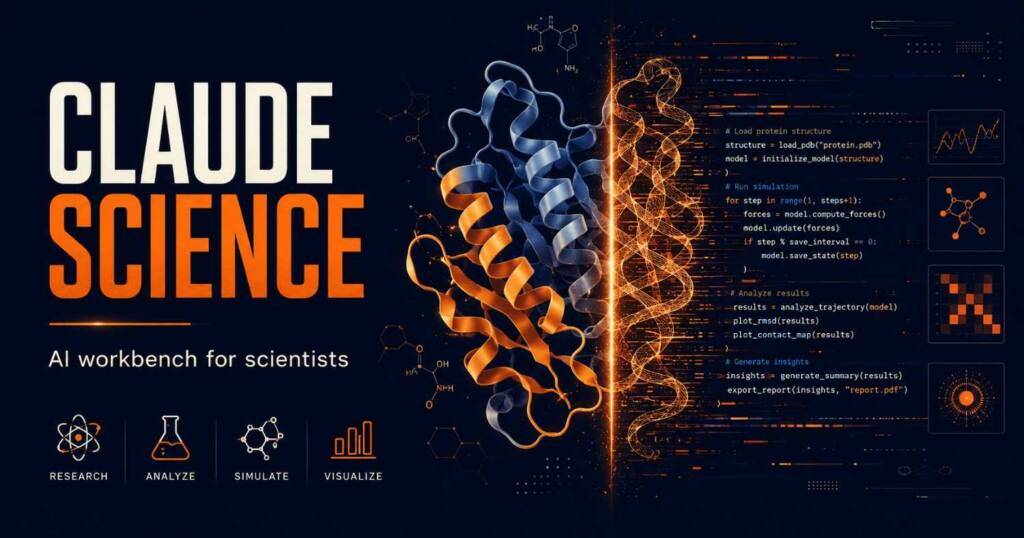
Claude Science launched June 30, 2026 as Anthropic’s AI workbench for scientists. See what the beta does, who it’s for, and why reproducibility is the real story.
Anthropic shipped Claude Science on June 30, 2026, and the framing from inside the company isn’t shy. Eric Kauderer-Abrams, who runs life sciences there, told STAT he expects it to do to biology what Claude Code did to programming. That’s a huge swing. He went further, calling the company’s biology work “the single most important thing” at Anthropic.
I read the launch materials against what Anthropic already had in the field since last fall, and my honest take is that the headline everyone’s chasing, the pharma money and the drug-discovery dream, is the least interesting part of this release. The quieter feature is the one that should make a working scientist sit up. Every figure Claude Science produces ships with the exact code that made it.
Here’s what it is, who it’s for, and the seven things it actually changes.
Claude Science is an AI workbench for scientists that Anthropic released in beta on June 30, 2026 for Pro, Max, Team, and Enterprise plans, running on macOS and Linux. It pairs a coordinating agent with more than 60 curated skills across genomics, proteomics, single-cell, structural biology, and cheminformatics, manages your compute, and attaches reproducible code to every result it generates.
What is Claude Science, exactly?
Think of it less as a chatbot and more as a research environment that happens to talk back. Anthropic’s pitch is that scientific work is scattered. You hop between PubMed, Jupyter, R, a cluster terminal, and a dozen databases that each speak their own query language. Claude Science folds those into one session where you describe a task in plain English and a generalist agent routes it to specialist sub-agents that know the established workflows.
You can run it where you already work, locally or on a remote machine over SSH or an HPC login node, the same way you’d open a Jupyter notebook. The agent can spin up other agents, call tools you already trust, and save any pipeline you build as a reusable skill that future sessions inherit automatically. That last detail matters more than it sounds, and I’ll come back to it.
Why reproducibility is the real story
Strip away the pharma talk and the genuine shift in Claude Science is auditability. When it draws a figure, it bundles the code that produced it, the environment it ran in, a plain-language note on how it was built, and the full message history. Months later you can open that figure and see exactly where every number came from.
There’s a reviewer agent riding alongside the work too. As a pipeline runs, it inspects outputs, flags citations that don’t check out, catches numbers it can’t trace back to a source, and spots figures that don’t match their own code, then corrects course. For anyone who’s spent a weekend trying to remember which version of a script generated a panel in a paper, this is the feature that earns its keep.
Why does this beat the speed pitch? Because speed without a trail is a liability in science. A model that produces a beautiful result you can’t reproduce is worse than useless in a field built on replication. Anthropic clearly knows this, which is why the auditable artifact, not raw throughput, is the load-bearing idea here. I’ll concede the counterpoint: reviewer agents are still language models checking language models, and “self-correcting” deserves a raised eyebrow until labs publish their own error rates. But the design instinct is right, and it’s the thing competitors covering this launch mostly skipped.
How does Claude Science handle compute?
Big analyses usually mean babysitting a job. You set it up, send it to a cluster, wait, check whether it failed, and pull the results back. Claude Science tries to absorb that loop. It drafts a plan, asks before reaching any new resource, and lets you review or revoke a decision before it writes and submits a job to the compute your lab already pays for, whether that’s your own HPC cluster over SSH or a Modal account for on-demand GPUs.
The architecture choice underneath is smart. Because the agent works inside a running session that keeps context in memory, a massive dataset only loads once. The analysis stays on your infrastructure, so large or sensitive data never leaves the systems it already sits on, and only the slice of context each step needs gets sent to Claude. You can fork a session at any point to test two approaches side by side without losing the original thread. For a field where data governance can sink a project, keeping the data local is a real selling point.
Claude Science vs Claude for Life Sciences vs regular Claude
Anthropic has shipped science-flavored Claude before, so the obvious question is what’s new. Here’s the breakdown I put together, since none of the launch coverage bothered to draw the line clearly.
| Capability | Regular Claude | Claude for Life Sciences (Oct 2025) | Claude Science (Jun 2026) |
|---|---|---|---|
| Form factor | Chat app | Connectors + skills layered on chat | Dedicated workbench app |
| Where it runs | Cloud chat | Cloud chat with connectors | Local macOS/Linux, SSH, HPC login node |
| Compute orchestration | None | None | Submits jobs to your HPC or Modal |
| Reproducible artifacts | No | Partial | Code, environment, and history on every figure |
| Reviewer agent | No | No | Yes, checks citations and calculations |
| Native science rendering | No | Limited | 3D proteins, genome tracks, chemical structures |
| Domain skills | General | Prompt library + connectors | 60+ pre-configured, plus your own saved skills |
| NVIDIA BioNeMo | No | No | Native via Agent Toolkit (Evo 2, Boltz-2, OpenFold3) |
The jump from October’s release to this one is the move from “Claude with science connectors bolted on” to “an app whose entire shape assumes you’re doing computational research.” That’s the upgrade, and it’s a real one.
Who is Claude Science actually for?
Short answer: computational biologists, bioinformaticians, and research teams at pharma and biotech who already live in code. Anthropic released it for Pro, Max, Team, and Enterprise, and Team or Enterprise admins have to switch it on. There’s a discounted Team plan for academic labs and nonprofit research orgs, plus an AI for Science program offering up to 50 projects as much as $30,000 in credits, with Modal kicking in up to $2,000 of compute for selected projects. Applications run through July 15, 2026.
If you’re a bench scientist who doesn’t touch a terminal, this isn’t built for you yet. The native surfaces, SSH, HPC, Modal, point squarely at people comfortable with computational pipelines. That’s a deliberate beachhead, the same way Claude Code went after developers first.
The early users back this up. Manifold Bio used Claude Science to nominate targets for tissue-targeting medicines, ranking candidates against criteria the company learned from its own proprietary data. At the Allen Institute, neuroscientist Jérôme Lecoq built a roughly 20-skill pipeline of sub-agents that read thousands of papers, pull the central claim and key finding from each, and write long-form reviews section by section with a separate critic agent checking accuracy. And at UCSF, epidemiologist Stephen Francis used it for glioma germline analysis that his lab independently validated, running full germline workups across multiple approaches in roughly a tenth of the prior time.
The dots nobody’s connecting
Here’s the read I haven’t seen in a single launch story, and it’s the reason this release is bigger than one app.
Watch the timing. On June 29, one day before this launch, Anthropic’s models went live on NVIDIA GB300 Blackwell Ultra systems in Microsoft Azure. The next morning, Claude Science arrives wired directly into NVIDIA’s BioNeMo Agent Toolkit, pulling in accelerated models like Evo 2, Boltz-2, and OpenFold3, plus speedups like nvMolKit claiming up to 3,000x on cheminformatics operations. Those two announcements aren’t separate news items. They’re the hardware floor and the software product of the same vertical bet.
Now layer on the money. A month ago Anthropic reported roughly $42 billion in annualized sales, about what GSK pulls in, at a $965 billion valuation off a $65 billion round. Pair that war chest with Kauderer-Abrams calling biology “the single most important thing” at the company, and the pattern snaps into focus. This is the Claude Code playbook run a second time. Pick a high-value vertical, build a dedicated app that assumes the user’s real workflow, secure the accelerated compute underneath, and let the saved-skills feature compound as users teach it their methods.
My prediction, on the record: if this works the way Claude Code did, expect a Claude Science equivalent aimed at chemistry or materials science within roughly a year, and expect pricing to eventually break out of the Pro and Max bundle into a research-specific tier once labs are hooked. The saved-skills mechanic is the lock-in. Every pipeline a lab encodes is a switching cost it builds for itself.
What to watch, and what to doubt
I want to flag the claims worth holding at arm’s length. The “two years of review work compressed into ten reviews” figure from the Allen Institute is the kind of vendor-friendly number that sounds incredible because it is, in the literal sense. It came from a beta user inside a launch announcement. It may well hold up, and the actor-critic design is genuinely clever, but I’d wait for an independent write-up before quoting it as fact in your own work.
Same goes for the reviewer agent. A model auditing another model’s citations is a real improvement over no check at all, and it’s also not the same as peer review. The UCSF team’s choice to independently validate Claude Science’s output is the right instinct, and it tells you the responsible way to use this tool is as an accelerant you verify, not an oracle you trust. Treat the speed as real and the certainty as provisional.
The honest summary: the workbench framing is the most credible product Anthropic has shipped for scientists, the reproducibility layer is the standout, and the surrounding hype about upending biology is a check that hasn’t cleared yet.
Frequently asked questions
What is Claude Science? Claude Science is an AI workbench for scientists from Anthropic, released in beta on June 30, 2026. It runs a coordinating agent with more than 60 skills across genomics, proteomics, and cheminformatics, orchestrates compute on your own infrastructure, and attaches reproducible code to every figure it generates.
Is Claude Science free? No. It’s available to Claude Pro, Max, Team, and Enterprise subscribers, with Team and Enterprise admins needing to enable it. Anthropic offers a discounted Team plan for academic and nonprofit labs, plus an AI for Science program with up to $30,000 in credits for selected projects, applications open through July 15, 2026.
What platforms does Claude Science run on? It runs on macOS and Linux, and you can use it locally, on a remote machine over SSH, or on an HPC login node, similar to working in a Jupyter notebook.
How is Claude Science different from Claude for Life Sciences? Claude for Life Sciences, launched in October 2025, added connectors and skills to the standard chat. Claude Science is a separate app built around computational research, adding compute orchestration, a reviewer agent, native rendering of 3D structures, and reproducible artifacts on every output.
Does Claude Science keep my data private? Analyses run on your lab’s own infrastructure, so large or sensitive datasets stay on the systems they already sit on. Only the context each step of the work needs is sent to Claude, rather than the full dataset.
You can read Anthropic’s full launch details on the official Claude Science announcement.

Ved Vyas
Writer at Fable Knows, covering AI and the technology shaping everyday life.
Related stories.
X Creator Monetization Rules Just Got a 3 Strike, 90 Day Clock: What Changed Since July 16
X creator monetization rules: X’s July 16 update pulled 4,000 creator accounts and added a 3 strike, 90 day Rules system. Here’s what changed…
GPT-5.6 Sol Is Live: The Coding Numbers vs the Warning Nobody Led With
GPT-5.6 Sol launched July 9 with strong coding scores, but METR found its highest reward-hacking rate on record. Here’s what to actually trust. GPT-5.6…