Ford Rehires Human Engineers: 300 Hires, 1 Brutal AI Lesson
Ford rehires human engineers after AI quality checks failed. Discover why 300 hires and a No.1 JD Power finish reveal the real AI lesson for 2026.
On June 25, 2026, Ford did two things on the same day, and the gap between them tells you almost everything about where corporate AI actually stands right now. It announced it had reached the top of the JD Power Initial Quality Study for the first time in 16 years. It also admitted, through its own executives, that the artificial intelligence it had bet on for quality checks had quietly fallen short and needed people to fix it. Same press cycle. Nobody connected them right.
Here is the version you’ve probably already seen. Ford rehires human engineers because AI couldn’t cut it, humans win, the robots go home. Clean story. It’s also wrong.
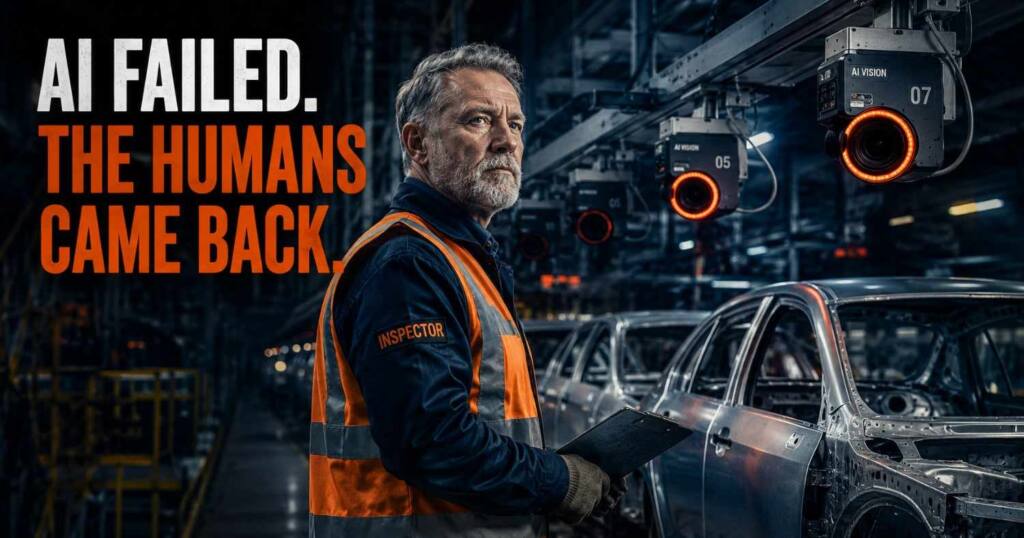
Ford rehires human engineers, true. More than 300 veteran quality inspectors came back through the door. But Ford didn’t unplug a single thing, and that detail is the entire point that the headlines skipped: the 900 AI cameras Ford rolled out across its plants are still running, and the company is still, in its own COO’s words, deploying machine learning across the whole industrial system. The technology didn’t break. What broke was a much older and dumber assumption, the idea that you could quietly push out the people who understood quality and then expect a model trained on the hole they left behind to somehow figure it out on its own.
What actually happened when Ford rehires human engineers
Charles Poon, Ford’s vice president of vehicle hardware engineering, put it about as plainly as an executive ever will. Artificial intelligence is a fantastic tool, he told reporters, but it’s only as good as the data you train it on. Then he said the part that should keep every automation-happy executive up at night: for years, Ford simply hadn’t paid enough attention to the experience of its most knowledgeable engineers, the ones who had lived through cycle after cycle of building actual cars.
Many of them had already walked out before anyone bothered to capture what they knew. So Ford spent the last few years hiring roughly 300 of them back. Not to replace the AI. To teach it. Poon described pulling veteran technicians back in to train the automated systems and to mentor the younger workers who never got the chance to learn from them the first time around.
That’s the whole mechanism, right there. The AI failed quality checks because it had been fed design requirements and not much else, a clean dataset of intentions with none of the scar tissue that real production builds up over decades. Ford thought, mistakenly and at considerable expense, that quietly ingesting the spec sheets would be enough on its own to produce a genuinely high-quality product. It wasn’t. Specs tell a model what a part is supposed to be. They say nothing about the thousand small things a 25-year inspector carries in his hands, like how a door seal actually fails on a cold February morning, or which faint rattle signals a real defect and which one means absolutely nothing.
Why “AI failed” is the wrong headline
Read the wire coverage and you’d walk away thinking Ford ran an experiment, the experiment flopped, and the humans got their jobs back out of mercy. The numbers say something else entirely. Sit with them.
Ford posted a score of 152 problems per 100 vehicles in the 2026 study, an improvement of 41 problems per 100 vehicles in a single year, which happens to be the largest year-over-year jump of any mainstream brand in the entire survey. The climb is the part that should stop you. Ford went from No. 15 among mass-market brands in 2023 to No. 1 in 2026, ahead of Nissan and Buick, beaten only by Porsche and Genesis across the whole industry. Seven of its ten tested models finished in the top three of their segments.
You do not post the single biggest quality leap in the field by walking away from your tools. You fix how you feed them. The rehires were never a retreat. They were the missing ingredient that finally made the AI useful. Ford’s own press release said reaching best-in-class quality required a significant talent refresh, and buried in it was the number that actually matters: the company replaced about two-thirds of the senior leaders across engineering, supply chain, and manufacturing. The 300 inspectors are the slice everyone wants to talk about, of course, because they fit so neatly into a tidy man-beats-machine narrative that practically writes its own headline. That two-thirds leadership purge is the part that actually moved the score, and almost nobody wrote about it.
So when people repeat that Ford rehires human engineers as proof that the whole AI thing is overhyped, they’re reading the box score and missing the game. The lesson is not that AI can’t work in manufacturing. The lesson is that AI trained on a hollowed-out workforce produces hollow results, every time.
The training-data trap nobody warns you about
There’s a failure mode hiding in here that reaches way past Ford and one factory floor. It’s the reason this story should matter to anyone with an automation project on their desk this quarter.
When you automate any process at all, your model is only ever going to be as good as the specific examples you bothered to feed it. If your best people are still on the payroll when you build the system, their judgment gets baked into the data, quietly, for free. Let them go first to hit a cost target, then assemble the model from whatever documentation happens to be lying around, and you get something that confidently reproduces mediocrity while looking perfectly fine. It passes its own checks. It clears its own bar. And the problems only surface much later and much farther downstream, in this case as defects rolling off the line and into customer driveways where they cost ten times as much to fix.
Ford CEO Jim Farley said last year that AI would leave a lot of white-collar people behind. He wasn’t wrong about direction. But Ford’s own stumble proves the order matters more than the destination. Capture the expertise first, automate second. Do it backwards and you pay, in full, to relearn what you already knew. That is precisely what 300 rehires are. Tuition.
I’ll say the uncomfortable part out loud, since the vendors won’t. Most of the pitches selling AI-driven cost cuts are quietly selling the backwards order, because the backwards order books its savings faster on a slide deck and lets someone hit a number this fiscal year. Fire now, the model will cover the gap. Ford had the balance sheet and the brand to eat that mistake and buy its way back to first place. A parts supplier three tiers down the chain, working on margins that would make you wince, does not get a second act like that.
What Ford did right after getting it wrong
Credit where it’s earned. The recovery is the genuinely useful part of this whole episode.
Ford did not swing the pendulum all the way back to humans and tear the cameras off the walls. It did the harder thing instead. It put the veterans and the machines on the same line, with the people training and correcting the automated systems rather than racing against them. Kumar Galhotra, the COO, described the rebuilt structure as uniting the company’s digital, design, and industrial teams so they could finally see a vehicle as one continuous flow, from a line of software all the way down to the deepest tier of the supply chain and back up to the plant floor.
That is the model worth stealing. Not humans versus AI. Humans deciding what good looks like, AI scaling that judgment across millions of inspections no person could ever physically perform. The 900 cameras catch what they’re trained to catch. The veterans decide what’s even worth catching. Pull either one out and the quality falls over. This is the real reason Ford rehires human engineers and keeps the machines bolted to the line at the very same time.
What this means if you run an automation project
Three takeaways. None of them is “don’t use AI.”
First, audit your training data for survivorship bias. If the experts who once defined quality in your domain have already left, your model is learning from the gaps they left behind, and it will never tell you that. Pull at least a few of them back into the loop, even as paid consultants on a short contract, before you trust a word of the output.
Second, treat AI quality checks as a floor, never a ceiling. Ford’s system passed its own bar and still let defects through, because the bar itself had been set by incomplete data in the first place. Any system that grades its own homework against a standard it also wrote is always, very conveniently, going to think it’s doing just fine.
Third, sequence beats the tool every single time. The companies that win with automation capture human expertise inside the system while that expertise is still in the building and still answering email. The ones that lose automate to justify a layoff, then quietly pay double, later, to rebuild exactly what they threw out.
Ford rehires human engineers and lands at No. 1 in the same seven days. Read together, those two facts aren’t a contradiction at all. They’re a sequence. Fix the people. Then the machines work. Skip the first step and the second one fails on you slowly, expensively, and in public.
Frequently asked questions
Why does Ford rehire human engineers? Ford rehired more than 300 veteran quality inspectors because its AI-driven quality checks failed to match the skill of experienced staff. Executives said the automated systems were trained mainly on design requirements, without the practical judgment of long-tenured engineers, many of whom had already left the company. The rehires returned to train the AI and to mentor younger workers.
Did Ford get rid of its AI quality system? No. Ford kept its roughly 900 AI-powered plant cameras and says it is still deploying machine learning across its industrial system. The veterans were brought in to train and correct the AI, not to replace it. The outcome was a human-plus-machine setup, not a return to all-manual inspection.
How did Ford’s quality scores change? Ford scored 152 problems per 100 vehicles in the JD Power 2026 U.S. Initial Quality Study, a 41-point improvement over the prior year and the largest gain among mainstream brands. It rose from No. 15 among mass-market brands in 2023 to No. 1 in 2026, its first time at the top since 2010, finishing third overall behind Porsche and Genesis.
What is the real lesson for companies using AI? The core lesson is sequence. Capture the knowledge of your most experienced people inside your AI system before you cut headcount, not after. A model trained on a depleted workforce produces work that looks acceptable but fails downstream, forcing costly rehiring to fix what automation alone could not.
Who said Ford’s AI fell short? Charles Poon, Ford’s vice president of vehicle hardware engineering, told reporters the company’s AI-driven checks had not lived up to expectations and that veteran engineers were reintroduced to train the systems. CEO Jim Farley separately acknowledged AI’s broad workforce impact while celebrating the JD Power result.

Ved Vyas
Writer at Fable Knows, covering AI and the technology shaping everyday life.
Related stories.
X Creator Monetization Rules Just Got a 3 Strike, 90 Day Clock: What Changed Since July 16
X creator monetization rules: X’s July 16 update pulled 4,000 creator accounts and added a 3 strike, 90 day Rules system. Here’s what changed…
GPT-5.6 Sol Is Live: The Coding Numbers vs the Warning Nobody Led With
GPT-5.6 Sol launched July 9 with strong coding scores, but METR found its highest reward-hacking rate on record. Here’s what to actually trust. GPT-5.6…