Midjourney Medical Wants to Scan Your Whole Body in 60 Seconds with midjourney ultrasound scanner in Ultrasonic CT.
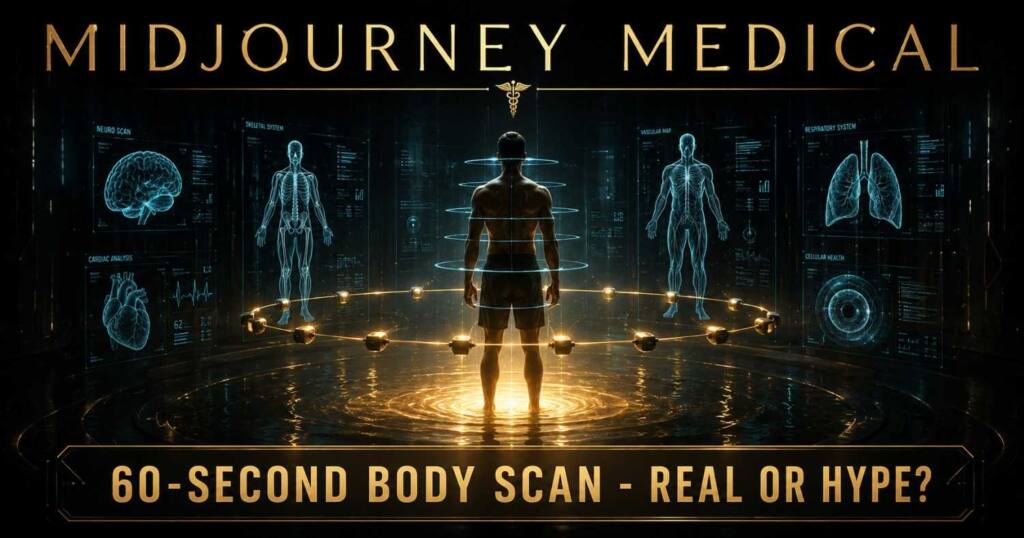
The AI image company just announced a full-body Ultrasonic CT with midjourney ultrasound scanner and a spa to put it in. The vision is wild, the science is real but oversold, and the medical questions are the part nobody is answering.
The company that made its name turning text prompts into dreamlike images now wants to scan the inside of your body. On June 16, 2026, Midjourney announced Midjourney Medical, a new division built around a machine it calls “Ultrasonic CT,” a full-body midjourney ultrasound scanner in Ultrasonic CT. you step into through a pool of warm water that images your entire body in about 60 seconds. No radiation, no magnets, just sound and water.
And the first place you will be able to try it is not a hospital. It is a spa. Midjourney plans to open the “Midjourney Spa” in San Francisco at the end of 2027, complete with hot tubs, saunas, cold plunges, and scanners tucked into pools of golden light.
If that sounds like science fiction written by a company that generates science-fiction images, you are not wrong to raise an eyebrow. The announcement is genuinely exciting and genuinely overhyped at the same time, and untangling which is which takes more than rewriting the press release. Let me walk through what Midjourney actually built, the real technology underneath it, the claims that do not survive scrutiny, and the medical questions that matter more than the marketing.
What Midjourney Medical Actually Announced
The pitch is simple and audacious. Step onto a platform, descend slowly into a shallow pool at about two inches per second, and pass through a ring of underwater sensors. Those sensors fire ultrasonic sound waves through your body from every angle, then listen for the echoes. Software reconstructs all that returning sound into a detailed three-dimensional map of your insides. You step out, towel off, and you have a scan.
Midjourney describes the sensors as acting like a ring of dolphins using echolocation. Each one is a tiny square the size of a grain of sand that works as both a speaker and a microphone, half a million of them in the ring, firing and listening millions of times per second. The company says this produces terabytes of data each second, so much that one second of scan data would equal 500 hours of HD video.
The ambition does not stop at one machine. Midjourney says it wants to deploy more than 50,000 of these scanners worldwide by 2031 and perform a billion full-body scans every month. To put that number in perspective, the company claims a single spa with 10 scanners could do more body scans a year than every MRI machine on Earth combined. Its stated dream is that with enough early imaging, the world could one day avoid a large share of deaths and healthcare costs. Those are not modest goals.
The framing Midjourney uses for why this matters is worth repeating, because it explains the whole project. The company argues that good health decisions come down to having data about your body, and that the ideal technology maximizes how much information you can get about yourself as quickly and cheaply as possible. Track that data over time, compare it to the population, share it with doctors and trainers and AI assistants, and in theory you make smarter, earlier, more frequent decisions. That is the thesis. Everything else is an attempt to build the machine that makes it real.
The Real Technology Underneath the Hype
Here is the part the breathless coverage skips, and it is the most important thing to understand.
The scanner is not built on Midjourney’s image-generation technology. None of it. The actual hardware comes from a licensing deal with Butterfly Network, the company that pioneered putting ultrasound transducers directly onto a semiconductor chip. According to Butterfly’s SEC filings, Midjourney signed a co-development and licensing agreement in November 2025, paying a $15 million upfront fee plus a $10 million annual license fee over a five-year term, with milestone payments and revenue sharing on top.
That detail matters for two reasons. First, it means the technical foundation is real and proven, not vaporware. Butterfly’s ultrasound-on-chip approach is exactly the kind of low-cost, mass-manufacturable component that Midjourney’s plan to build 50,000 units depends on. Second, it punctures the romantic framing. The story being told is “AI image company reinvents medicine,” but the imaging breakthrough here has nothing to do with generative AI. It rests on licensed ultrasound hardware and the heavy computation needed to turn sound into pictures.
There is AI involved, but it is the unglamorous kind. The system uses machine learning to reconstruct images from wave data and to segment what it sees, identifying which parts of a scan are fat, muscle, bone, or organ. That is discriminative AI reading a scene, not the image-generating kind that made Midjourney famous. Worth knowing before you buy the narrative.
“Ultrasonic CT” Is a Marketing Name, Not a Medical One
Let me be blunt about the branding, because it is genuinely misleading.
“Ultrasonic CT” is a contradiction in terms. CT stands for computed tomography, which specifically means X-ray imaging reconstructed into slices. Midjourney’s machine uses no X-rays at all. It is ultrasound. Calling it “CT” borrows the authority of a familiar medical term for something that is physically a different thing.
The company also says its scans are “in many ways superior to even MRI machines.” MRI uses powerful magnetic fields to image soft tissue in extraordinary detail. Ultrasound does not work the same way and does not, today, match MRI resolution. In fact, early technical observers noted the obvious tradeoff: Midjourney’s approach is radiation-free, magnet-free, fast, and potentially cheap, but it currently produces coarser resolution than either CT or MRI. The “100 times faster than MRI” line is real on speed, but speed is not the same as image quality, and the announcement quietly blurs the two.
None of this makes the project fake. It makes the marketing language something to read carefully rather than swallow whole. The physics is sound. The vocabulary is salesmanship.
The Spa Is the Strategy, Not a Gimmick
The decision to launch inside a spa rather than a clinic sounds frivolous, but it is actually the cleverest part of the plan.
Midjourney’s reasoning is that the warm-water immersion the scanner requires already feels like a spa experience, so why not build something people want to visit anyway. The scan becomes a side effect of a pleasant outing. Go for the saunas and cold plunges, and walk out with a library of data about your body. The company wants it open 24/7, somewhere you would go with friends.
There is a regulatory logic hiding in this too. By launching as a wellness destination rather than a diagnostic medical facility, Midjourney sidesteps the hardest part of healthcare: FDA approval for diagnosing disease. The company has been explicit that it will initially offer only “body composition maps,” telling you your ratios of fat, muscle, and the like, with no diagnostic claims. It says it will submit results to the FDA over time to unlock more.
This is the same regulatory lane that whole-body MRI services like Prenuvo and Ezra already operate in. Body-composition data with no disease claim can fall under the FDA’s general-wellness policy, which is far easier to clear than a diagnostic device. Smart, and also a quiet admission of how far this is from being actual medicine right now.
The Roadmap, and Why 2027 Is Optimistic
Midjourney laid out a timeline that is aggressive even by Silicon Valley standards.
The next 12 months are for refining the algorithms and hardware and running research trials. A first “research spa” comes before the public one. The flagship San Francisco Spa opens around the end of 2027. In 2028 the company wants to expand to more cities on a third-generation scanner with fully custom silicon, which it says is where image quality and scan times get “serious.” By 2031, the goal is the 50,000-scanner fleet doing a billion scans a month.
Read that timeline with healthy suspicion. Medical hardware is brutally hard to scale. Each step, from regulatory clearance to manufacturing custom chips to building physical spa locations in city after city, is its own multi-year challenge. Midjourney itself admits its own current image quality is not yet at clinical grade and that regulation is the next big limit. The vision is coherent. The schedule assumes almost nothing goes wrong, and in medicine, things go wrong.
The Medical Question Nobody in the Announcement Answers
This is the part I care about most, and it is almost entirely absent from the launch.
Scanning a billion healthy people every month sounds like an unambiguous good. Catch problems early, save lives. But whole-body screening of people with no symptoms is one of the most contested ideas in medicine, and for a real reason: false positives and overdiagnosis.
When you image an entire body in high detail, you find things. Lots of things. Most of them are harmless, benign lumps, cysts, and anomalies that would never have caused harm. The medical term for these is incidentalomas. Each one can trigger a cascade of follow-up scans, biopsies, anxiety, and sometimes treatment that carries its own risks, all for something that was never going to hurt you. The same debate has dogged Prenuvo, the full-body MRI service that costs around $2,500 a scan, where leading radiologists have warned that the scans could lead to negative outcomes and have called for rigorous studies to prove benefit. Research has even shown that false-positive findings carry real psychological harm.
Now imagine that problem at Midjourney’s intended scale, with coarser resolution than MRI, marketed as a casual spa add-on, and analyzed partly by AI. The potential to generate enormous numbers of false alarms is real, and the announcement does not grapple with it at all. “More data about your body” is not automatically “better health outcomes.” Sometimes it is just more anxiety and more unnecessary procedures. That gap, between a cool full-body image and a safe, useful medical product, is the entire question, and Midjourney has not answered it yet.
A Research Lab With No Investors
One genuinely unusual thing is how Midjourney is funding this. The company has no outside investors. It describes itself as a community-backed research lab, profitable from its image-generation subscriptions and funded by everyday users rather than venture capital.
That independence is why it can announce something this strange without a board pushing back. It is also why it is leaning on its community for feedback, waitlists, and clinical-trial volunteers rather than a traditional product launch. Whether a self-funded image company can shoulder the cost and complexity of building medical infrastructure at global scale is an open question, but the freedom to try without investors demanding a quick return is a real advantage.
It also fits a broader pattern worth noticing. Across 2025 and 2026, the labs that got rich on software AI have been pushing into physical hardware, from robotics to wearables to, now, medical devices. The logic is that once you have built world-class teams in computation and machine learning, the next frontier is pointing them at atoms rather than bits. Midjourney moving into a water tank full of ultrasound sensors is one of the stranger expressions of that trend, but it is the same impulse: take the engineering muscle built for one domain and aim it somewhere physical and ambitious. Whether that muscle transfers cleanly to the brutal realities of regulated medicine is exactly what the next few years will test.
So Should You Be Excited or Skeptical?
Both, honestly, and in specific proportions.
Be excited that someone is seriously attacking the cost and unpleasantness of medical imaging. MRI is slow, expensive, claustrophobic, and scarce. A fast, radiation-free, potentially cheap full-body scan would be a real gift if it works at clinical quality. The underlying ultrasound-on-chip technology is legitimate, and the ambition to make body imaging routine is worth rooting for.
Be skeptical of the timeline, the “Ultrasonic CT” and “better than MRI” language, and above all the unexamined assumption that scanning everyone constantly is good for them. The resolution is not there yet. The regulatory path is long. The false-positive problem is enormous and unaddressed. And a spa is a strange place to make decisions about your health.
The most honest way to hold this is as an early-stage research bet from an unusual company, not a product you will be using soon. Midjourney built a real prototype and a bold plan. The distance between that and safe, reimbursable healthcare is the whole ballgame, and it has not been played yet.
Frequently Asked Questions
What is Midjourney Medical’s Ultrasonic CT? It is a full-body scanner that uses ultrasound, not X-rays or magnets. You step into a shallow pool and descend through a ring of underwater sensors that send sound waves through your body from every angle, building a 3D image in about 60 seconds. Despite the “CT” name, it uses no X-ray and is technically ultrasound imaging.
When and where can I use it? Midjourney plans to open its first location, the Midjourney Spa, in San Francisco at the end of 2027. A research spa comes first. Wider rollout to other cities is targeted for 2028 and beyond, with no confirmed pricing yet.
Is it actually better than an MRI? Not today. It is far faster, radiation-free, and magnet-free, but early observers note its current resolution is coarser than both CT and MRI. The speed claim is real, the image-quality claim is aspirational.
Does it use Midjourney’s AI image generation? No. The scanner is built on licensed ultrasound-on-chip hardware from Butterfly Network. The AI involved reconstructs and labels scans, which is a different technology from the text-to-image generation Midjourney is known for.
Will it diagnose diseases? Not at launch. Midjourney says it will initially offer only body-composition maps with no diagnostic claims, which keeps it in the FDA’s general-wellness lane. It says it will seek FDA clearance for diagnostic capabilities over time.
Is whole-body scanning actually safe? The scan itself uses harmless sound waves. The bigger concern is medical: screening healthy people often turns up harmless findings that lead to unnecessary follow-up tests, biopsies, and anxiety. This overdiagnosis problem already affects services like Prenuvo, and Midjourney has not addressed how it will handle it at scale.

Ved Vyas
Writer at Fable Knows, covering AI and the technology shaping everyday life.
Related stories.
X Creator Monetization Rules Just Got a 3 Strike, 90 Day Clock: What Changed Since July 16
X creator monetization rules: X’s July 16 update pulled 4,000 creator accounts and added a 3 strike, 90 day Rules system. Here’s what changed…
GPT-5.6 Sol Is Live: The Coding Numbers vs the Warning Nobody Led With
GPT-5.6 Sol launched July 9 with strong coding scores, but METR found its highest reward-hacking rate on record. Here’s what to actually trust. GPT-5.6…