Snap Specs Are Here at $2,195: Full Specs, the Real Catch, and Whether They Beat Meta
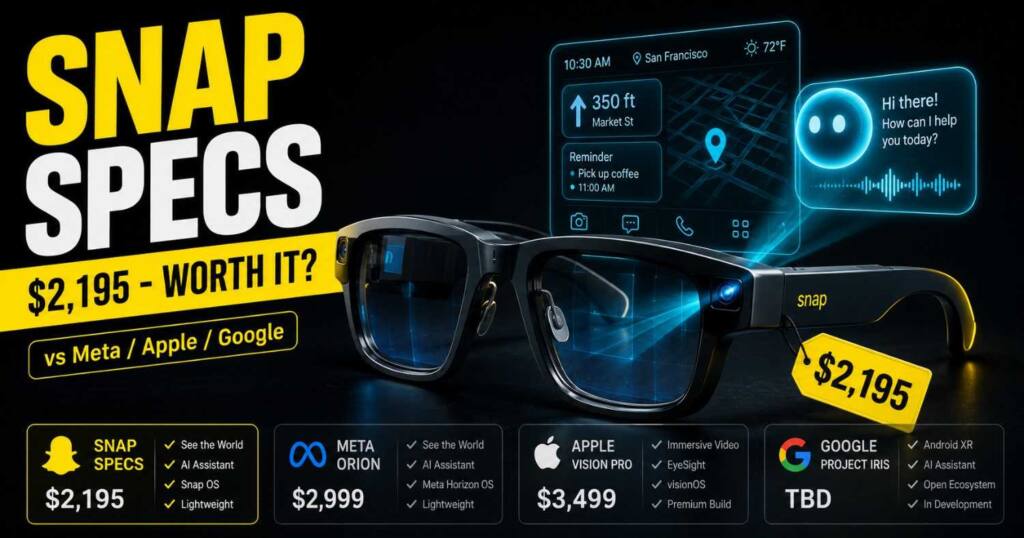
Snap just opened pre-orders for true AR glasses that ship this fall. Here is what they actually do, where the hype gets ahead of reality, and how they stack up against Meta, Apple, and Google.
Snap walked onto the stage at Augmented World Expo on June 16, 2026, and did something none of its bigger rivals have managed yet. It put real, standalone augmented reality glasses up for pre-order, no phone tether, no puck, no waitlist for developers only. They are called Specs, they cost $2,195, and they ship this fall in the US, UK, and France.
That price probably made you wince, and we will get to whether it is justified. But the bigger story is what Snap pulled off here. While Meta, Apple, and Google have all promised true AR glasses and shipped either prototypes or camera-and-audio devices instead, Snap actually beat them to a buyable product. After a decade of work and more than $3 billion poured into AR, the company behind Snapchat got there first.
Let me walk through exactly what Specs are, the parts the press release glosses over, how they compare to everything else on your face right now, and whether anyone should actually buy a pair.
What Snap Specs Actually Are
First, the category matters, because “smart glasses” has become a muddy term that covers wildly different things.
Specs are true AR glasses. That means they can place virtual objects and interfaces into the real world in three dimensions, anchored to your actual surroundings, and you interact with them using your hands. This is a different species from the Ray-Ban Meta glasses most people picture, which are mainly a camera, speakers, and a voice assistant with no real display. It is also a step beyond Meta’s newer Ray-Ban Display, which bolts a small fixed heads-up display into one lens for notifications. Specs are closer in ambition to a Meta Quest headset shrunk into eyewear, or to Meta’s Orion prototype that the company has said it cannot yet ship.
The headline achievement is that they are fully standalone. Two Snapdragon processors live inside the frames themselves, one handling computer vision and the other running Lenses, Snap’s name for AR experiences. There is no battery puck in your pocket and no phone doing the heavy lifting, which is exactly the tether that Xreal and Google’s Project Aura still rely on.
They are built from Swiss TR90 polymer, a lightweight high-strength plastic, and come in two sizes: a 47mm frame at 132 grams and a 52mm frame at 136 grams. Removable inserts handle prescriptions, so glasses wearers are covered.
The Display and the Clever Lens Trick
The display is where Snap spent its engineering budget, and it shows.
Specs use Snap’s own liquid crystal on silicon technology to drive a 51-degree field of view with 16 million colors. In practical terms, Snap says that translates to something that feels like a 24-inch monitor sitting in front of you when you are working, or a 115-inch cinema screen floating about ten feet away when you are watching a movie. The 51-degree field of view is roughly in the range of Microsoft’s old HoloLens 2 and Magic Leap 1, which is genuinely large for glasses this light.
The piece that impressed me most is the lens. Snap redesigned its waveguide using billions of nanostructures so small that more than 10,000 fit on the tip of a single hair. And the lenses tint automatically: they use the same electrochromic technology found in Boeing 787 Dreamliner windows, shifting from clear to dark in about 10 seconds. That solves a real problem, since AR displays wash out in bright light, and it means you are not stuck wearing obvious tinted lenses indoors.
On performance, Specs hit 7-millisecond motion-to-photon latency, which Snap verified with robotic measurement. For context, that is actually faster than the Apple Vision Pro’s roughly 12 milliseconds. Low latency is what keeps virtual objects from swimming or lagging as you move your head, and it is a big part of whether AR feels solid or nauseating.
The Catch Nobody Puts in the Headline
Here is where I have to slow the hype train down, because the spec sheet has a soft spot Snap is being quiet about.
Battery life is rated at “up to four hours of mixed use.” That sounds reasonable until you notice what “mixed use” bundles together: audio playback, video playback, Lenses, AI assistance, and Bluetooth notifications, all averaged. It is a vague figure, and Snap pointedly did not give a number for continuous AR use, the demanding 6DoF spatial computing that is the entire point of the product. The previous developer Spectacles managed only 45 minutes of that heavy use. So if you are imagining four straight hours of immersive AR, temper that. The charging case adds four more charges for up to 20 hours of mixed use total, which helps, but you will be docking these often.
The other honest caveat is how they look. Snap got the weight down dramatically from the 226-gram developer Spectacles, and 132 grams is a real achievement. But Specs are still noticeably heavier than Ray-Ban Meta glasses, which sit around 50 grams, and the temples are wide enough that nobody will mistake these for ordinary eyewear. They read as tech glasses. That matters for the whole pitch, because the entire premise is wearing them out in the world, and social acceptance is the thing that killed Google Glass.
And there is a quieter tension worth naming. Snap promises on-device processing, an LED that lights up when recording, and user control over what gets stored or shared. That is a solid privacy design. But Snap makes its money from advertising, and asking people to trust an ad company with a camera and AI that sees everything you see is a real hurdle, no matter how good the LED indicator is.
AI That Can See What You See
The reason any of this matters more in 2026 than it did in 2016 is AI.
Specs put AI assistance into your field of view rather than a text box. Because the glasses can see what you see, the assistant can understand context: it can identify objects, connect information to the places around you, and offer guidance exactly where you need it. Snap has reportedly built in models from both OpenAI and Google to power this. Picture getting a repair walkthrough overlaid on the actual appliance, or asking about a landmark just by looking at it.
This is the genuine argument for AR glasses over a phone. Pulling out your phone, opening an app, and typing a question breaks your attention. An assistant that already sees your situation removes that friction. Whether it works smoothly in the real world is the open question, and that is exactly the kind of thing that only a hands-on test will settle.
A Platform Built on Lenses
Snap is not starting from zero on software, which is its quiet advantage.
Developers have already published hundreds of Lenses for Specs. The examples Snap showed point at the range: reading the green on a golf course, overlaying interactive lessons onto a drum kit, or a tool called Vector Fields that makes invisible forces visible for education. Over the past year and a half, Snap shipped 10 updates to its Snap OS with more than 40 new features and APIs.
The newest push is aimed at making Lenses faster to build. Snap is rolling out agentic development inside Lens Studio through a developer preview in Claude Code, Codex, and Cursor, plus a new Native Development Kit that lets developers bring their own code and libraries in. If AR follows the pattern of the PC, the web, and smartphones, the platform that wins is the one developers actually build for, and Snap has a head start here that Apple and Google do not.
How Specs Compare to Meta, Apple, and Google
This is the context the spec-sheet coverage skips, and it is where Specs get genuinely interesting.
Against Ray-Ban Meta, there is no real overlap. Those are 50-gram camera-and-audio glasses with no spatial display, and they have sold in the millions precisely because they are cheap, light, and look normal. Specs do something Ray-Ban Meta simply cannot, at four times the price and triple the weight.
Against Meta Ray-Ban Display, the gap is about ambition. That device adds a small 20-degree monocular heads-up display weighing 69 grams, useful for notifications and glanceable info. Specs are a full spatial computer with a 51-degree binocular display. Different leagues, different goals.
Against Meta’s Orion, the comparison is closest in spirit, except Orion is a prototype Meta has openly said it cannot sell, weighs 98 grams, and requires a separate compute puck. Specs are real and standalone. Snap shipped the thing Meta showed off behind glass.
Against Apple and Google, it is mostly about timing. Apple’s lightweight glasses, reportedly codenamed N50, are still in development and aimed at a similar AI-plus-AR future, paired with new AirPods and a small camera device. Google and Samsung’s Android XR glasses launch this fall in an audio-and-camera first generation with no display, and the display version is on a 2027 roadmap. Snap beat all of them to a buyable true AR product. Whether first also means best is a different question, and an expensive one for early buyers to answer.
The History That Explains Why This Is a Big Deal
To understand why this launch matters, you have to know how many times Snap has tried and stumbled.
Spectacles started in 2016 as a sunglasses-style camera sold from yellow vending machines. They went viral, then flopped, and Snap wrote down $40 million in unsold inventory in 2017. The company kept iterating quietly, shifting to a developer focus. The fourth generation in 2021 added real AR with a tiny 26-degree field of view and 30 minutes of battery. The fifth generation in 2024 widened the view to 46 degrees but ballooned to 226 grams and rented to developers for $99 a month.
Specs are the payoff of that long, costly road. Snap took a product that was a punchline in 2017 and turned it into the first consumer true AR glasses you can actually pre-order. Whatever happens next, that arc is the real story, and it is why the $3 billion and 7,000-plus patents Snap filed during development are not just press-release filler.
Should You Actually Buy Snap Specs?
Here is the honest verdict, stripped of launch-day excitement.
Pre-order if you are a developer, a creator, or an early-adopter with money to burn who wants to be first into spatial computing and help shape what gets built. The $200 deposit is refundable, so reserving a spot costs you nothing but the option. For this group, Specs are the most capable AR glasses you can buy, full stop.
Wait if you are a normal consumer hoping for everyday glasses. At $2,195, with four-hour mixed-use battery, a tech-forward look, and a software library that is still early, this is a first-generation product at a first-generation price. The experiences that justify the cost mostly do not exist yet. Snap has promised a fall campaign with new experiences from creators like Jimmy Butler, Imogen Heap, and Kaia Gerber, so the picture should be clearer by ship date.
Skip entirely if you just want a camera and an assistant on your face. Ray-Ban Meta at a fraction of the price does that job better, lighter, and without announcing to everyone that you are wearing a computer.
The smartest read on the 2026 AR market is that it is about to get crowded fast, with Apple, Google, Samsung, and Meta all landing products over the next two years. Buying any of them today is buying into a platform that has not been picked yet.
Frequently Asked Questions
How much do Snap Specs cost and when do they ship? Specs cost $2,195 and are available to pre-order now with a $200 refundable deposit. They are expected to ship in fall 2026 in the United States, the United Kingdom, and France.
Are Snap Specs real AR glasses or just smart glasses? They are true AR glasses. Unlike Ray-Ban Meta, which is mainly a camera and audio device, Specs place 3D virtual objects into your real surroundings with a 51-degree field of view and hand tracking, all processed on the glasses themselves with no phone or puck required.
How long does the battery last? Snap rates them at up to four hours of mixed use, which blends audio, video, Lenses, AI, and notifications. Snap did not publish a figure for continuous heavy AR use, which on the previous developer model was only 45 minutes. The charging case adds up to 20 total hours of mixed use.
Do Snap Specs need a phone to work? No. They are fully standalone, with two Snapdragon processors built into the frames. This sets them apart from tethered options like Xreal and Google’s Project Aura.
How do Snap Specs compare to Meta’s glasses? Ray-Ban Meta is lighter, cheaper, and has no spatial display. Meta Ray-Ban Display adds only a small fixed notification screen. Meta’s full AR prototype, Orion, is not for sale and needs a separate puck. Specs are a standalone spatial computer and the first true AR glasses a consumer can actually buy.
Can you wear Snap Specs with a prescription? Yes. Specs come in two frame sizes with removable inserts that support a wide range of prescriptions.
Is the camera a privacy risk? Specs use an LED that lights up when recording and prioritize on-device processing, with user controls over what is stored or shared. Still, Snap is an advertising company, and trusting always-on glasses that see what you see remains a real concern for many people.

Ved Vyas
Writer at Fable Knows, covering AI and the technology shaping everyday life.
Related stories.
X Creator Monetization Rules Just Got a 3 Strike, 90 Day Clock: What Changed Since July 16
X creator monetization rules: X’s July 16 update pulled 4,000 creator accounts and added a 3 strike, 90 day Rules system. Here’s what changed…
GPT-5.6 Sol Is Live: The Coding Numbers vs the Warning Nobody Led With
GPT-5.6 Sol launched July 9 with strong coding scores, but METR found its highest reward-hacking rate on record. Here’s what to actually trust. GPT-5.6…