X Money: 7 Bold Features in Musk’s Everything-App Bet
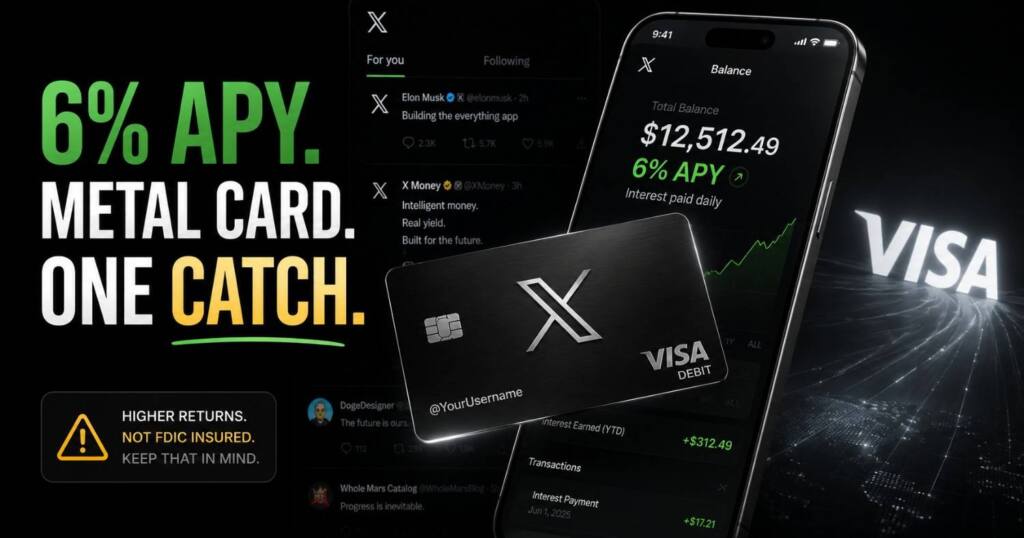
X Money is rolling out to more US Premium users with 6% APY, a metal Visa card, and 3% cashback.
After months of delay, Elon Musk finally pushed his banking product to a wider audience. On June 25, 2026, X began rolling out X Money to a broader set of premium users in the United States, the clearest step yet toward the “everything app” Musk has promised since he bought Twitter. This is not a tip jar bolted onto a social feed. Far from it. It is a full payments and banking service, with a metal Visa card, a 6% savings rate, and ambitions aimed squarely at Venmo, Cash App, and the bank you already use, all stitched into a feed you open without thinking.
Here is what X Money actually offers, how it works under the hood, where the eye-catching numbers come from, and the real reasons to be cautious before you trust a social network with your paycheck.
What X Money Is
X Money is the payments and banking layer built directly inside X, the platform formerly known as Twitter. Rather than a standalone app you download, it lives in the app you may already open dozens of times a day. The pitch is simple, almost suspiciously so. Send money to friends, hold a balance, earn interest, spend with a card, and eventually run much of your financial life without leaving the feed.
The current expansion is deliberately gradual. Dhruv Batura, who now leads X Money after more than a decade at Tesla, said the company is widening access to gather feedback and fix issues before a full public launch. So the expansion is a controlled rollout to verified US premium users who are 18 or older. Not a flip-the-switch global release. Slow and watched. The phased path runs from a closed beta early in 2026, through a limited external beta, to today’s wider availability.
It helps to know why this matters to Musk specifically. He co-founded PayPal, he has called payments the foundation of his super-app plan since 2023, and this product is the piece that turns that talk into something you can hold in your hand.
Every X Money Feature That Matters
Strip away the hype and the feature list reads like a direct challenge to every major fintech in America. Here are the seven that count.
- A 6% annual yield on balances you hold in X Money, which is roughly 12 to 15 times the national savings average of about half a percent.
- A personalized all-black metal Visa debit card, engraved with your X handle, that runs on Visa’s global network.
- 3% cashback on eligible purchases, a rate that rivals strong credit cards, on a debit card.
- Zero foreign transaction fees, which makes the card genuinely useful when you travel or buy from overseas sellers.
- Peer-to-peer payments inside X, so you can send cash to another user instantly without a separate app.
- FDIC-insured deposits up to $250,000 per person, held through a partner bank rather than by X itself.
- Near-instant settlement through Visa Direct, where a transfer lands in seconds instead of the one-to-three business days an old bank transfer takes.
One feature is notably absent. No crypto. X Money launched as a fiat-only product, with no Bitcoin, no Dogecoin, and no stablecoin rails. Crypto support has been floated for later. At launch, this is dollars only, which surprised the people who assumed Musk would lead with tokens given how often he talks about them.
How X Money Actually Works
The important thing to understand is that X is not the bank. The service runs on partnerships, and those partners do the regulated heavy lifting.
Visa provides the card network, which is why the card is accepted at the same hundred-million-plus merchant locations as any other Visa. Cross River Bank, a New Jersey-chartered institution and an FDIC member, holds the actual deposits. Cross River is a banking-as-a-service provider that already powers fintechs like Affirm and Upstart, so the plumbing is proven. The FDIC insurance on your balance comes through that bank relationship, not from X, a distinction worth remembering if anything ever goes wrong.
On the legal side, X has secured money-transmitter licenses in 41 states plus Washington, D.C. That is real progress, and also an incomplete map. The most important gap is New York, where regulators have held back approval. Because a financial app like this generally needs authorization in every state it serves, the missing licenses are part of why the rollout has moved slowly and only to a slice of users so far.
Where Does 6% APY Come From?
A 6% yield is the headline that makes people stop scrolling. It deserves a hard look. When the national average sits near half a percent and big banks pay almost nothing, a number this high naturally raises the question of who is paying for it.
The honest answer is that the math has to work somewhere. Cross River Bank has to generate enough return to cover those 6% payouts, the FDIC insurance costs, and the card rewards on top. Some analysts argue a rate this generous is effectively a subsidy to win users fast, and that it may not survive at large scale. A lean, cloud-based cost structure helps, but high yield plus rich cashback is expensive to sustain once millions of people pile in. Treat the 6% as a real perk today and an open question for tomorrow, not a permanent promise. Read the fine print. The rate you see at sign-up is the rate the company can afford while it is buying your attention, and attention gets cheaper to keep once you have already moved your money in.
X Money vs Venmo, Cash App, and Your Bank
On paper, the service undercuts almost everyone. Venmo and Cash App handle peer-to-peer payments but do not pay meaningful interest on a balance. Most banks do not come close to 6%, and few hand you 3% cashback on a debit card with no foreign fees. Add near-instant Visa Direct settlement and the offer looks aggressive against both fintech apps and traditional accounts.
The catch is trust and habit. That part is harder to engineer than any interest rate, because it accrues slowly over years of people quietly deciding a company will not lose their money. PayPal, Cash App, and Apple Pay have spent years earning the confidence people extend before they route a paycheck somewhere. Zelle and Venmo are already woven into how Americans split rent and pay friends. The product has the better spec sheet, but spec sheets do not move money on their own. The psychological distance between doom-scrolling a feed and trusting that same app as your bank is real, and no amount of yield closes it overnight.
The Everything-App Dream
The product is the cornerstone of a much larger ambition. Back in 2023, Musk framed buying Twitter as an accelerant for “X, the everything app,” a single place for communication, commerce, and your entire financial world. Payments were always the missing pillar, and this is the attempt to set it.
The distribution advantage is the part rivals cannot copy. X reaches roughly 600 million monthly active users, an audience no standalone fintech can match on day one, and the wallet sits inside that app with no extra download. The model that inspires all of this is China, where WeChat Pay and Alipay turned chat apps into financial systems. No Western company has pulled that off, partly because US financial rules are fragmented and consumers love their credit-card rewards. The timing is loaded too, arriving just after X’s parent company SpaceX went public, which sharpens investor interest in new revenue beyond ads. For more on how Musk’s companies keep crossing into each other’s lanes, see our Article about X Monetization.
The Catch: Regulation and Trust
Ambition this size attracts attention, and the service already has plenty. Senator Elizabeth Warren sent Musk a pointed letter demanding answers on consumer protection, on whether the product would issue a stablecoin, and on its work with Cross River Bank, which faced an FDIC enforcement action in 2023 over fair-lending practices. As Payments Dive reported, Warren is among the most vocal lawmakers on holding payment providers accountable. That letter is a preview of the scrutiny ahead.
New York remains the standout holdout on licensing, with state officials publicly urging regulators to deny X a license, citing concerns about identity verification and Musk’s history with regulators. There is also the 2025 GENIUS Act, which could restrict paying yield on stablecoins and complicate any future crypto plans. None of this kills the project, but together it explains the careful, state-by-state, beta-by-beta pace. A financial product cannot move fast and break things the way a social feature can.
Should You Use X Money?
Here is my honest read. If you are an active X user in an eligible state, the offer is genuinely strong on paper, and testing peer-to-peer payments or a small balance to test the 6% rate is low risk given the FDIC coverage through Cross River. The card perks are real, and the instant settlement is a genuine upgrade for creators and gig workers who are tired of watching a payment sit in limbo for three business days before it finally clears. Real money, faster.
This is an early rollout from a company still collecting feedback and ironing out problems, the 6% yield may not last, and the regulatory picture is unsettled, with New York still outside the tent. The smart play is to treat it as a promising second account to experiment with, not a replacement for an established bank, at least until the product proves it can hold these generous terms at real scale across millions of users and every state regulator watching. Use it.
Just do not depend on it yet. For most people, X Money earns a trial, not your full trust, and that is a perfectly reasonable place to start. The everything-app dream is closer than it has ever been, closer than any Western company has managed to get, with the user base, the card network, and the banking partner all finally lined up behind a single login. It is not finished. Not yet.
X Money FAQ
Is X Money FDIC insured? Yes, indirectly. Deposits are held by Cross River Bank, an FDIC member, with coverage up to $250,000 per person. X itself is not a bank, so the protection flows through that partner relationship.
What does the X Money card offer? It is an all-black metal Visa debit card engraved with your X handle, with 3% cashback on eligible purchases, zero foreign transaction fees, and support for Apple Pay and Google Wallet. Physical cards ship after identity verification.
Does X Money support crypto? Not at launch. The current product is fiat-only, with no Bitcoin or Dogecoin payments. Crypto support has been discussed for the future but is not live today.
Where is X Money available? It is rolling out to verified US premium users who are 18 or older, in the 41 states plus Washington, D.C., where X holds money-transmitter licenses. New York is a notable exception.
Is the 6% APY guaranteed? No. It is the current promotional rate, and several analysts question whether a yield that high can survive at scale. Consider it attractive for now rather than a permanent fixture.
How is X Money different from Venmo? Both send money between users, but X Money adds a 6% yield on balances, a cashback metal Visa card, and tight integration with X’s 600-million-user platform. Venmo does not pay meaningful interest on a balance.

Ved Vyas
Writer at Fable Knows, covering AI and the technology shaping everyday life.
Related stories.

Google Messages Chat Themes: 7 Must-Know Tips for 2026
Google Messages chat themes let you set custom wallpapers and colors per chat, visible only to you. Here is how to use them and…
Suno AI Prompts That Actually Work in 2026: 7 Proven Fixes for v5.5
Suno AI prompts that stop generic output in 2026. Get the v5.5 formula, a copy-paste library, and the trick to sound like any artist.…