GPT-5.5 Instant update: 7 Real Changes That Make ChatGPT Smarter in 2026
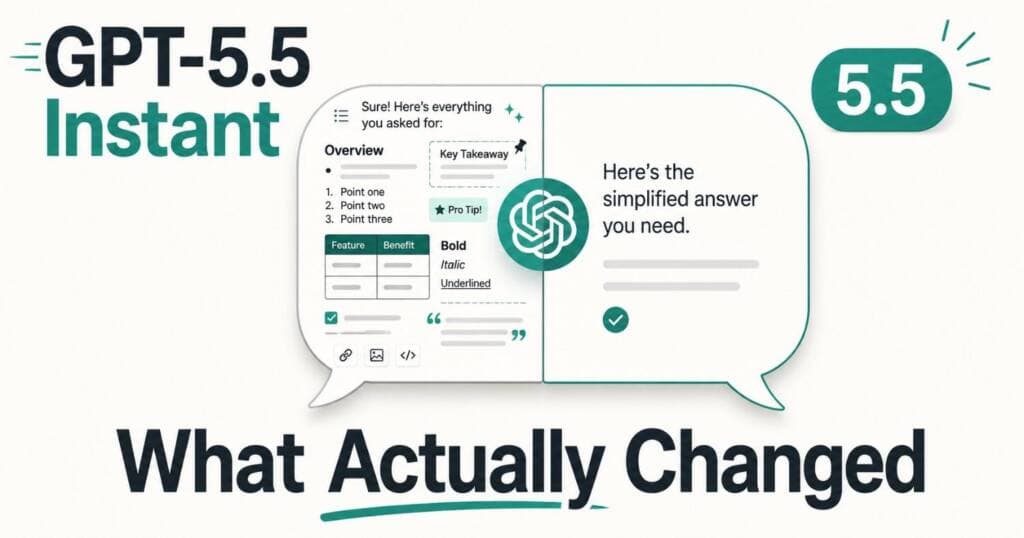
The GPT-5.5 Instant update cuts hallucinations 52%, trims bloat, and adds memory controls. See the 7 real changes and the trade-off OpenAI skips.
The model behind most of your ChatGPT conversations just got swapped out, and you probably weren’t told.
That is the strange thing about the GPT-5.5 Instant update. No keynote. No Sam Altman hype thread, no countdown, no fanfare at all. OpenAI just quietly swapped out GPT-5.3 Instant, the default model that hundreds of millions of people lean on every single day, and dropped in something tighter, more accurate, and a touch more human. Open ChatGPT any time after May 5 and you are already talking to it.
So what actually changed, and does any of it matter for how you use the thing day to day? I dug through OpenAI’s own published numbers and then spent a while poking at the actual behavior myself to see what held up. Here is the honest breakdown. It covers the gains that are real, the one new feature almost nobody is talking about, and the quiet trade-off OpenAI would rather you not dwell on.
What the GPT-5.5 Instant update actually is
Instant is the fast, everyday model. It is not the slow reasoning one you sit and wait on for a hard problem, it is the quick one that fires back the instant you hit enter on the ordinary stuff. OpenAI calls it the daily driver. That label is the whole point. Improve the model that handles the bulk of all ChatGPT traffic and even a tiny gain gets multiplied across billions of messages a day, which is why a release this understated can still matter more than a flashy one.
GPT-5.5 Instant replaces GPT-5.3 Instant as the default. OpenAI skipped 5.4 Instant entirely on the way there, which tells you these point releases exist to ship gains fast rather than to climb a tidy version ladder. In the API it surfaces as chat-latest. No button, no setting, no migration. For almost everyone the change simply happened.
The pitch is three words. Smarter, clearer, more personalized. That is the same sentence stapled to every model announcement ever shipped, so the words alone mean nothing until you check the receipts. The difference this time is that OpenAI actually put hard numbers behind the claim, and those numbers are worth holding to the fire one at a time.
Fewer hallucinations, and the numbers are big
Here is the one headline that should matter most to anyone leaning on ChatGPT for real work, the kind where a wrong answer carries a cost.
On high-stakes prompts, the kind covering medicine, law, and finance, the GPT-5.5 Instant update produced 52.5% fewer hallucinated claims than GPT-5.3 Instant. That is OpenAI’s internal evaluation, so treat it as the company’s own scorecard rather than an independent audit, but a cut of that size is not noise. It also reduced inaccurate claims by 37.3% on the messy, challenging conversations real users had flagged for factual errors.
Why does this land harder than a benchmark score? Because hallucination is the single biggest reason people quietly stopped trusting AI for anything that actually matters. You ask about a drug interaction, a contract clause, a tax rule. The model hands back a confident answer that is flat wrong, and you would never know unless you already knew. Halving that on exactly the domains where a wrong answer can hurt you is the most useful thing in this release. It will not eliminate mistakes. You still verify anything that matters. But the floor moved up, and for the everyday model that most people never switch away from, the floor is what counts.
GPT-5.5 Instant also sharpened up on the boring-but-important stuff, including reading photo and image uploads, handling STEM questions, and deciding on its own when to run a web search instead of guessing from stale memory. That last point is the sneaky-important one. A model that recognizes the edge of its own knowledge and actually goes to look it up will beat a model that confidently papers over the gap every time, and that instinct is exactly what separates a tool you trust from a tool you babysit.
Shorter answers, less fluff, fewer emojis
If you have used ChatGPT for a while, you know the tic. You ask a simple question and get back five headers, a bulleted list, a bolded summary, three emojis, and a follow-up question you never asked for. The GPT-5.5 Instant update is OpenAI finally admitting that got out of hand.
In one of its own side-by-side examples, the new model used 30.2% fewer words and 29.2% fewer lines to answer a casual advice question, and the shorter answer was the better one. It dropped the scaffolding and gave usable scripts. No “what not to do” appendix nobody asked for. No gratuitous emoji. No desperate closing flourish to impress you.
This is the change you feel first with GPT-5.5 Instant, long before any hallucination stat registers. Answers feel calmer. The model finally stops performing for you. It reads less like a search engine doing jazz hands and more like a competent person who respects your time. OpenAI says it now asks far fewer unnecessary follow-up questions and trims the kind of clutter that used to make a simple reply feel swollen and exhausting to read. After a day of using it, that restraint is the thing I would not want to give back.
There is a catch worth naming. Concise is wonderful right up until it clips the one thing you actually needed, and a few times the trimmed answer dropped a caveat the older, chattier model would have spelled out for me without being asked. Most of the time tighter wins. Occasionally you ask a follow-up to claw the depth back. Fair trade. Still a trade.
A warmer tone, on purpose
OpenAI did not just make the model shorter. It made it friendlier, and that is a deliberate design choice with a history behind it.
Cast your mind back to the GPT-5 launch. The model was technically stronger and people hated how it felt. Reddit threads read like breakup letters. Users mourned the warmer GPT-4o they had quietly built a rapport with, and OpenAI got a brutal lesson in how much tone matters to the people who actually live in the product. OpenAI rolled back, reinstated old models, and has been tuning tone ever since. The GPT-5.5 Instant update is the latest step in that long apology. The GPT-5.5 Instant update deliberately keeps the warmth and personality that make ChatGPT pleasant to talk to, while stripping out the runaway verbosity that had quietly made the thing exhausting.
A later refinement pushed this further by teaching the model to read your intent before it answers. Rather than reaching for a generic reply, it now tries to work out whether you want a practical recommendation, a bit of emotional support, real analysis, or just a fast fact, then shapes the response around that read. When it works, the conversation feels less robotic. You are not fighting the model to get the register you wanted.
I will be straight about my view here, because it cuts against how these releases usually get covered. This matters more than most benchmark gains, since the model you keep coming back to is the one that feels right in daily use, not the one that edges out a rival by half a point on some leaderboard nobody outside the lab reads. Tone is not fluff. For a tool you open twenty times a day, tone is the product.
Memory sources: the feature nobody is talking about
Buried under the smarter-and-friendlier headline is the most genuinely new thing in this release, and it is about control, not capability.
The GPT-5.5 Instant update introduces memory sources across all ChatGPT models. When a response gets personalized, you can now see exactly what context the model used to shape it: which saved memories, which past chats. And you can delete or correct anything that is outdated or wrong. If ChatGPT keeps assuming you live in a city you moved away from, you can find the memory feeding that and kill it.
This quietly answers a real anxiety. Personalization helps right up until the moment it feels like the AI knows too much about you and refuses to show its work. Showing the receipts behind a personalized answer is the right instinct, full stop. Memory sources are not shown to others if you share a chat, you can delete chats you do not want cited, and temporary chats skip memory entirely.
Be clear-eyed about the limits, though. OpenAI admits the view may not show every factor that shaped an answer. It might surface the most relevant past chats rather than every chat it actually searched. So it is a window into the personalization, not a full audit log. It is useful, refreshingly honest about its own incompleteness, and still a step most rival assistants have not bothered to take.
The personalization upgrade, and who actually gets it
The model now pulls context more capably from your past chats, your uploaded files, and your connected Gmail, assuming you have linked it. It decides on its own when an answer would genuinely benefit from that context rather than dragging it in every time, and it searches your history fast enough that you stop repeating yourself. Picking up an ongoing project where you left off is the obvious win.
Here is the part the cheerful announcement glosses over: not everyone gets this yet. The enhanced personalization from past chats, files, and Gmail is rolling out first to Plus and Pro users on the web. Mobile is coming. Free, Go, Business, and Enterprise are promised “in the coming weeks.” Memory sources roll out across all consumer plans on web, then mobile. And availability of specific personalization sources can vary by region, which matters if you are reading this outside the US.
So if you are on the free plan and wondering why your ChatGPT does not feel more personal yet, that is why. The smarter core model reached everyone day one. The personalization layer is arriving in stages.
How to get GPT-5.5 Instant and keep the old one
You do not need to do a single thing to get the GPT-5.5 Instant update. It is the default, rolling out to all users including free accounts. Just open ChatGPT. It is already there.
If you preferred the old behavior, paid users can still reach GPT-5.3 Instant through the model configuration settings, but only for three months before OpenAI retires it. After that, the old default is gone. So if there is a specific way the previous model handled your workflow that you want to compare or hang onto, do it now, not in month four.
For developers, point at chat-latest in the API to ride the current default, or pin the specific version if you need stability while you test. The usual advice applies: do not assume a new default behaves identically in your pipeline just because it scores better in general. Run your own evals on your own prompts before you ship.
GPT-5.5 Instant vs GPT-5.3 Instant: what actually moved
Strip away the marketing and line the two models up. What genuinely changed, and what is just polish?
On factuality, the gap is real. GPT-5.3 Instant was perfectly capable of stating a wrong fact with total confidence, especially in dense domains. The GPT-5.5 Instant update cuts hallucinated claims by more than half on high-stakes prompts, at least according to OpenAI’s own internal testing, which is its scorecard rather than a neutral one. That is the difference between a tool you double-check out of habit and one you double-check out of paranoia. The habit stays. The paranoia eases a little.
On tone, GPT-5.3 Instant was the over-eager one. It padded answers, stacked headers, reached for an emoji, and closed with a follow-up question whether or not you wanted one. GPT-5.5 Instant says less and means it. In OpenAI’s own coworker-advice example, the new model used about 30% fewer words and landed the tone better, informal and practical instead of overbuilt. The old model was never wrong, exactly. It was just doing far too much of everything at once.
On personalization, GPT-5.3 Instant could use memory but gave you no window into it, and this is where GPT-5.5 Instant pulls clearly ahead. The GPT-5.5 Instant update adds memory sources, so for the first time you can see and edit the context behind a personalized reply. That is not a tweak. It is a genuinely new capability, and it stands as the single cleanest reason to prefer the new model even if you never once notice the accuracy bump under the hood.
There is one honest mark in the old model’s favor. Completeness. GPT-5.3 Instant’s habit of including everything meant it rarely left out a detail. The new model’s restraint occasionally clips something. For most people, most of the time, tighter wins. If your work depends on exhaustive answers, you may find yourself asking one extra question. Knowing that going in is the whole point of a fair comparison.
Frequently asked questions
Is the GPT-5.5 Instant update free? Yes. The core model rolled out to every ChatGPT user, free accounts included, as the new default. The enhanced personalization features are a different story, reaching Plus and Pro users first on the web, with Free, Go, Business, and Enterprise promised in the coming weeks.
What happened to GPT-5.4 Instant? OpenAI skipped it. The jump went straight from GPT-5.3 Instant to GPT-5.5 Instant, with nothing released under the 5.4 Instant label in between, because the point-release numbers track meaningful updates inside the GPT-5 generation rather than a strict counting sequence.
Can I still use GPT-5.3 Instant? Paid users can still reach it through the model configuration settings for three months before OpenAI retires it for good. Free users move to the new default automatically, with no fallback option at all.
Does GPT-5.5 Instant really hallucinate less? On OpenAI’s internal evaluations, it produced 52.5% fewer hallucinated claims than GPT-5.3 Instant on high-stakes prompts in medicine, law, and finance. These are the company’s own numbers, not an independent benchmark, so verify anything critical yourself. But the reduction is substantial.
What are memory sources in ChatGPT? It is a new transparency feature that shows you which saved memories or past chats were used to personalize a given response, and it lets you delete or correct any of them. The feature rolls out across all consumer plans.
Will the shorter answers leave out detail I need? Sometimes. The model trims genuine fluff well, but a tightly concise reply can occasionally drop a small caveat that the older, wordier model would have spelled out for you. If you need more depth, ask a follow-up. Most of the time the shorter answer is the better one.
The GPT-5.5 Instant update is not a flashy release, and that is exactly why it might be one of OpenAI’s most important. It targets the one model the most people touch, cuts hallucinations on the topics where wrong answers do real damage, trims the bloat that made ChatGPT tiring to read, and hands you actual visibility into what the AI remembers about you.
If you use ChatGPT casually, you will mostly notice that it feels calmer and stops over-explaining. If you use it for serious work, the factuality gains and the memory controls are the parts to pay attention to. Just keep the trade-off in mind: shorter sometimes means you ask one more question, and OpenAI’s accuracy numbers are its own. Verify what matters, and enjoy a model that finally stopped trying so hard.
For the complete technical details and side-by-side examples, OpenAI published its GPT-5.5 Instant announcement.

Ved Vyas
Writer at Fable Knows, covering AI and the technology shaping everyday life.
Related stories.
Fable 5 Return: 5 Critical Things the Headlines Are Skipping
The Fable 5 return is close. What comes back, and at what price, is the part nobody is reporting clearly. Fifteen days after the…
Mythos 5 Is Back: US Frees Anthropic’s AI for 100+ Firms
Mythos 5 is cleared for 100+ US institutions after a 12-day block. See why the government froze Anthropic’s model, what triggered it, and what’s…