OpenAI Jalapeño Chip: 5 Hard Truths Behind the Bold Nvidia Challenge
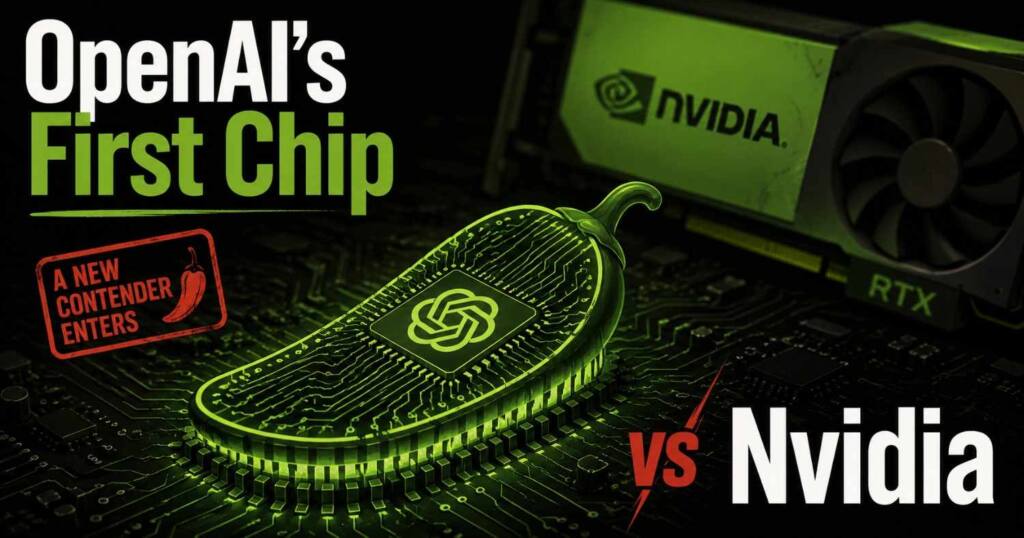
The OpenAI Jalapeño chip targets Nvidia’s grip on AI inference. See what is real, what is marketing, and what it means for AI prices.
OpenAI just stopped being only a software company. On Wednesday it walked on stage holding a piece of silicon it designed itself, and that single object says more about the next three years of AI than any model release this month.
The chip is called Jalapeño. It was built with Broadcom, it runs inference instead of training, and the company says it sips power far more efficiently than the best chips money can buy right now. Sam Altman accepted the first wafer from Broadcom CEO Hock Tan on stage while Greg Brockman called it part of a long full-stack infrastructure strategy, and the headlines more or less wrote themselves.
But a press release is not a benchmark, and the OpenAI Jalapeño chip arrives wrapped in claims nobody outside the two companies can verify yet. So let’s separate what is real, what is marketing, and what it actually means for the price you pay to use AI.
What the OpenAI Jalapeño chip actually is
Jalapeño is an ASIC. That stands for application-specific integrated circuit, which is a fancy way of saying it does one job and refuses to do anything else. The one job here is inference.
Inference is the part of AI almost nobody thinks about. Training is when a model learns. Inference is every single time you hit enter and wait, and that means every ChatGPT reply, every Codex task, and every API call your app fires off is inference work. Here is the part people miss. Inference is where the money quietly bleeds out, because you train a model exactly once but you run inference billions of times a day, every day, forever.
OpenAI built Jalapeño from a blank sheet. Richard Ho, who runs the company’s hardware program, said they shaped the architecture around the exact patterns that matter for large language models, the kernels, the memory movement, the networking, the way requests get served. They did not take an old AI accelerator and bolt on new features. They started over.
Broadcom handled the hard physical engineering, the silicon implementation, and its Tomahawk networking technology that lets thousands of these chips talk to each other at high speed, while a Canadian firm called Celestica handles the board, rack, and system integration and TSMC actually fabricates the things. Three companies. One chip. So while OpenAI did the core design, this is a three-way build, and that matters for reasons I will get to.
Engineering samples are already alive in the lab, running real workloads including a model called GPT-5.3-Codex-Spark at production frequency and power. That is further along than most “we made a chip” announcements, which usually show a render and a roadmap.
The nine-month build is the real flex
Forget the Jalapeño chip for one second. The timeline should scare competitors more than the silicon does.
OpenAI and Broadcom say they took the Jalapeño chip from first design all the way to manufacturing tape-out in nine months, and tape-out is the moment the design gets locked and handed to the factory. For an advanced, high-performance chip, that step normally drags on far longer. Nine months is wild. The companies believe it is the fastest such cycle ever pulled off in cutting-edge semiconductors.
How did they pull it off? They used their own AI models to speed up parts of the design and optimization work. Sit with that for a moment. The same systems you query through ChatGPT helped build the hardware that will soon run them. If AI can genuinely help engineers design better chips faster, the cost of compute drops for the whole industry, and OpenAI gets a flywheel where each generation of model helps build the machine that runs the next one.
That is either the most important sentence in the announcement or the most overhyped one. We won’t know which until a second-generation chip ships on a similarly compressed schedule. But if it holds, the speed advantage compounds, and that is harder to copy than any single chip.
Why OpenAI wants out from under Nvidia
Let’s be blunt about the target. This chip is aimed squarely at Nvidia, even though nobody will say the name in the press release.
OpenAI has run almost entirely on Nvidia GPUs for years. Training, inference, all of it. Nvidia’s chips are brilliant and its software is sticky, which is exactly the problem. Depend on one supplier for the single most important input to your business, and that supplier sets your price. Hock Tan said it without flinching: you should not rely on some other company’s GPU for something this central.
So Jalapeño is a way out. Not a clean break, a way out at the edges. OpenAI has been busy spreading its bets across the board. It took a $30 billion investment from Nvidia in February as part of a $110 billion round, then committed to two gigawatts of Amazon’s Trainium chips, signed for AMD’s MI450 GPUs, and started using Cerebras silicon for inference. Now it owns a design outright.
Here is the part the cheering misses. OpenAI is late. Google has shipped its own TPUs for years, Amazon has Trainium and Graviton, and Microsoft, which happens to be OpenAI’s biggest backer, launched its Maia 200 inference chip in January 2026 that already runs some OpenAI workloads. Anthropic and ByteDance are chasing custom silicon too. OpenAI is the most compute-hungry company on earth and it was the last of the giants without its own chip. Jalapeño fixes an embarrassing gap more than it opens a new frontier.
And one detail keeps surfacing in every version of this story. The company sitting underneath Google’s chips, Anthropic’s plans, and now Jalapeño is the same one: Broadcom. The real winner of the scramble to escape Nvidia might be the firm quietly selling everyone the shovels.
The number everyone is repeating, and why you should pause
Broadcom’s CEO reportedly said the chip cuts inference costs by roughly 50%. That number is racing around the internet, and it is the single most important claim in the whole story, because cheaper inference is the only thing that reaches you, the user.
I want to believe it. I also want to flag, loudly, that it is a vendor claim with zero independent proof behind it.
Look hard at what OpenAI has chosen not to tell us, because the silence is the story: no process node, no core counts, no memory specs, and no peak FLOPS figure that an independent engineer could pick apart. Nothing concrete. Just adjectives. No actual benchmark numbers. The phrase doing all the heavy lifting is “substantially better performance per watt than current state-of-the-art,” and “substantially” is not a unit of measurement. OpenAI says a detailed technical report is coming “in the coming months.” Until that lands, parity with Nvidia’s Blackwell chips or Google’s TPUs is a sentence in a press release, not a fact.
This is the gap I have not seen any other coverage stress hard enough, so here it is plainly. Custom chip launches have a long history of spectacular slide decks followed by quiet delays and underwhelming real-world numbers. Maybe the Jalapeño chip is different. The lab samples running live are a genuinely good sign. But “trust us, it’s faster” from the company that designed it is exactly the kind of claim you wait to verify. The receipts arrive later in 2026 and through 2027. Hold your excitement until then.
What this means for you, the person paying for AI
Strip away the stock tickers and the silicon jargon, and one question is left. Does this make AI cheaper, faster, or better for the people actually using it?
Eventually, maybe. Inference cost is the hidden tax on everything AI, and it quietly decides how much a startup pays to build on the API, how fast ChatGPT answers you when traffic spikes, and how many steps an agent can grind through before the bill turns frightening. If OpenAI genuinely halves its inference cost and passes even part of that on, you get faster responses, cheaper API pricing, and agents that can actually grind through long tasks without the meter exploding.
There is a quieter business angle here too. OpenAI is heading toward a public offering while burning staggering sums on training, so a chip that drags down the cost of inference, the part that runs forever and ever, becomes a credible story for how the company climbs out of its financial hole. Cheaper inference is good for you. It might also be how OpenAI survives.
But none of this is here today. Initial deployment targets the end of 2026. Real volume arrives in 2027, with Hock Tan telling CNBC it goes “full tilt” in the first half of 2028. The long goal is custom chips powering 10 gigawatts of compute by 2029, which is roughly the output of ten nuclear reactors. This is a 2027 and 2028 story dressed up as a 2026 headline.
The market reaction was telling in its calm. After the reveal, Broadcom stock ticked up around 2%, and Nvidia slipped a fraction of a percent. Not a crash, not a panic. Investors read it the way you should: a real, serious move that pressures Nvidia’s pricing power over time, not an overnight threat to the king.
Why inference, not training, was the smart first target
OpenAI could have aimed its first chip at training. It didn’t, and the choice is shrewd.
Training a frontier model is chaotic. The workloads shift, the math is brutal, and Nvidia’s lead there rests on a decade of software and tooling that nobody dislodges in one product cycle. Inference is the opposite. It is repetitive and predictable. The same shapes of computation, run over and over, billions of times. That predictability is exactly what an ASIC feeds on. When you know the precise pattern you need to accelerate, you can strip out everything else and build hardware that does that one thing close to its theoretical limit.
Analysts tracking the custom-silicon trend have been saying this for a while. Inference is the soft spot in Nvidia’s armor, the place where rivals have the best shot at breaking the grip. The OpenAI Jalapeño chip plants its flag right there. It does not try to beat Nvidia at the hardest game. It picks the game it can actually win, the one that also happens to be the largest and fastest-growing slice of AI compute spend.
There is a strategic patience in that I find easy to respect. You don’t announce a training chip and invite a direct, losing comparison with Blackwell. You ship an inference chip, prove it on your own workloads, and let the cost savings make the argument for you.
Broadcom is the quiet kingmaker of the post-Nvidia era
Every story about labs escaping Nvidia keeps circling back to one company, and it isn’t OpenAI.
It’s Broadcom. The same firm sits behind Google’s TPUs, behind Jalapeño, and behind a major recent compute pact involving Anthropic. ByteDance, Meta, Apple, and Fujitsu are all reportedly circling Broadcom’s custom-accelerator expertise too. While everyone watches the labs fight Nvidia head-on, Broadcom has quietly become the supplier of the muscle the labs lack: the connectivity, the networking silicon, the manufacturing relationships, the ability to turn a design into millions of working units.
This is the part of the OpenAI Jalapeño chip story that deserves more attention than it gets. OpenAI did the architecture, yes. But it could not have done this alone, and the partner it leaned on is the same partner half the industry is leaning on. Back in October 2025, when the original OpenAI Broadcom agreement was announced, Broadcom shares jumped as much as 9%. Investors understood immediately who profits from a world where every giant wants its own silicon.
If you are trying to figure out where the durable value sits in this scramble, it might not be in any single chip. It might be in the one company selling shovels to every miner in the gold rush. Nvidia still owns the mountain. Broadcom is renting out the tools to dig around it.
Frequently asked questions
What is the OpenAI Jalapeño chip used for? It is built only for inference, the process of running already-trained AI models to generate responses. It handles workloads across ChatGPT, Codex, the API, and future agentic products. It does not touch training. OpenAI keeps Nvidia and other hardware for that.
Who actually makes Jalapeño? OpenAI did the core architecture and design. Broadcom contributed silicon implementation and its Tomahawk networking technology. Celestica handles board and rack integration, and TSMC manufactures the physical chips. This is a true partnership, not a one-company victory lap, and that detail shapes who actually profits from the OpenAI Jalapeño chip over the long run.
Will Jalapeño replace Nvidia for OpenAI? No, and not soon. It reduces dependence on Nvidia for inference specifically. Training, where Nvidia’s lead is strongest, still runs on Nvidia hardware. OpenAI has called Nvidia a key partner even while shipping its own chip.
Is the chip available now? No. Engineering samples are running in the lab. Initial deployment is targeted for the end of 2026, with meaningful volume in 2027 and a full ramp into 2028.
Does it really cut costs by 50%? That figure comes from Broadcom’s CEO and has not been independently verified. OpenAI has not released benchmarks or hardware specs. Treat it as a vendor claim until the promised technical report arrives.
Why is it named Jalapeño? OpenAI has not said. It fits a wider habit of AI hardware projects wearing playful internal codenames instead of stiff corporate labels.
The bottom line you can actually act on
Jalapeño is a serious chip and a smart strategic move, and it is also a 2027 story being sold as today’s news. The OpenAI Jalapeño chip proves the company wants to own its full stack, from models down to the metal, and it tightens the screws on Nvidia’s pricing power for the long haul. The nine-month build using its own models is the part competitors should genuinely fear.
If you build on AI, watch the inference pricing pages, not the press releases. The moment OpenAI’s own silicon starts running your queries, the savings either show up in what you pay or they don’t. That is the only benchmark that matters to you, and it is the one we are all still waiting on.
For the full official details, OpenAI published its Jalapeño announcement with statements from Brockman, Ho, and Tan. And if you want the wider context on how this fits the company’s compute strategy.
check article about gpt 5.5 cyber

Ved Vyas
Writer at Fable Knows, covering AI and the technology shaping everyday life.
Related stories.

Apple Price Hike: 7 Brutal Increases as Chip Costs Soar
The Apple price hike raised Mac, iPad, and Xbox prices up to $1,300. See exactly what changed, why memory chips are to blame, and…
Midjourney Medical Wants to Scan Your Whole Body in 60 Seconds with midjourney ultrasound scanner in Ultrasonic CT.
The AI image company just announced a full-body Ultrasonic CT with midjourney ultrasound scanner and a spa to put it in. The vision is…